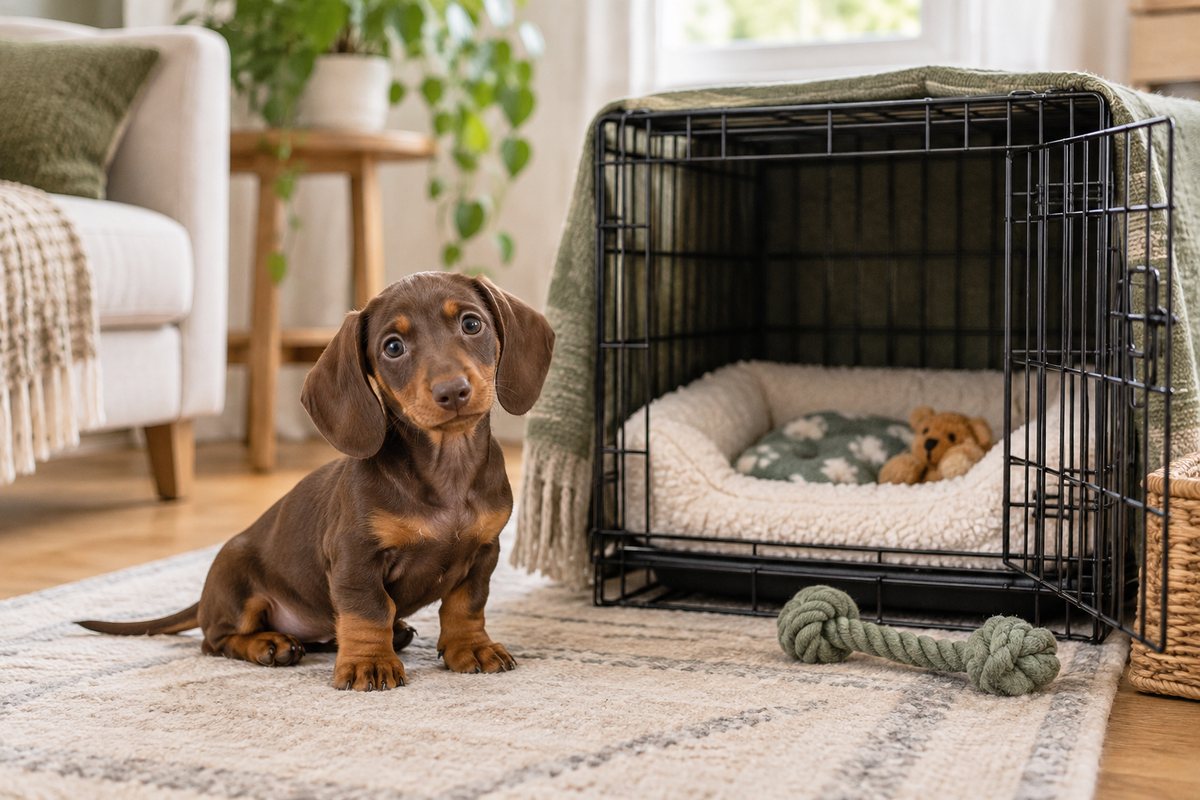
How to train a Dachshund puppy starts with short, predictable, reward-based lessons. Start on the first day your puppy comes home: set a potty routine, introduce the crate as a calm resting place, reward the behaviors you want, and protect your puppy’s long back by teaching safer movement early.
Dachshunds are clever hounds with big opinions. That does not mean they are impossible to train. It means your plan needs to be clearer than your puppy’s impulses: same cues, same schedule, tiny food rewards, lots of praise, and no long lectures after mistakes.
How to train a Dachshund puppy: quick training plan
- 8-12 weeks: name response, potty schedule, crate comfort, gentle handling, safe socialization, and simple cues like sit and come.
- 3-4 months: longer sleep stretches, leash basics, door manners, calm alone-time practice, and consistent redirection for biting or barking.
- 4-6 months: proof cues around distractions, build recall, prevent jumping from furniture, and keep house training consistent through adolescence.
For most families, the best answer to how to train a Dachshund puppy is to build one repeatable daily rhythm: potty first, short lesson next, rest after that, and calm rewards whenever your puppy chooses the behavior you want.
Before you start: set up the house
A Dachshund puppy learns faster when the environment makes good choices easy. Before training sessions, prepare a small puppy zone with a crate or pen, washable bedding, safe chew toys, water, and baby gates. Block access to rugs, bedrooms, couches, stairs, and hidden corners until potty habits are reliable.
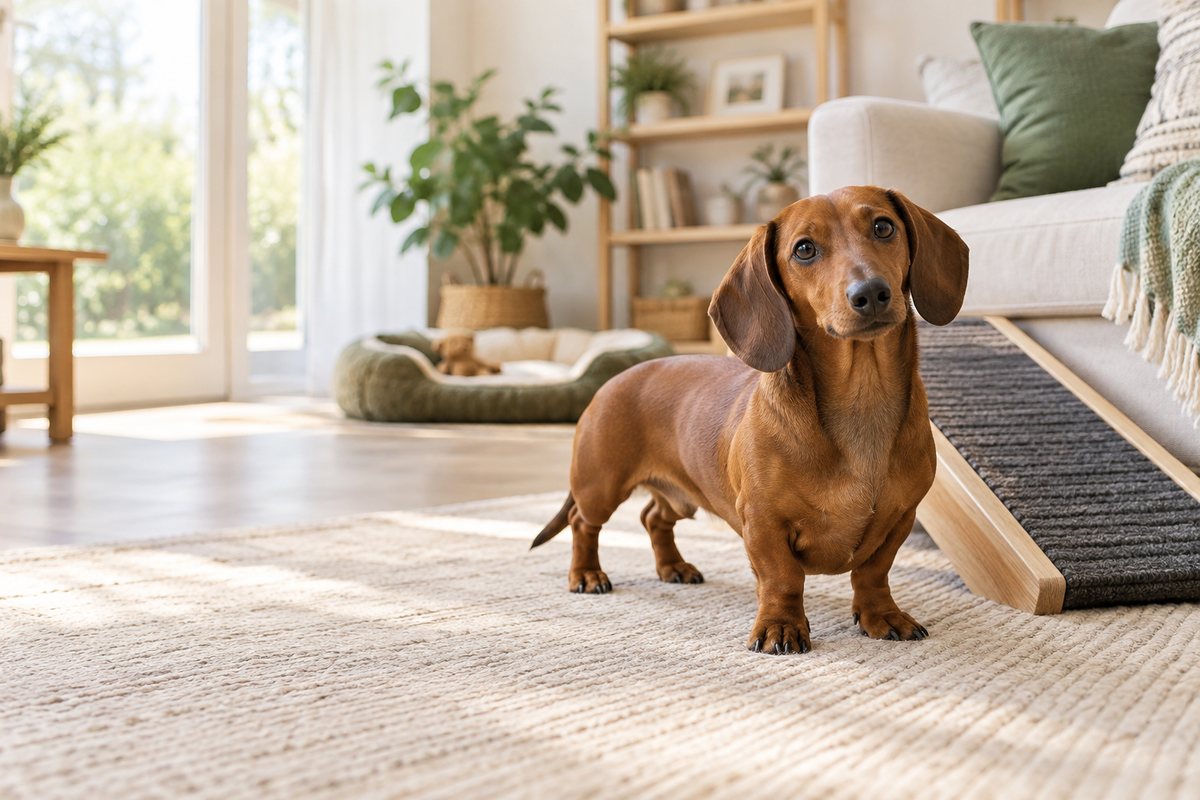
Use a harness rather than relying only on a collar for walks. Because Dachshunds have a long body and short legs, also think about back-safe habits from the beginning: lift your puppy with support under the chest and rear, prevent repeated furniture jumping, and teach ramps or steps slowly rather than letting the puppy launch on and off sofas. For more body-safety context, read the Dachshund Compass guide to Dachshund back pain signs.
Step 1: teach your puppy their name
Your puppy’s name should mean, “Look at me, something good is coming.” Say the name once in a cheerful voice. When your puppy turns toward you, mark it with “yes” and give a tiny treat. Practice five to ten times, then stop before your puppy gets bored.
Do not use the name as a warning. If “Daisy, no!” is the sound your puppy hears all day, the name becomes background noise. Use the name for attention, then give a clear cue: “Daisy, come,” “Daisy, sit,” or “Daisy, outside.”
Step 2: start potty training on day one
The American Kennel Club recommends starting Dachshund housetraining as soon as the puppy comes home, using a regular schedule and the same potty area each time. That consistency matters because many Dachshund puppies are confident enough to invent their own bathroom rules if the house is too open too soon.
Take your puppy out after waking, after eating, after drinking, after play, after naps, before bedtime, and any time sniffing or circling starts. Go to the same spot, use a simple phrase like “go potty,” and reward immediately after your puppy finishes. The reward must happen outside, not after you walk back into the kitchen.
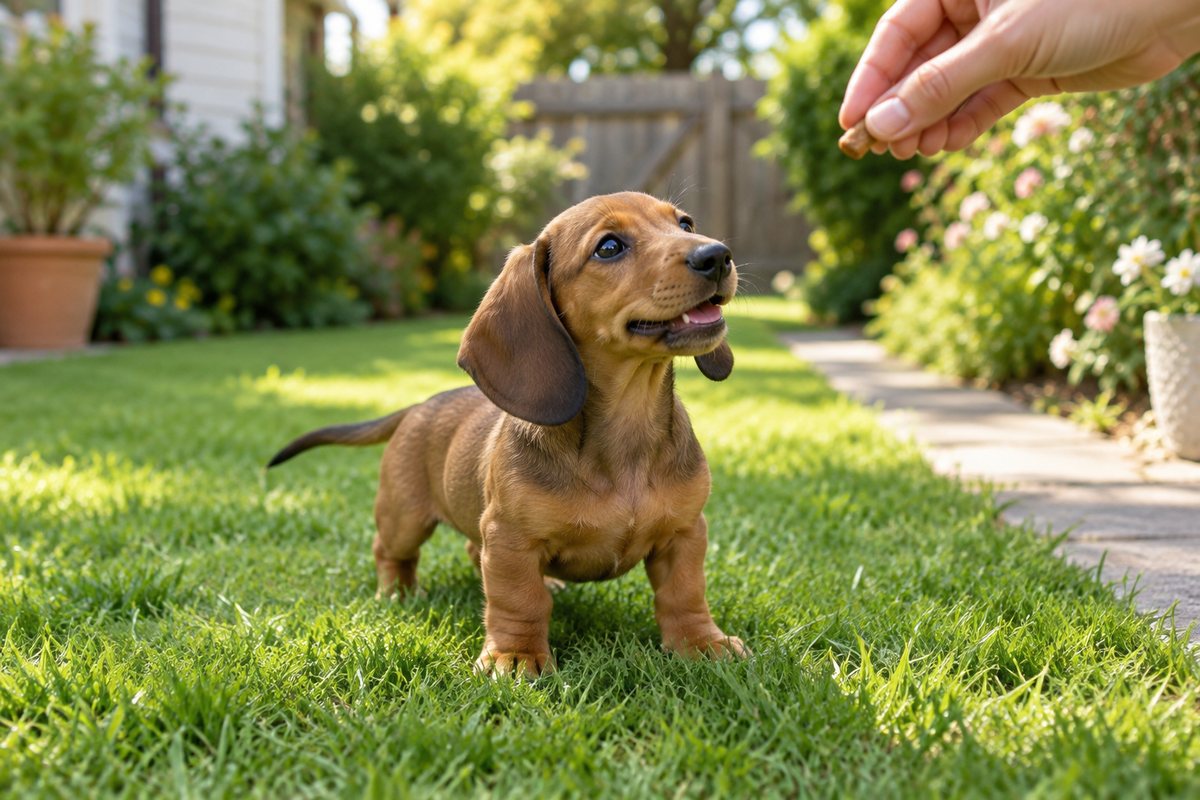
A simple Dachshund puppy potty schedule
| Time | What to do |
|---|---|
| Morning | Carry or walk your puppy straight outside before greeting, feeding, or play. |
| After meals | Go outside within 5-15 minutes, then again after active play. |
| During play | Pause every 20-30 minutes for a potty break. |
| After naps | Outside immediately. Puppies often need to go as soon as they wake. |
| Evening | Final potty trip right before bed. |
If accidents happen, clean them with an enzymatic cleaner and tighten supervision. Punishment after the fact does not teach your puppy where to go. It usually teaches the puppy to hide next time.
Step 3: make the crate a safe resting place
A crate can help with sleep, travel, safety, and potty training, but only if your puppy learns that the crate is comfortable. Choose a crate that is big enough for standing, turning, and lying down, but not so large that one end becomes a bathroom. If you bought an adult-size crate, use the divider. This is a practical part of how to train a Dachshund puppy because it gives your puppy a predictable place to rest between lessons.
Feed meals near the crate, toss treats inside, and let your puppy walk in and out without pressure. Then close the door for a few seconds while your puppy is calm. Build slowly: seconds first, then minutes, then a short nap. If your puppy panics, reduce the difficulty. The goal is not to “win” a crying contest; it is to teach calm confinement.
- Put the crate near you at night for the first few days.
- Take your puppy outside after every crate nap.
- Do not use the crate as punishment.
- Give a safe chew only when you can supervise.
Step 4: use short positive training sessions
Dachshunds were bred to work with confidence and persistence. That is useful when you teach them clearly, and frustrating when training becomes repetitive. Keep sessions to two or three minutes for a young puppy. End while your puppy still wants more.
Use tiny soft treats, praise, and play. Reward the exact behavior you want. If you ask for “sit,” reward while your puppy is sitting. If you ask for “come,” reward when your puppy reaches you, not after they wander away again.
First cues to teach
- Sit: lure your puppy’s nose slightly up and back, then reward when the rear touches the floor.
- Come: crouch, sound happy, reward generously, and never call your puppy for punishment.
- Touch: teach your puppy to bump your hand with their nose. This is useful for recall and redirection.
- Drop it: trade for a treat or toy before your puppy learns to run away with forbidden items.
- Settle: reward calm lying down on a mat or bed.
Step 5: socialize safely before the window closes
Socialization is not the same as letting everyone touch your puppy. It means carefully introducing people, surfaces, sounds, handling, car rides, grooming tools, and friendly vaccinated dogs at an intensity your puppy can handle. The American Veterinary Society of Animal Behavior notes that the first three months are the most important window for puppy socialization and recommends safe socialization before puppies are fully vaccinated.
Ask your veterinarian which places are safe in your area. A well-run puppy class, visits with healthy vaccinated dogs, sitting outside a quiet store, hearing traffic from a safe distance, and practicing gentle handling at home can all build confidence without flooding your puppy.
Step 6: prevent barking habits early
Dachshunds often notice everything: doors, windows, footsteps, squirrels, neighbors, and every suspicious leaf. Do not wait until barking is a full-time hobby. Reward quiet attention, teach a “thank you” cue, and manage the view from windows if your puppy rehearses barking all day. If barking is already your biggest problem, the companion guide on why Dachshunds bark so much explains the common triggers.
When your puppy notices a trigger, say “yes” before the bark starts and feed a treat. You are teaching the puppy that seeing something does not require sounding the alarm. If barking has already started, calmly move your puppy away, wait for quiet, then reward.
Step 7: teach back-safe habits
Training a Dachshund puppy is also about protecting their body. Dachshunds are known for back risk, including intervertebral disc disease. The Dachshund Club of America advises lifestyle habits that limit the possibilities of disc herniation, including avoiding obesity, reducing excessive jumping, and teaching quiet confinement when needed. In other words, how to train a Dachshund puppy should include safe movement habits, not only obedience cues.
Make the safe choice easier than the risky one. Put ramps near furniture you allow. Block furniture you do not allow. Reward all four paws on the floor. Teach your puppy to wait to be lifted rather than jumping from your arms or off the couch.
Common Dachshund puppy training mistakes
When you review how to train a Dachshund puppy, most setbacks come from giving the puppy too much freedom before the routine is reliable.
- Giving too much freedom too soon. A puppy who can wander out of sight can practice accidents, chewing, and barking before you can teach better choices.
- Repeating cues. “Sit, sit, sit” teaches your puppy that the first cue does not matter. Say it once, help, then reward.
- Making sessions too long. A bored Dachshund puppy may look stubborn when they are simply done.
- Using punishment for potty accidents. This damages trust and rarely improves housetraining.
- Ignoring body safety. Jumping on and off furniture can become a habit before owners realize it.
When to get help
Talk with your veterinarian or a qualified positive-reinforcement trainer if your puppy is not making potty progress by 4-6 months, panics in confinement, growls when handled, guards food or toys, or seems unusually fearful. Early help is easier than waiting until the pattern is stronger. If you keep wondering how to train a Dachshund puppy after several consistent weeks, a trainer can spot timing, reward, or environment issues that are easy to miss at home.
Sources
- American Kennel Club: How to Train a Dachshund Puppy
- American Kennel Club: Housetraining Dogs
- VCA Animal Hospitals: How To Potty Train Your Puppy
- VCA Animal Hospitals: Puppy Training Schedule
- AVSAB: Puppy Socialization Position Statement
- Dachshund Club of America: IVDD Booklet
Affiliate disclosure: If you buy through links on this page, I may earn a commission at no extra cost to you.
For owners who want a structured, positive-reinforcement training plan at home, Brain Training for Dogs is an online course that can pair well with short daily Dachshund training sessions.