Direct answer
Dachshund stairs safety starts with the actual staircase and the actual dog. It requires a useful stair plan for that individual home. Prevent unsupervised rushing and slips, keep essential food and resting spaces accessible, and decide how the dog will move between floors before closing a gate. A dog with pain, weakness, or previous spinal disease needs an individual veterinary plan. General advice does not prove that every healthy Dachshund must avoid every step.
The AKC Dachshund breed guide advises owners not to allow the breed to run up and down stairs; the VCA breed profile recommends restricting stair access. These are conservative breed-care recommendations. A 2016 observational Dachshund study did not establish that stair avoidance prevents IVDD. Its stair-use finding must not be read as proof that climbing stairs protects a dog either: activity, previous disease, and owner behavior can affect a survey result.
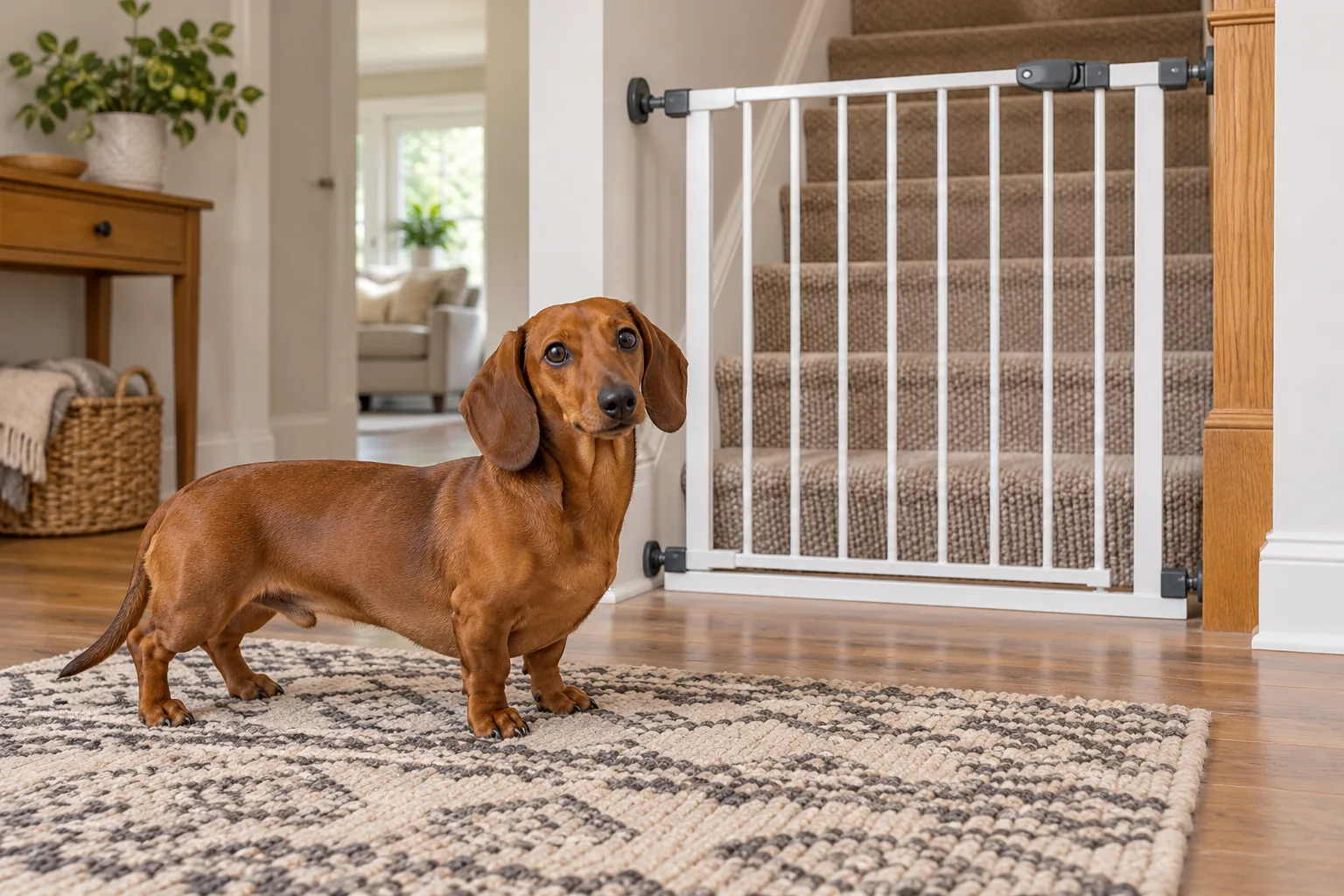
Dachshund stairs safety: access control
Start with the floor plan: which stairs are unavoidable, how frequently the dog uses them, and who can supervise. A gate can prevent unsupervised rushing; a sleeping area on the same level can remove repeated trips. Consider traction and lighting for the person carrying the dog as well as the dog’s footing. The safest rule is one that the household can actually follow every day.
Make a simple map of the dog’s morning, workday, and night. If food, water, toileting access, and the usual bed can all stay on one level, the dog may have no reason to use the stairs while home alone. If people spend the evening upstairs, plan how the dog will join them or remain comfortable downstairs. Do not gate the dog away from water or a safe resting place.
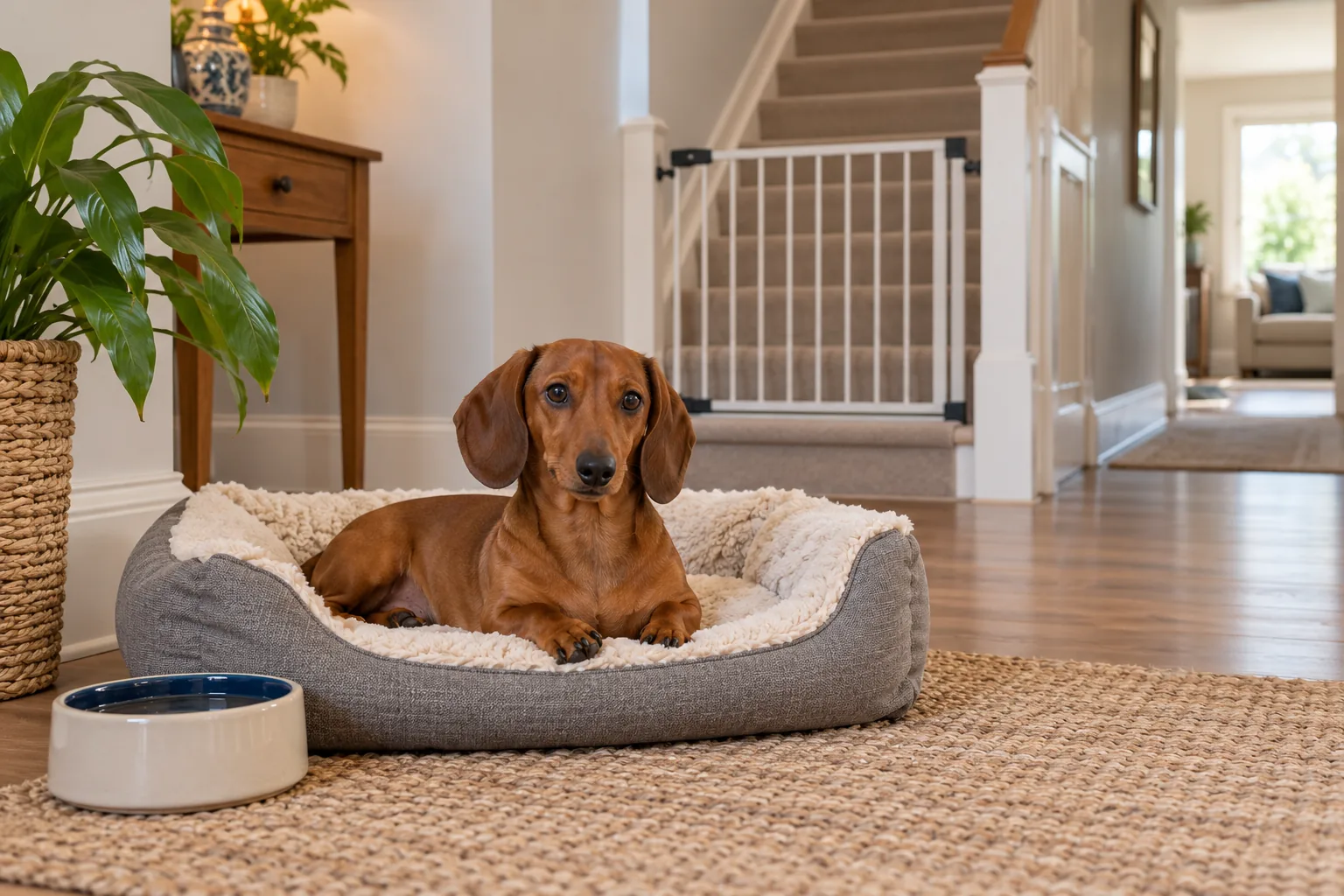
At the top of a steep flight, a properly installed barrier prevents a sudden dash toward the edge. Check the gate’s fit and closure every day; a small Dachshund may squeeze under or around a poorly fitted barrier. Avoid leaving a loose temporary obstacle where people may trip while carrying the dog. These are general household safety steps, not claims that a particular gate design prevents disc disease.
Grip, lighting, and pace
Slippery treads, narrow turns, poor lighting, and excitement can make any staircase more difficult. Keep the route well lit and free of shoes, toys, and loose runners. If you use a stair covering, it should lie flat and provide dependable traction rather than creating a new trip hazard. Trim nails to a comfortable length, because poor nail contact can alter footing. If the dog repeatedly slips, stop asking it to use those stairs until the environment or transfer plan changes.
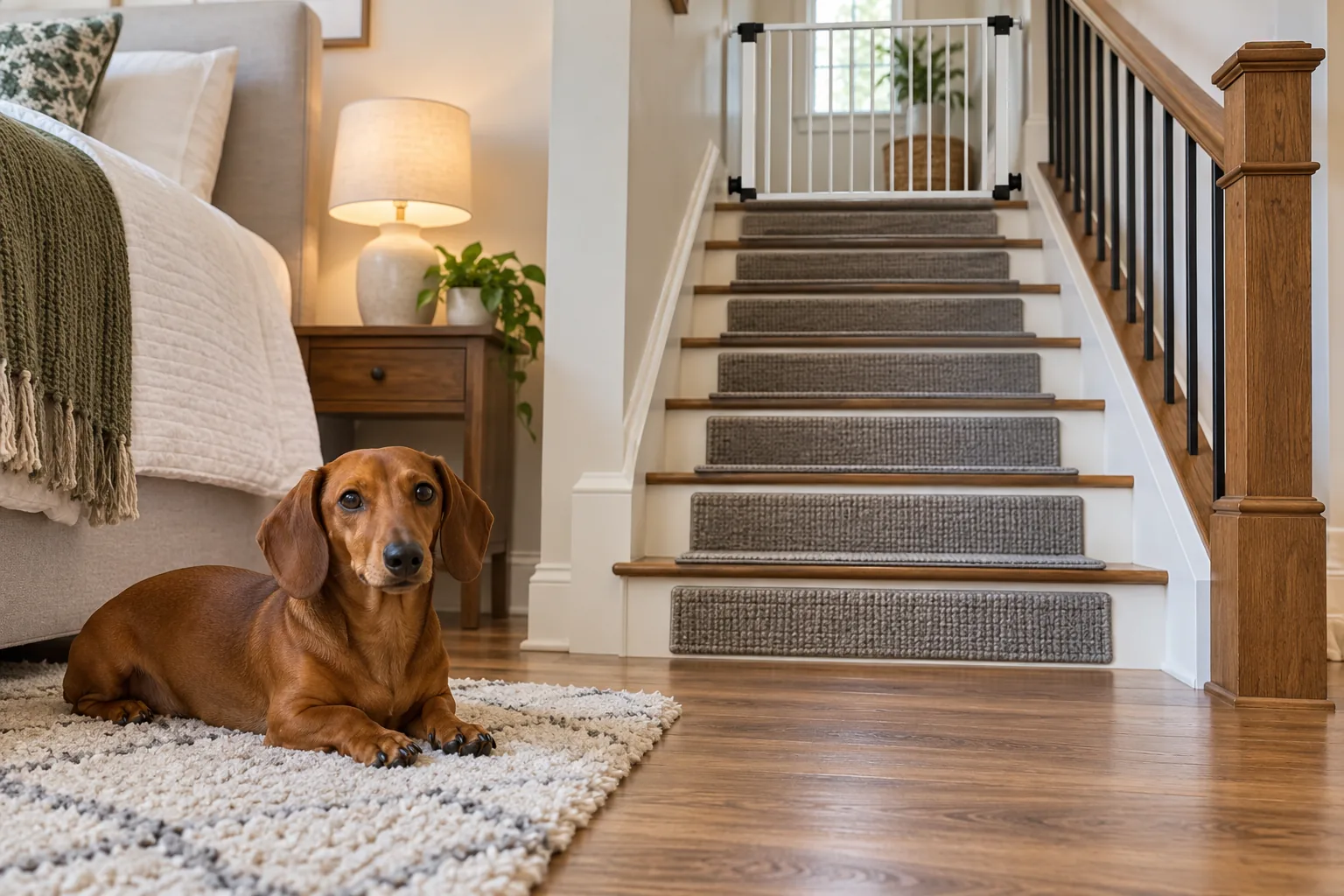
Avoid making the stairs part of a chasing game. Call the dog to a calm stop before opening the gate, and reward waiting. A cue can help you control a transition; it cannot make a steep, slick staircase physically safe. Young, elderly, overweight, or unsteady dogs may need a stricter arrangement than a fit adult. The VCA breed profile supports restricting access, but it does not supply a universal number of permitted trips per day.
Training alternatives
If stair access cannot be eliminated, ask the veterinarian about the dog’s individual risk, especially after back pain or surgery. Do not assume that training alone makes repeated fast stair runs harmless. Reward calm movement and prevent chasing games on steps. This is a household-management decision, distinct from choosing between a ramp and pet stairs as products.
For a dog that is comfortable being carried, support the chest and rear, hold the body close, and use the handrail if possible. The person carrying the dog must have secure footing and a free view of the steps. If the dog wriggles, is too heavy to carry confidently, or reacts painfully, do not force the lift. Ask a veterinarian or rehabilitation professional about a safer way to transfer that individual dog. A spinal patient under activity restriction may need a very different plan from a healthy dog.
If people cannot safely carry the dog, rethink the household layout before choosing a product. A main-floor sleeping space, baby gate, or closed door can remove the need for repeated transfers. Pet steps designed for a sofa are not a substitute for a safe route between building floors; our ramp-versus-stairs buyer guide covers furniture-access products, not this multilevel-home routine.
What the stair evidence does and does not show
The DachsLife 2015 study published in 2016 asked owners about lifestyle and veterinary-diagnosed IVDD. It reported associations between several activity measures and IVDD risk, but the design cannot prove that using stairs causes or prevents disease. Owners of dogs with prior back trouble may already be limiting activity, and recall or selection effects can distort a retrospective survey. The stair finding should therefore not be turned into a prescription to make a dog climb flights of steps.
That matters because two simplistic messages circulate: “one stair flight causes IVDD” and “daily stairs prevent IVDD.” Neither follows from the evidence. Conservative breed guidance still supports controlling high-speed, unsupervised stair use; an active, fit dog also needs normal exercise. Your veterinarian can weigh the dog’s body condition, history, gait, home layout, and any previous IVDD episode.
When to ask a veterinarian
Revisit the setup as a puppy grows or an adult ages. A dog that pauses, trembles, yelps, slips, or changes its stair habit may be showing discomfort. Stop the activity and seek veterinary advice when the change is sudden or painful. The ACVS IVDD overview describes pain, a wobbly hind-end gait, loss of movement, and bladder dysfunction as concerning signs. Sudden weakness or inability to walk is urgent; do not test the dog by asking it to climb another flight.
Give family members one consistent rule so the dog is not encouraged up the stairs by one person and blocked by another. If a dog recovering from IVDD has an activity-restriction plan, follow the treating veterinarian’s directions rather than a general web article.
A practical example
In a two-story home, a gate at the foot of the stairs may solve unsupervised rushing, but it also means the family must plan where the dog sleeps and how it joins people upstairs. A safety rule works only when everyone follows it and the dog has a comfortable alternative. Write the rule on a family note: “Gate closed unless an adult is managing the transfer.” Then check it for a week. If the dog waits anxiously at the gate each evening, the rest location or people schedule may need to change.
Quick household checklist
- Can the dog access water, a resting place, and toilet breaks without using the stairs alone?
- Does a gate reliably prevent a dash onto the flight?
- Are steps dry, uncluttered, and well lit?
- Is the person carrying the dog physically able to do so without falling?
- Does everyone know what to do when the dog appears painful or unsteady?
This checklist is a management aid, not a medical clearance test.
Frequently asked questions
Must every Dachshund be carried on every staircase?
No universal rule can be derived from current evidence. The AKC and VCA advise restricting risky stair use, while the DachsLife study cannot prove that complete avoidance prevents IVDD. Discuss an individual plan with a veterinarian, especially when there is pain or prior disc disease.
Will a baby gate prevent IVDD?
No. A gate controls access and can prevent an unsupervised dash; it cannot change a dog’s underlying predisposition. It also needs a practical alternative route or resting area.
My dog suddenly refuses stairs. Is that stubbornness?
Do not assume so. New reluctance, yelping, wobbliness, or weakness can be a sign of pain or neurological trouble. Stop stair use and contact a veterinarian. Sudden inability to walk or bladder problems need urgent attention per the ACVS.