Direct answer
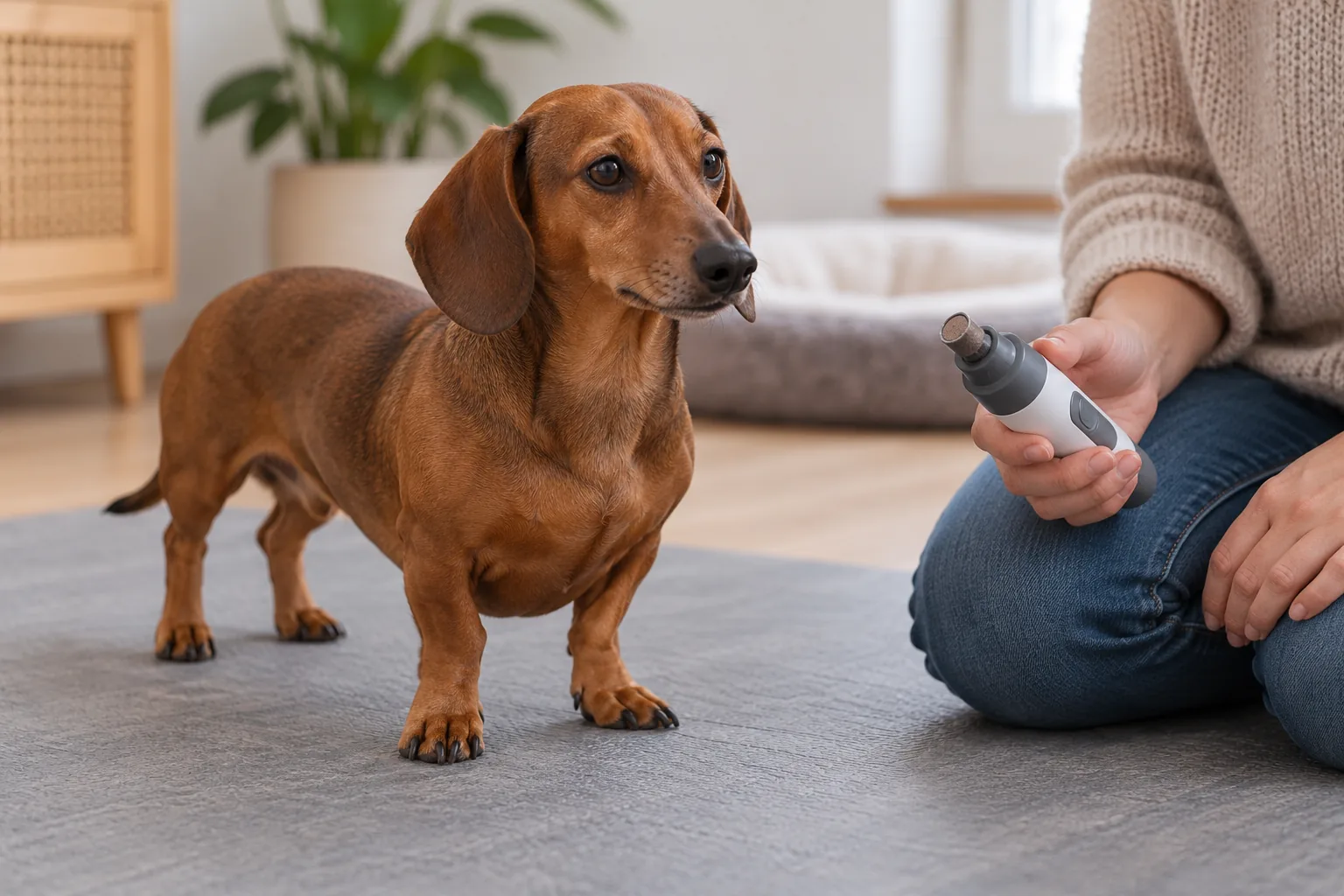
The best nail grinder for Dachshunds is one you can hold steadily, use in tiny increments, and introduce without frightening the dog. Compare speed control, vibration, noise, how clearly you can see the nail, and whether hair could catch in moving parts. A grinder is not automatically safer than clippers: either tool can reach the sensitive quick. The AKC nail-care discussion notes that some dogs prefer grinding while others do not. Choose for your Dachshund’s tolerance and your control, not a universal "best" label.
Start with the dog’s comfort and the handler’s view
Place the tool in your hand before selecting a model. A heavy or awkward grip makes precise work harder around small paws. Inspect how the sanding surface is exposed. A large protective cap may prevent accidental contact yet also hide the tip of a small nail; a fully exposed head may improve visibility but requires more care around fur and pads. Test the switch placement so you can stop promptly without changing your grip.
Consider where grooming happens. A quiet, well-lit floor-level setup with nonslip footing gives the dog stability and lets the handler see each nail. A Dachshund should not be balanced on a high table unless it is professionally secured. Choose a device you can clean and maintain according to its instructions. Replacement heads and battery availability matter more over time than a decorative accessory kit.
What the features actually change
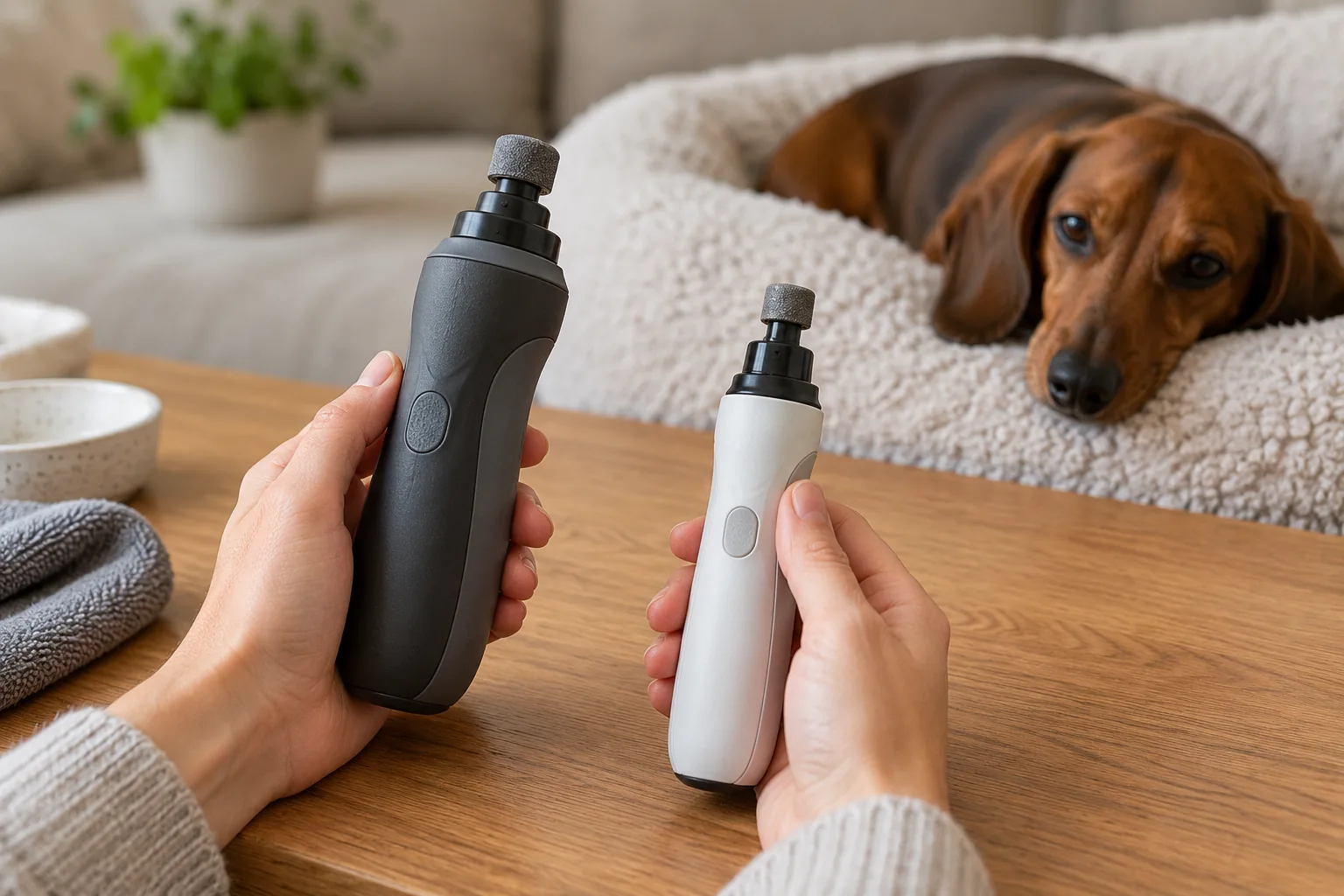
For many owners, the best nail grinder for Dachshunds is the one that allows calm, precise, brief contact. Variable speed can help you find a setting that removes small amounts predictably, but "more powerful" does not mean more appropriate. Excess pressure or prolonged contact can heat the nail and cause discomfort. A quiet motor may still transmit vibration through the paw. Ask for a return policy where possible; no specification sheet can tell you exactly how your dog will feel. The AKC grooming guidance recommends pairing tool sound with rewards well before attempting a full trim.
Keep long hair clear of rotating parts. This is especially relevant for long-haired Dachshunds, whose foot furnishings can catch. A helper can gently hold fur away while you work, but do not improvise restraints that make the dog panic. If a nail is cracked, bleeding, embedded, or painful, stop and call a veterinarian rather than grinding over injury.
Introduce the grinder in small stages
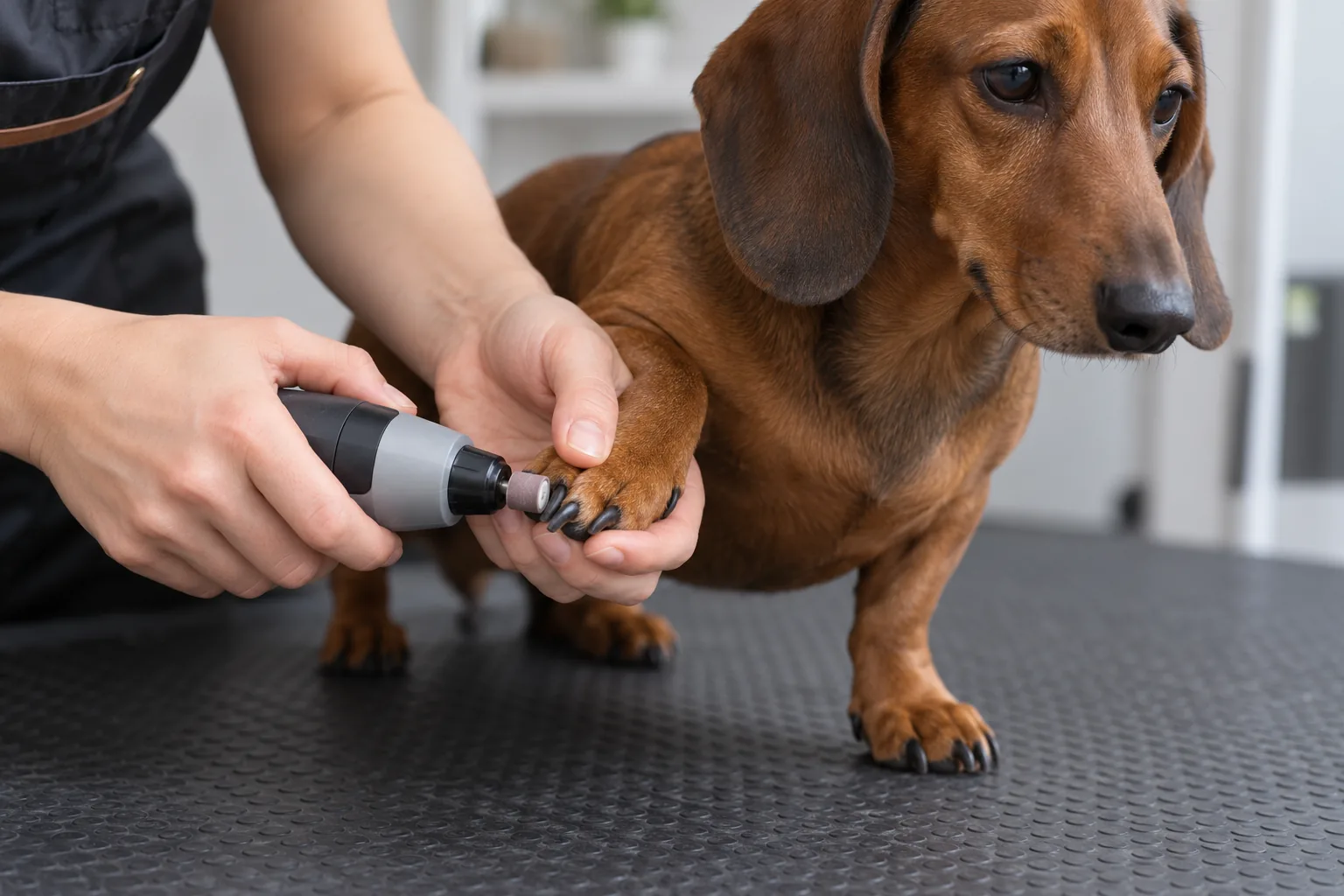
Begin with the switched-off tool near the dog and reward voluntary investigation. On another session, turn it on at a distance and reward calm behavior. Then bring it closer, touch the paw with the off tool, and eventually make a very brief contact with one nail. Stop while the dog is still comfortable. The AKC desensitization advice describes rewarding sound and paw handling over time; there is no requirement to finish every nail in one sitting.
Look at the nail between brief contacts. On dark nails the quick is harder to see, so remove only small amounts and ask a groomer or veterinarian to demonstrate if uncertain. The AKC at-home grooming guide advises learning proper technique and having a plan for accidental bleeding. This article selects a tool; the separate trimming guide should explain anatomy and technique in more detail.
A practical comparison test
If shopping in person, compare a compact tool and a larger one in your hand. Can you see the exact point of contact? Can you reach the front dewclaws without twisting the dog? Is the switch easy to stop? Does the cap leave room for the dog’s nail size? If buying online, check the actual dimensions, head replacement options, and instructions rather than relying on star ratings from unrelated breeds. Do not claim a model is "silent" or "quick-proof" without evidence.
At home, trial one nail after gradual acclimation. Record whether the dog accepts sound and vibration, and whether you can make a clean, controlled pass. If the dog strongly resists, a groomer or vet technician can help develop a handling plan. Forcing an anxious dog through a full session can make later grooming harder.
Buying checklist
- Comfortable grip and switch placement for short, controlled contact.
- Nail clearly visible with any guard fitted.
- Manageable vibration and sound for this dog.
- A way to keep paw hair out of moving parts.
- Replaceable head and clear cleaning instructions.
- Suitable return terms if the dog’s response makes the tool unusable.
This is a criteria guide, not a current product ranking or a medical procedure. Verify exact model claims and add an affiliate disclosure before monetized links.
Prevent common handling mistakes
Do not grasp a paw so tightly that the dog must fight to pull away. Support it gently in a natural position and use a nonslip surface. Keep the grinder moving in brief touches instead of holding it against one nail until heat builds. Watch the dog’s body language: pulling away, lip licking, yawning, or sudden stillness can mean the session is too hard. Pause and return to a step the dog can manage. Because a Dachshund is low to the ground, a floor-level setup often avoids the additional hazard of a fall from a grooming table.
If the dog’s nails are dark, do not infer that the quick is always at the same depth across all nails. Ask a professional to show the relevant visual and tactile cues on this particular dog. The AKC grooming-at-home guidance recommends proper technique and appropriate tools, including a plan if a nail bleeds. This buying article does not replace that hands-on demonstration.
When to stop using the tool
Stop if the grinder stalls, vibrates unpredictably, becomes hot, catches hair, or makes the dog more distressed with repeated attempts. Inspect and replace a worn sanding head according to the manufacturer’s instructions. A cracked, bleeding, or painful nail needs veterinary or professional grooming assessment, not another pass with the grinder. If a dog tolerates clippers but not a grinder, using clippers with competent technique may be the kinder choice. The best tool is the one that enables regular, low-stress maintenance without injury, not the one with the most settings.
Frequently asked questions
Is a grinder safer than nail clippers?
Not automatically. It allows gradual removal, but can still injure the quick or heat the nail if used carelessly. Choose the method you can use accurately and that the dog accepts.
How many nails should I do at once?
There is no fixed target. A single calm nail can be a better first session than a complete but stressful trim. Use the separate nail-trimming article for the ongoing schedule.
What if the nails are already very long?
Ask a veterinarian or groomer to assess the quick and demonstrate a safe reduction plan. Do not try to grind down a large amount in one session.