
A Dachshund may bark at other dogs because of leash frustration, fear, excitement, lack of social skills, territorial behavior, or past bad experiences. The bark may sound bold, but many small dogs bark because the leash makes them feel trapped. The goal is not to force dog greetings. The goal is to help your Dachshund notice other dogs calmly and recover before barking takes over.

This article focuses on barking at other dogs. For stranger barking, see why Dachshunds bark at strangers once live. For overall barking, use why Dachshunds bark so much.
Why does my Dachshund bark at other dogs?
Your Dachshund may bark at other dogs because the sight of a dog predicts excitement, worry, or blocked access. ASPCA lists social facilitation, frustration, and alarm barking among common barking categories. AKC also emphasizes that understanding the reason for barking is the first step in changing it.
Common patterns
| Pattern | Likely cause | Best first step |
|---|---|---|
| Pulls and barks toward dogs | Frustrated greeting | Reward calm looking, not greetings |
| Barks and hides behind you | Fear | Add distance |
| Barks at fence line | Territorial rehearsal | Block access and train recall |
| Barks after another dog barks | Social facilitation | Interrupt early and move away |
| Stiff body and hard stare | High arousal or aggression risk | Get professional help |
Training plan
- Find a distance where your Dachshund can see another dog and still eat.
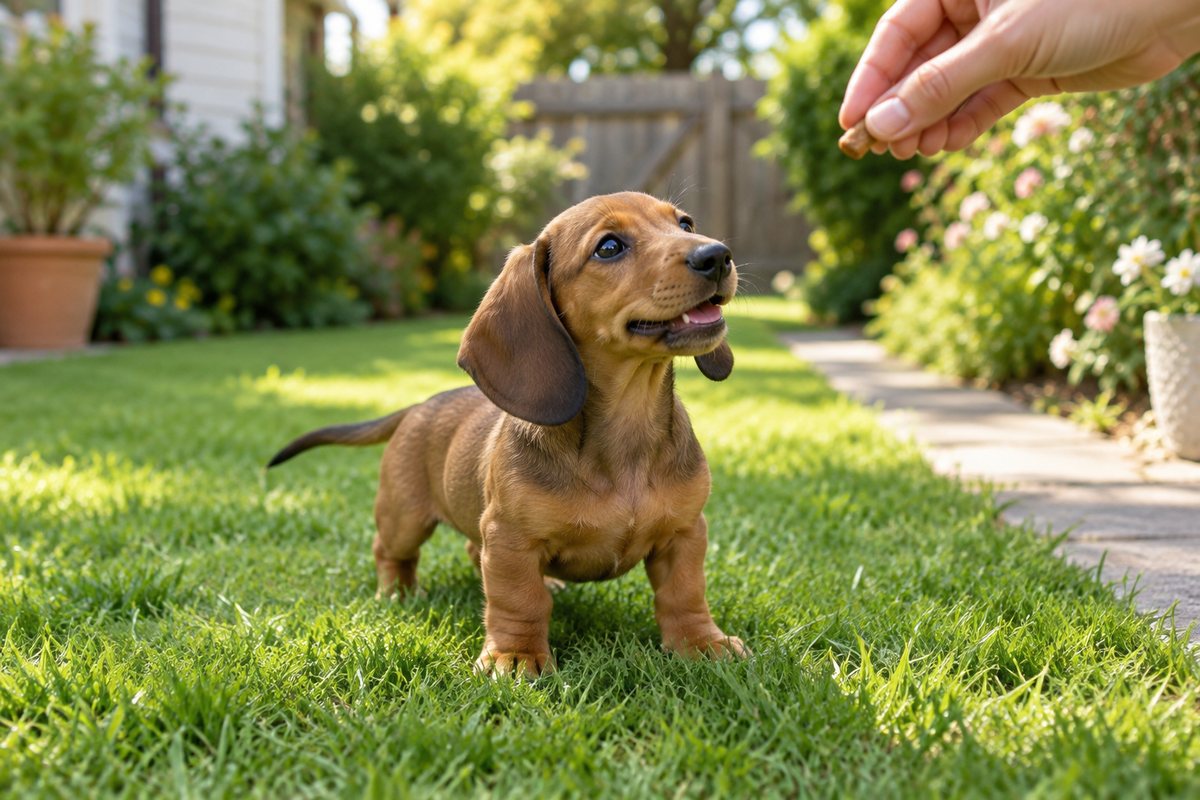
- Mark and reward the moment they look calmly.
- Reward turning back to you.
- Move away before barking starts.
- Practice with calm dogs at a distance.
- Slowly reduce distance only when your dog stays relaxed.
Do not walk straight toward another dog to “socialize” a barking Dachshund. That can flood the dog and make the behavior worse. VCA territorial guidance warns that constant exposure to anxiety-provoking stimuli can heighten fear rather than fix it.
Management while training
- Walk during quieter times.
- Cross the street before your dog explodes.
- Use parked cars or hedges as visual breaks.
- Avoid tight leash pressure and head-on approaches.
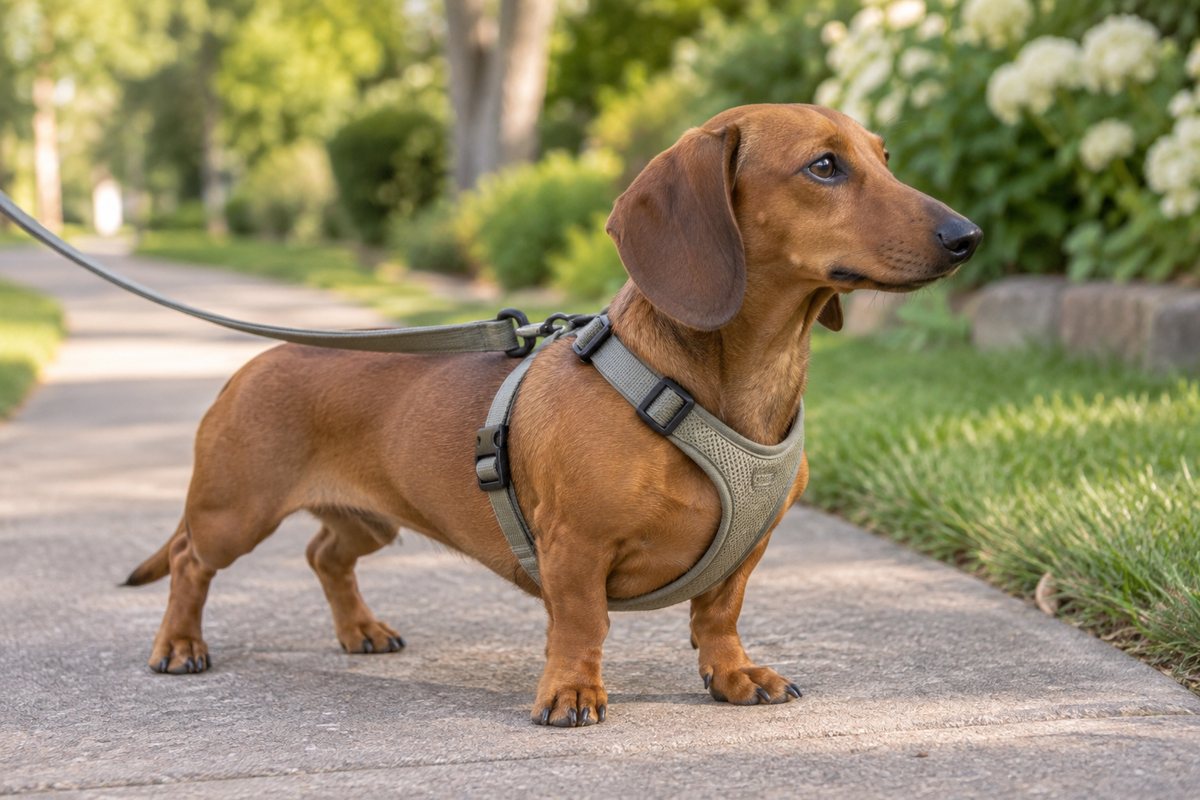
- Use a secure harness that your dog cannot slip.
- Skip dog parks until leash reactivity improves.
For pulling management, see no pull harness for Dachshunds. For escape risk, see escape proof harness for Dachshunds.
Mistakes to avoid
- Letting your Dachshund greet every dog while pulling.
- Using dog parks as “socialization” for a reactive dog.
- Yanking the leash when your dog sees another dog.
- Waiting too close before rewarding calm behavior.
- Assuming small dog barking is harmless.
FAQ
Does barking at dogs always mean aggression?
Not necessarily. Barking can come from fear, frustration, or excitement. Stiff body, lunging, snapping, or inability to recover means you should get qualified help.
Should I allow a greeting during barking?
Not while barking and pulling. Teach calm observation first. Greeting should be optional, calm, and well-managed.
Find your Dachshund’s working distance
The right training distance is where your Dachshund can notice another dog and still eat, sniff, respond to their name, or turn back to you. If they cannot do any of those things, you are too close. More distance is not failure. It is the setup that lets learning happen.
| Dog’s response | Meaning | Owner move |
|---|---|---|
| Looks and eats treat | Good working distance | Reward and continue |
| Stares and stiffens | Close to threshold | Move farther away |
| Barks and lunges | Over threshold | Create distance immediately |
| Hides behind you | Fearful | Do not force greeting |
| Pulls to greet | Frustrated | Reward calm check-ins first |
When parallel walks help
Some Dachshunds improve with parallel walks beside a calm, neutral dog at a comfortable distance. The dogs do not need to greet. They simply move in the same direction while staying under threshold. This can be safer than face-to-face greetings because head-on approaches often increase tension.
- Choose a calm helper dog.
- Start far apart.
- Walk in the same direction, not directly toward each other.
- Reward check-ins and loose leash movement.
- End before either dog escalates.
A simple training plan for barking at dogs
The goal is not to make your Dachshund greet every dog. The goal is to help your dog notice another dog and stay able to think. Start at a distance where your Dachshund can still eat and respond. Reward the moment they see the dog, then reward turning back to you. Move away before barking takes over.
- Choose a quiet place with enough distance.
- Let your Dachshund notice the other dog.
- Mark and reward before barking begins.
- Turn away or create distance after a few successful looks.
- Repeat on easy setups before trying busier places.
Mistakes that increase dog barking
Pulling straight toward other dogs, tightening the leash suddenly, or forcing greetings can make the problem worse. Many Dachshunds are small enough to feel vulnerable, but bold enough to bark loudly. Give them distance, predictable handling, and rewards for calm choices.
| Mistake | Why it backfires |
|---|---|
| Close sidewalk passes | Dog goes over threshold |
| Face-to-face greetings | Too intense for many dogs |
| Leash corrections | Adds stress around dogs |
| Training only in busy areas | No chance to practice calmly |
Barking at other dogs FAQ
Is my Dachshund aggressive if they bark at dogs?
Not always. Barking can come from fear, frustration, excitement, poor social experiences, or leash pressure. The important question is whether your Dachshund can recover, take food, move away, and stay safe. If barking includes snapping, biting, or intense lunging, get professional help.
Should I let my Dachshund meet more dogs?
More greetings are not always the cure. If your dog is already over threshold, greetings may make the pattern worse. Practice calm observation at a distance first. When greetings happen, choose calm dogs, loose body language, and short interactions, then move away before tension builds.
What should I do during a surprise dog encounter?
Create distance quickly and calmly. Turn down a driveway, cross the street, step behind a car, or use a treat scatter to redirect your Dachshund’s nose. Avoid tightening the leash and standing still while the other dog approaches head-on.
Distance plan for barking at other dogs
Barking at other dogs is often a distance problem. Your Dachshund may be afraid, frustrated, excited, or over threshold on leash. The fix starts before the bark: notice the other dog earlier and move to a distance where your Dachshund can still think.
Repeated close encounters can train the behavior you do not want. If every walk includes barking at the same fence, corner, or narrow path, change the route temporarily while you teach calmer observation.
| Situation | What it suggests | Best next step |
|---|---|---|
| Barks then hides | Fear likely | Increase distance and avoid greetings |
| Barks while pulling forward | Frustration or excitement | Reward disengagement before approach |
| Barks at fences | Barrier rehearsal | Change route and reward quiet passing |
| Barks only on leash | Leash tension and restriction | Practice wider arcs and loose leash |
| Cannot take treats | Too close | Retreat before training |
why does my Dachshund bark at other dogs: practical checklist
- Carry high-value treats on dog-heavy routes.
- Cross the street before your dog explodes.
- Reward looking at the dog and then back at you.
- Use U-turns without apology when space is too tight.
- Avoid nose-to-nose leash greetings.
- Practice with calm dogs at planned distances when possible.
When to change course
If barking includes snapping, redirected bites, or repeated lunging, use a certified trainer or behavior professional. Safety and distance are part of good training, not failure.
why does my Dachshund bark at other dogs: owner scenarios and fixes
The final step for why does my Dachshund bark at other dogs is matching the advice to the exact situation in front of you. Dachshunds are small, persistent, routine-sensitive dogs, so a plan that looks correct on paper can fail if the room setup, timing, gear, reward value, or health context is wrong. Before changing everything, choose the one pattern that happens most often and work there first.
This also helps prevent mixed signals. If you sometimes reward the unwanted pattern, sometimes interrupt it, and sometimes ignore it, your Dachshund may keep trying the behavior because the rules are unclear. A simple plan that everyone in the home follows for one week is usually more useful than a complicated plan that changes every day.
| Owner situation | How to handle it |
|---|---|
| When the main issue is barks then hides | Start with the practical fix: increase distance and avoid greetings. Give it several calm repetitions before adding a second change. |
| When the pattern looks like barks while pulling forward | Assume the setup is slightly wrong for your Dachshund and adjust the environment before expecting better behavior. |
| When you see barks at fences | Slow the plan down. Dachshunds often improve faster when the next step is easier, clearer, and more predictable. |
| When barks only on leash keeps returning | Look for a trigger that happens before the problem. Changing that trigger usually works better than reacting afterward. |
| When cannot take treats is involved | Treat it as a sign to re-check fit, comfort, schedule, or health rather than assuming your dog is ignoring you. |
How to make the plan easier for your Dachshund
If progress stalls, make the next repetition easier instead of louder or longer. For why does my Dachshund bark at other dogs, easier can mean more distance, a shorter session, a lower height, a quieter room, softer handling, smaller rewards, or fewer choices. The easier version should let your dog succeed while still practicing the skill you want.
Watch recovery time. A Dachshund who can return to sniffing, eating, resting, or walking normally is usually in a workable zone. A dog who stays frantic, stiff, avoidant, or obsessed with the trigger is telling you the setup is too difficult. That is useful information, not a training failure.
7-day improvement plan
- Day 1: write down when the why does my Dachshund bark at other dogs problem happens, where it happens, and what happened right before it.
- Day 2: remove the easiest trigger or setup mistake connected to barks then hides.
- Day 3: practice the first checklist step: carry high-value treats on dog-heavy routes..
- Day 4: repeat the same plan at an easier level instead of adding a new rule.
- Day 5: add one support step from the checklist: cross the street before your dog explodes..
- Day 6: ask whether your dog recovers faster than earlier in the week.
- Day 7: keep what improved, drop what confused your dog, and decide whether health or professional support is needed.
This seven-day plan will not solve every case of why does my Dachshund bark at other dogs, but it gives you cleaner information. If the pattern improves, keep building gradually. If it stays the same or worsens, the cause may be discomfort, fear, poor fit, too much freedom, or a trigger that needs a different article-specific plan.
Quality check before you rely on the advice
The safest version of the advice should be specific, observable, and easy to repeat. You should know what you are changing, what success looks like, and when to stop. For Dachshunds, stop signs include pain, limping, yelping, frantic barking, snapping, refusal to eat rewards, vomiting, repeated accidents, or sudden behavior changes.
When in doubt, choose the lower-risk version: more distance, better traction, shorter sessions, calmer rewards, clearer routines, and earlier veterinary input. That keeps the why does my Dachshund bark at other dogs plan helpful without pushing a small long-backed dog through stress, pain, or confusion.
Sources
- ASPCA: Barking
- AKC: Understanding and Managing Excessive Barking in Dogs
- VCA: Barking in Dogs
- VCA: Territorial Aggression in Dogs
- Cornell: Excessive Barking