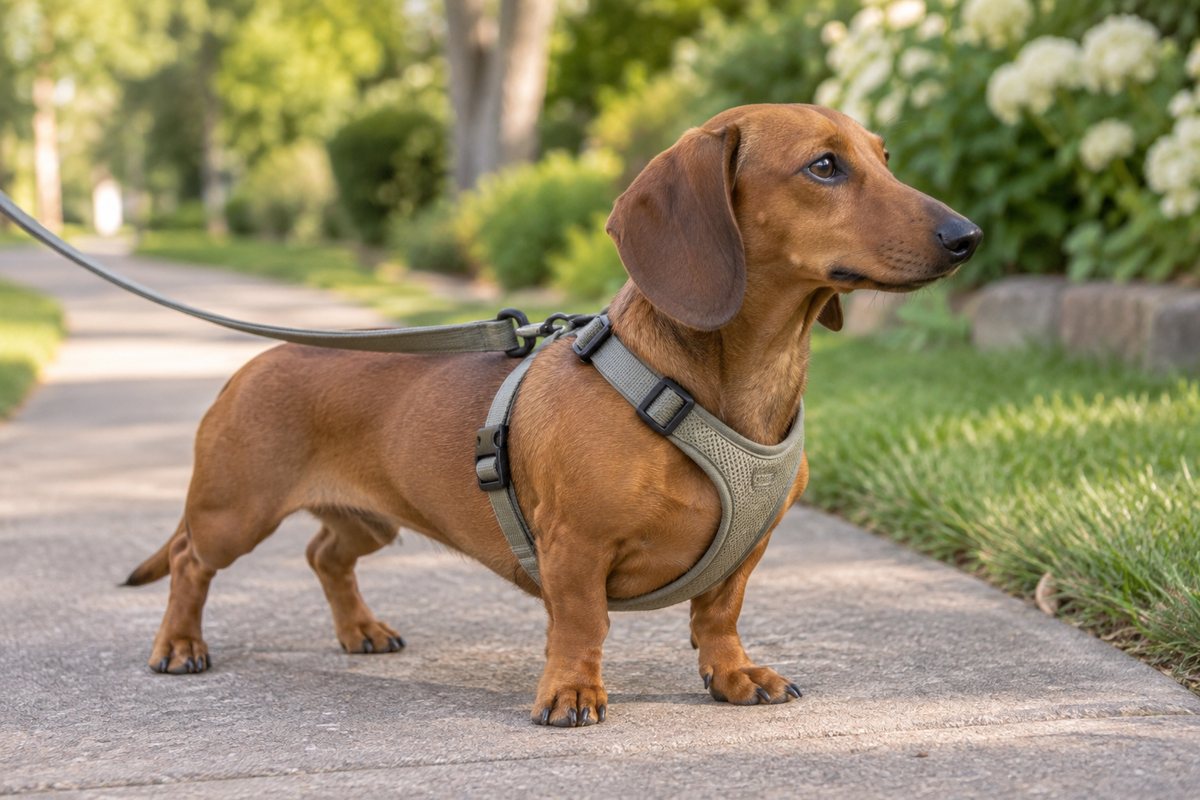
A no pull harness for Dachshunds can make walks easier, but it should not be treated like a magic brake. The best no-pull setup combines a well-fitted harness, calm leash handling, short training sessions, and rewards for walking near you. Because Dachshunds have long backs and short legs, the harness should redirect pulling without twisting the body, pressing on the throat, or restricting the shoulders.
This guide explains what to look for in a no-pull harness, when a front clip helps, how to train loose leash walking, and which mistakes can make pulling worse. If your Dachshund lunges, barks, freezes, or panics on walks, pair gear changes with behavior training rather than relying on equipment alone.
Table of Contents
No pull harness for Dachshunds: quick answer
For most Dachshunds that pull, look for an adjustable Y-front or chest-support harness with a front leash ring, a back leash ring, soft edges, and enough body length that the girth strap does not rub behind the elbows. The front clip can help turn the dog’s chest slightly toward you when they surge forward, while the back clip can be useful for relaxed walking once training improves.
A no-pull harness should reduce leverage, not punish the dog. Avoid any setup that causes coughing, limping, shoulder restriction, rubbing, or obvious discomfort. VCA notes that harnesses are preferred over collars for some dogs with neck or cervical disc concerns, which is one reason Dachshund owners often choose harnesses for walking.
How no-pull harnesses work
No-pull harnesses usually work by changing the leash attachment point. A back-clip harness lets a strong puller lean forward and use the chest like a sled dog. A front-clip harness redirects the chest when the dog hits the end of the leash, making straight-line pulling less efficient.
That does not teach loose leash walking by itself. It only changes the mechanics. Your Dachshund still needs to learn that walking near you makes good things happen and pulling makes forward progress stop.
- Front clip helps redirect forward pulling.
- Back clip is useful for casual walking after skills improve.
- Dual clip gives both options.
- Training rewards teach the behavior you actually want.
- Short sessions prevent frustration for both dog and owner.
Best features for Dachshunds
A Dachshund no-pull harness needs to fit a long, low body. A harness that is too short, too bulky, or too loose can slide, rub, or alter movement.
| Feature | Why it matters | Dachshund fit note |
|---|---|---|
| Front leash ring | Redirects pulling | Should sit centered on the chest |
| Back leash ring | Useful for normal walks | Good for dogs who no longer surge |
| Adjustable neck and girth | Creates a close fit | Important for narrow shoulders and deep chests |
| Y-front shape | Reduces throat pressure | Check that front legs move freely |
| Soft, low-profile straps | Reduces rubbing | Short coats can show irritation quickly |
| Secure hardware | Prevents loosening under movement | Inspect clips and adjusters often |
For general sizing and product categories, use best harness for Dachshunds. If your main concern is slipping backward out of the harness, use escape proof harness for Dachshunds once that article is live.
Front clip vs back clip
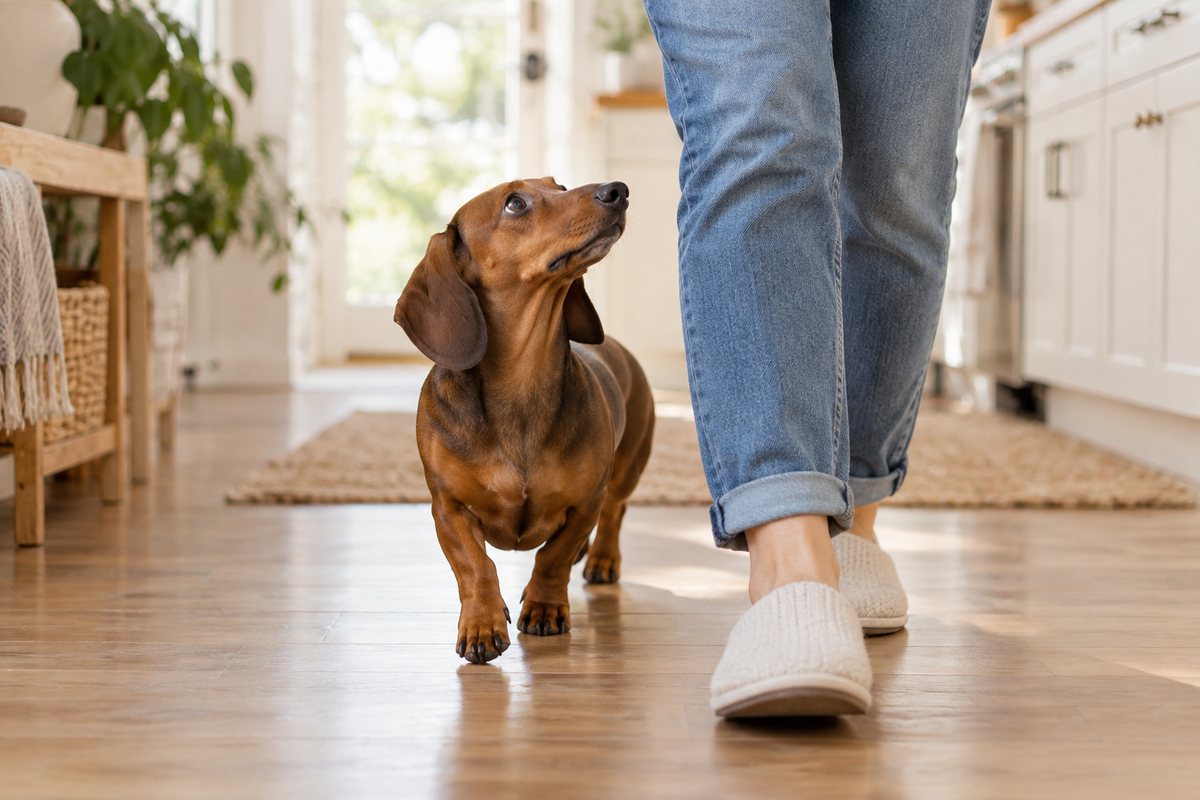
Many Dachshund owners do best with a dual-clip harness because it gives options. Use the front clip for training sessions or high-distraction areas. Use the back clip for relaxed sniff walks once your dog can keep slack in the leash.
| Clip type | Best use | Watch-out |
|---|---|---|
| Front clip | Pulling reduction and redirection | Leash can tangle under short legs if too loose |
| Back clip | Relaxed walking and long-line sniffing | May encourage leaning into the leash |
| Dual clip | Training flexibility | More hardware means fit matters more |
| Collar attachment | ID tags or backup only | Avoid using neck pressure to stop pulling |
Some handlers use a double-ended leash with one end on the front ring and one on the back ring. This can provide more control, but it also requires coordination. Practice indoors before using it near traffic or other dogs.
Fit checklist
- Measure chest girth behind the front legs.
- Measure lower neck where the harness sits.
- Choose size from the product’s own chart.
- Adjust both sides evenly so the chest ring stays centered.
- Check that the strap does not rub the armpits.
- Walk indoors and watch shoulder movement.
- Recheck fit after the first few walks.
A harness that slides sideways during pulling is not fitted correctly. A harness that restricts stride is not a good tradeoff for less pulling. The goal is control plus comfort.
Loose leash training plan
Use the harness to make training easier, then teach the skill. Choose a quiet area, use tiny treats, and keep the session short enough that your Dachshund can succeed.
- Reward your Dachshund for standing beside you before moving.
- Take one step and reward while the leash is slack.
- Gradually add more steps between rewards.
- If the leash tightens, stop instead of pulling back.
- Call your dog back to your side and reward.
- Use turns and direction changes before your dog hits the leash end.
- End the session before your dog becomes frantic or tired.
Use food wisely. Dachshunds can learn quickly with rewards, but training treats still count as calories. For tiny reward ideas, see best treats for Dachshund training.
Pulling, barking, and reactivity
If your Dachshund pulls because they bark at strangers, dogs, bikes, or noises, the problem is not only leash manners. It may be fear, frustration, excitement, or guarding behavior. A no-pull harness can help you manage the body, but you still need to change the emotional pattern.
- Increase distance from triggers before your dog explodes.
- Reward looking at you or sniffing calmly.
- Avoid tight-leash staring contests.
- Practice during quiet times of day.
- Ask a qualified trainer for help if lunging is intense.
For behavior support, read why Dachshunds bark so much, why Dachshunds bark at strangers once live, and how to train a Dachshund puppy.
Mistakes to avoid
- Expecting the harness to train the dog without rewards or practice.
- Choosing a front clip that hangs too low and tangles the legs.
- Letting the harness rub behind the elbows.
- Using leash pops or jerks to stop pulling.
- Walking too close to triggers during early training.
- Feeding large treats that cause weight gain.
- Ignoring signs of pain, limping, coughing, or movement change.
If your Dachshund suddenly pulls less because they are reluctant to move, that is not training success. It could be discomfort. Review Dachshund back pain signs and talk with your veterinarian if movement changes.
FAQ
Do no-pull harnesses work for Dachshunds?
They can help, especially front-clip or dual-clip designs, but they work best when paired with loose leash training. They reduce pulling leverage; they do not automatically teach manners.
Is a front-clip harness safe for Dachshunds?
It can be safe if the harness fits well and does not restrict movement or tangle the leash under the legs. Watch shoulder motion, elbow rubbing, and your dog’s comfort.
Should I use a collar to stop pulling?
For many Dachshunds, a harness is a better walking tool because it avoids direct leash pressure on the neck. Keep a collar for ID tags, but do not rely on neck pressure to control pulling.
What if my Dachshund pulls and barks?
Treat it as a training and behavior issue, not only a gear issue. Increase distance from triggers, reward calm check-ins, and work with a trainer if the behavior is intense or hard to manage safely.
Final fit notes for no-pull harnesses
A no-pull harness should make walks easier without changing your Dachshund’s posture or causing rubbing. If the front clip twists the body sharply, the harness is being used as a brake instead of a guide. Fit the harness first, then practice rewarding loose leash moments before your dog reaches the end of the leash.
Use the warning signs below as a practical filter before you decide the plan is working. If one of these signs appears repeatedly, the next step is not more pressure; it is a clearer setup, a smaller training step, or a health check when comfort may be involved.
- Harness rotates toward one shoulder
- Dog coughs or lowers head
- Armpit hair rubs thin
- Pulling improves only with heavy pressure
For Dachshunds, the best plan is usually the one that reduces jumping, slipping, confusion, stress, or repeated rehearsal. Keep the routine boring enough to repeat, specific enough to measure, and flexible enough to change when your dog gives you new information.
During the first week, judge progress by calmer leash pressure, faster recovery after distractions, and fewer hard lunges. If your Dachshund is still pulling with the same intensity, return to quieter routes and reward earlier.
Sources
- AKC: How to Find the Right Dog Harness for Your Dog
- AKC: How to Put on a Dog Harness
- VCA: Cervical Intervertebral Disc Disease in Dogs
- Cornell University College of Veterinary Medicine: Intervertebral Disc Disease
- Review of Collars, Harnesses, and Head Collars for Walking Dogs