Why does my Dachshund sleep on me? Most of the time, your Dachshund is choosing warmth, security, scent, routine, and closeness. Dachshunds are people-oriented dogs with a strong desire to stay near their favorite human, and sleeping on you can become the coziest version of that habit.

That does not automatically mean something is wrong. Many Dachshunds simply like contact sleeping. The question is whether the behavior is relaxed and optional, or whether your dog panics, guards you, growls when moved, cannot settle anywhere else, or suddenly changes sleeping habits. This guide explains the normal reasons, the Dachshund-specific reasons, and the signs that mean you should adjust the routine. If you have wondered, “why does my Dachshund sleep on me every night?”, the best answer usually starts with comfort before it jumps to behavior problems.
Table of Contents
Why does my Dachshund sleep on me? Quick answer
Your Dachshund probably sleeps on you because your body is warm, familiar, safe, and strongly associated with comfort. Dogs often seek proximity to people they are bonded with, and Dachshunds are especially likely to choose soft, warm, enclosed places. If your dog is relaxed, easy to move, and able to sleep in other places too, sleeping on you is usually a normal bonding habit.
It becomes a problem if your Dachshund growls when moved, guards the bed, disrupts your sleep, seems distressed when separated, or starts sleeping on you suddenly along with signs of pain, illness, or anxiety. In those cases, the answer is not to punish the behavior. The answer is to understand what the sleep behavior is doing for your dog and build a healthier routine.
Normal reasons Dachshunds sleep on people
| Reason | What it looks like | Usually a problem? |
|---|---|---|
| Warmth | Your Dachshund presses against your legs, stomach, chest, or lap | No, unless you are uncomfortable or overheated |
| Security | Your dog relaxes faster when touching you | No, if they can also settle elsewhere |
| Bonding | Your dog chooses you after normal exercise, food, and play | No, this can be a normal attachment behavior |
| Routine | Your Dachshund expects the same sleep spot every night | No, unless the routine becomes rigid or disruptive |
| Anxiety | Your dog cannot rest unless physically on you and panics when separated | Possibly; look for other separation signs |
| Pain or discomfort | Sudden clinginess, restlessness, yelping, shaking, or reluctance to move | Yes; call your veterinarian |
The American Kennel Club notes that many dogs sleep in close contact with owners and that co-sleeping can be acceptable for some households. The important part is the dog’s behavior around the bed: can they move when asked, share space politely, and rest without escalating guarding or anxiety?
Dachshund-specific reasons
Dachshunds are small, long-bodied dogs bred for work that involved going to ground. The Dachshund Club of America describes the breed as a hunting dog with structure and disposition tied to underground work. Modern pet Dachshunds are not hunting badgers in your bedroom, but many still love warmth, soft bedding, tunneling, and close contact.

That is why a Dachshund who follows you from room to room may also choose to sleep on your lap, chest, legs, or against your side. The behavior can be the night-time version of staying close during the day. For the related daytime behavior, read why your Dachshund follows you everywhere.
Why does my Dachshund sleep on me for warmth?
AKC behavior experts describe several reasons dogs crawl under covers, including warmth, comfort, and den-like security, and specifically mention Dachshunds among breeds that may be prone to burrowing. If your Dachshund sleeps on you and then tries to slide under the blanket, the behavior may be less about control and more about creating a warm little den with their favorite person.
This is especially common with short-coated Dachshunds, older dogs who like warmth, and dogs who have learned that your lap or bed is the softest place in the home. For the blanket-specific version, see why Dachshunds sleep under blankets.
Is it separation anxiety?
Sleeping on you is not, by itself, separation anxiety. AKC distinguishes clingy “Velcro dog” behavior from true separation anxiety. A Velcro dog wants to be near you when you are home. A dog with separation anxiety shows distress when separated, often with behaviors such as vocalizing, destruction, house-soiling, escape attempts, or inability to settle when alone.
VCA notes that dogs with separation anxiety may need help learning to relax, settle, and show independence. If your Dachshund only sleeps on you but rests calmly when you leave, eats normally, and can nap in a bed or crate, the behavior is probably closeness rather than separation anxiety.
When to worry
| Red flag | What it may mean | Next step |
|---|---|---|
| Growling when moved | Bed guarding, pain, or poor handling tolerance | Stop forcing movement; train a cue and consult a trainer or vet |
| Sudden clinginess | Pain, illness, fear, or a household change | Watch for other symptoms and call your veterinarian if it persists |
| Restlessness at night | Discomfort, potty needs, anxiety, or sleep disruption | Check routine, bathroom timing, bedding, and medical signs |
| Can’t sleep away from you | Over-dependence or separation-related distress | Teach an independent settle area gradually |
| Back pain signs | Possible spinal pain or injury | Limit jumping and contact your veterinarian promptly |
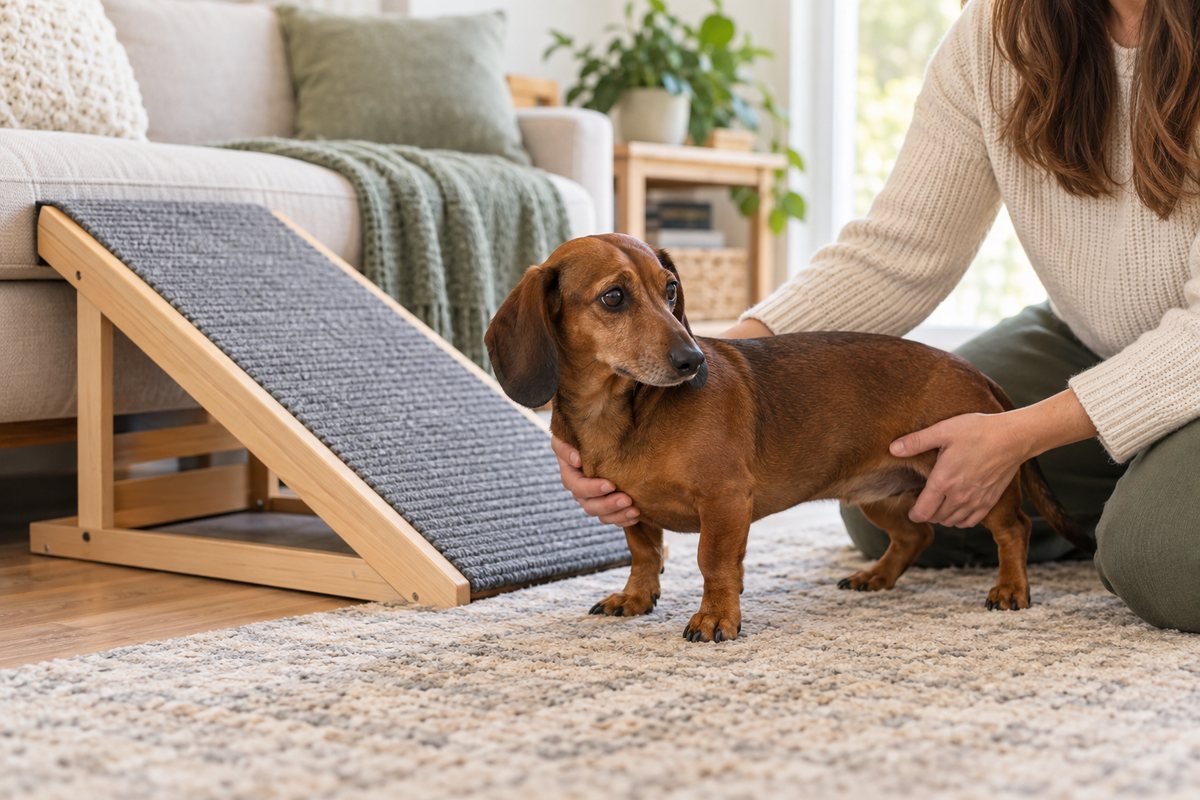
Back safety matters for this breed. If your Dachshund sleeps on you in bed, think about how they get up and down. Repeated jumping from furniture is not ideal for a long-backed dog. Use a ramp, lift carefully, or create a lower sleep space. If your dog shows pain, trembling, weakness, a hunched back, reluctance to move, or changes in gait, read Dachshund back pain signs and call your veterinarian.
What to do if you want more space
You do not have to ban your Dachshund from the bedroom to create better sleep manners. Start by deciding what you want: sleeping beside you instead of on you, sleeping in a dog bed beside your bed, sleeping in a crate, or sleeping in another room. Then teach that routine kindly and consistently.
- Choose a target spot: a low dog bed, crate, blanket, or bolster bed near you.
- Add warmth: use a soft blanket and keep the area draft-free.
- Reward the spot: give treats when your Dachshund chooses the bed before climbing on you.
- Teach a cue: use “bed” or “place” and reward calmly.
- Move gradually: start close to your bed, then increase distance only if your dog is relaxed.
- Keep the rule consistent: mixed rules can make night behavior more persistent.
If your Dachshund is a puppy, pair the sleep routine with calm crate work and predictable potty timing. The guide on how to crate train a Dachshund puppy can help, and how to train a Dachshund puppy gives the broader foundation.
Should you let your Dachshund sleep on you?
It depends on your sleep, your dog’s manners, and your household. Letting your Dachshund sleep on you can be fine if everyone sleeps well, your dog is easy to move, and the habit is not worsening anxiety, guarding, or pain. It is less ideal if you wake up stiff, your dog growls, your partner cannot get into bed, your Dachshund jumps on and off furniture all night, or your dog cannot cope with any separation.
A good compromise is to allow closeness but build an independent option. Your Dachshund can cuddle before sleep, then move to a dog bed, ramp-accessible spot, or crate. That gives affection without making your body the only safe place to rest.
FAQ
Why does my Dachshund sleep on my chest?
Your chest is warm, rhythmic, and close to your face and scent. Some Dachshunds find that deeply comforting. If it affects your breathing or sleep, teach your dog to settle beside you instead.
Why does my Dachshund sleep between my legs?
The space between your legs can feel warm, enclosed, and secure. It may mimic the den-like feeling many Dachshunds enjoy. Use a blanket nest or dog bed if you need more room.
Does sleeping on me mean my Dachshund is dominant?
Usually, no. Most sleep-on-you behavior is about comfort, warmth, attachment, habit, or anxiety. Focus on manners and emotional state rather than assuming dominance.
Should I stop my Dachshund sleeping on me?
Stop or modify the habit if it disrupts sleep, causes guarding, encourages unsafe jumping, or seems tied to anxiety. If your dog is relaxed and everyone sleeps well, it may simply be a harmless cuddle habit.
Why did my Dachshund suddenly start sleeping on me?
Sudden clinginess can come from cold weather, schedule changes, stress, aging, pain, illness, or a new household routine. If the change is dramatic or comes with other symptoms, call your veterinarian.
Sources
- American Kennel Club: Should I Let My Dog Sleep With Me?
- American Kennel Club: Why Do Dogs Sleep So Much?
- American Kennel Club: Why Does My Dog Follow Me Everywhere?
- American Kennel Club: Why Do Dogs Crawl Under the Covers?
- VCA Animal Hospitals: Should My Dog Sleep in My Bed?
- VCA Animal Hospitals: Separation Anxiety in Dogs
- Dachshund Club of America: Judges Education Materials
- American Kennel Club: Earthdog 101