Direct answer
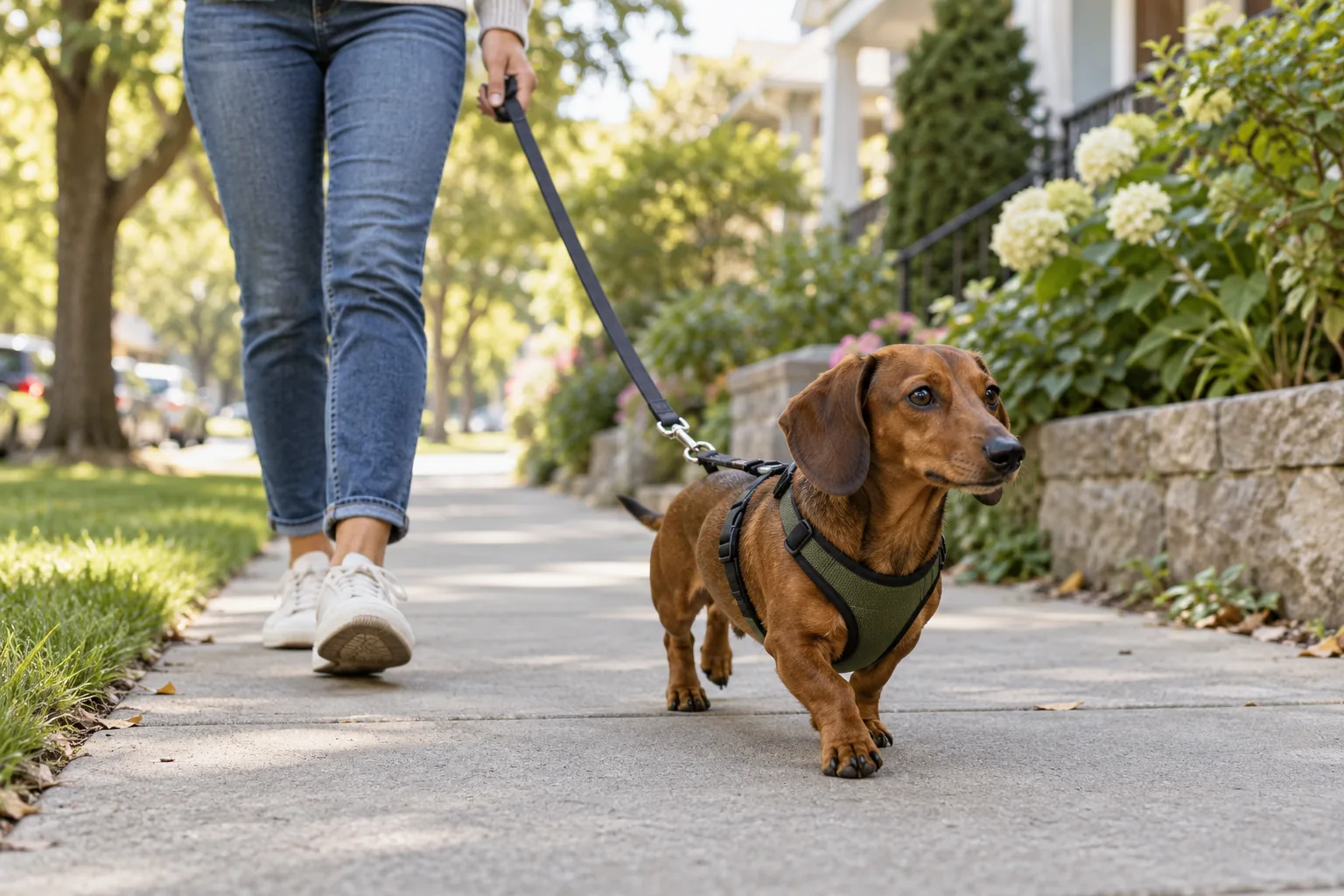
The best leash for Dachshunds on most everyday walks is a fixed-length leash that you can hold securely and that has a clip proportionate to your Dachshund’s harness. Match its length to the setting: city sidewalks and busy paths require close, predictable control; a quiet open space may allow a longer line if the handler can manage it safely. A retractable leash is not an all-purpose replacement. AKC’s retractable-leash guidance recommends a standard leash around traffic, crowds, and other dogs, and explains why a long extending line can be difficult to control quickly.
This is a buyer-criteria page, not a loose-leash training lesson. A leash will not teach a dog not to pull. The existing leash-training guide covers technique; the collar and harness guides cover those separate fit decisions. If product links are later added, verify the exact model and claims and place a clear affiliate disclosure nearby.
Best leash for Dachshunds: pick the route before the material
Imagine the place where the leash will be used most often. On a sidewalk with traffic, parked cars, other dogs, and people who do not want a greeting, a compact fixed length makes distance easier to manage. On a broad quiet field, a longer fixed line can permit sniffing while the dog remains attached. Check local leash laws first. The longest possible leash is not automatically the kindest choice if it exposes the dog to hazards you cannot reach in time.
For a Dachshund, observe where the clip hangs when the dog stands. A heavy metal clip can knock against a small chest or twist a light harness. Bring the actual harness to a store if possible; test whether the clip closes securely and swivels smoothly without opening under ordinary movement. Do not attach a heavy line to a delicate ID collar simply because the colors match.
The handler matters too. A leash you cannot grip when wet, that tangles around your legs, or that cuts into your palm is a poor choice even if its advertised breaking strength is high. Try the handle with gloves if you use them. Confirm that any secondary traffic handle is positioned where you can use it without leaning awkwardly over a small dog.
Fixed length, long line, and retractable are different tools
| Type | Best considered for | Main caution |
|---|---|---|
| Standard fixed leash | Everyday street and neighborhood walking | Too short may keep constant tension; too long may drag |
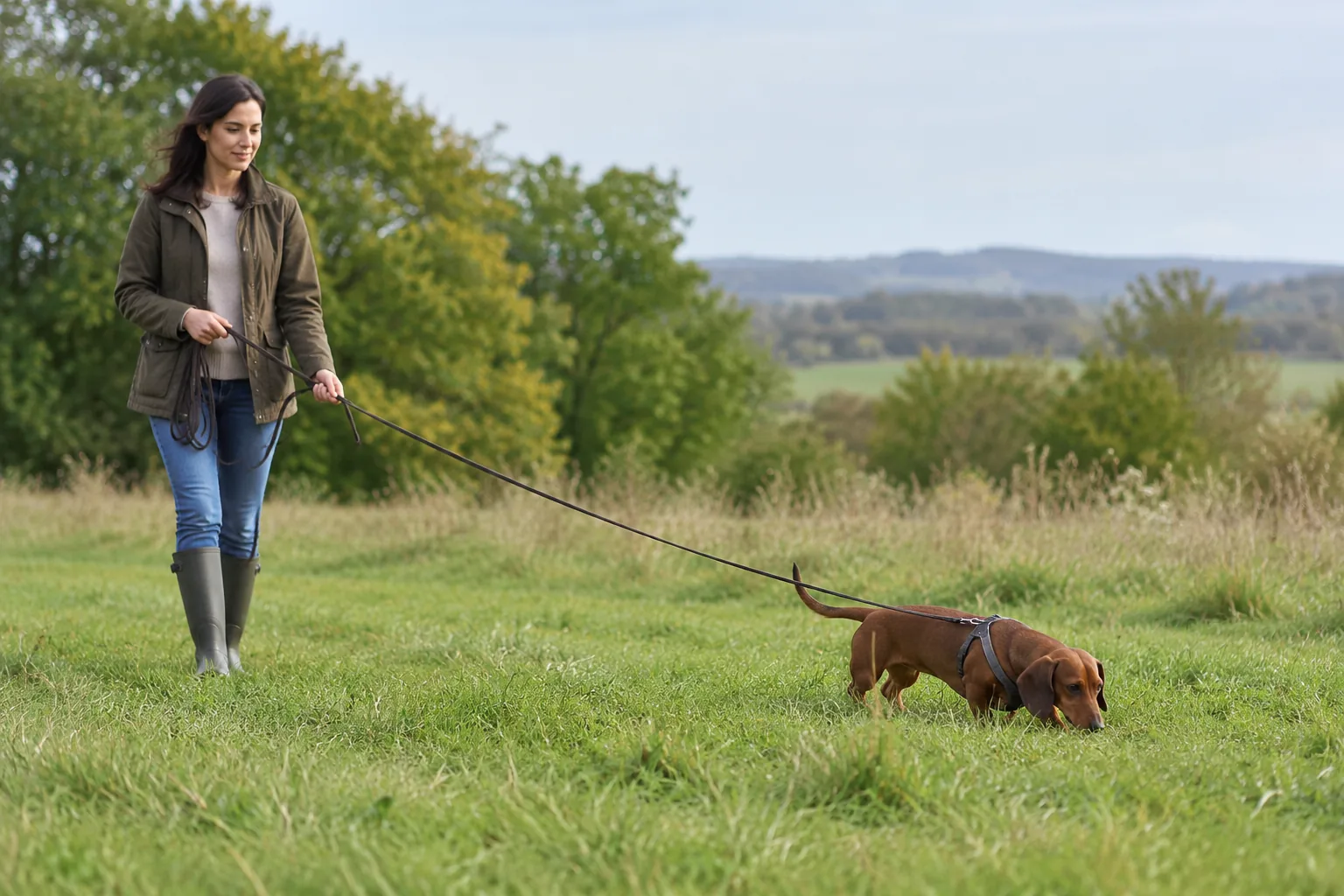
| Longer fixed line | Open, low-traffic sniffing space where permitted | Needs careful handling to avoid tangles and sudden stops |
| Retractable line | Limited suitable open contexts with trained handler | Harder to regain control near traffic; cord and dropped-handle hazards |
AKC notes that a retractable handle’s lock does not reel in a pulling dog. A dog that runs to the end of the line can experience a sudden jolt, and thin cord can injure people or animals if it wraps or is grabbed while moving. A dropped handle may chase and frighten the dog. Those are reasons to choose a standard leash in many ordinary situations, not proof that all retractable products are always unsafe.
A long fixed line can also cause tangles if allowed to trail through feet or brush. Learn to gather and release it in a controlled way and avoid wrapping it around your hand. In small spaces, shorten usable length before another dog approaches. If you have not practiced, start with a manageable standard leash.
Inspect the hardware at the dog end
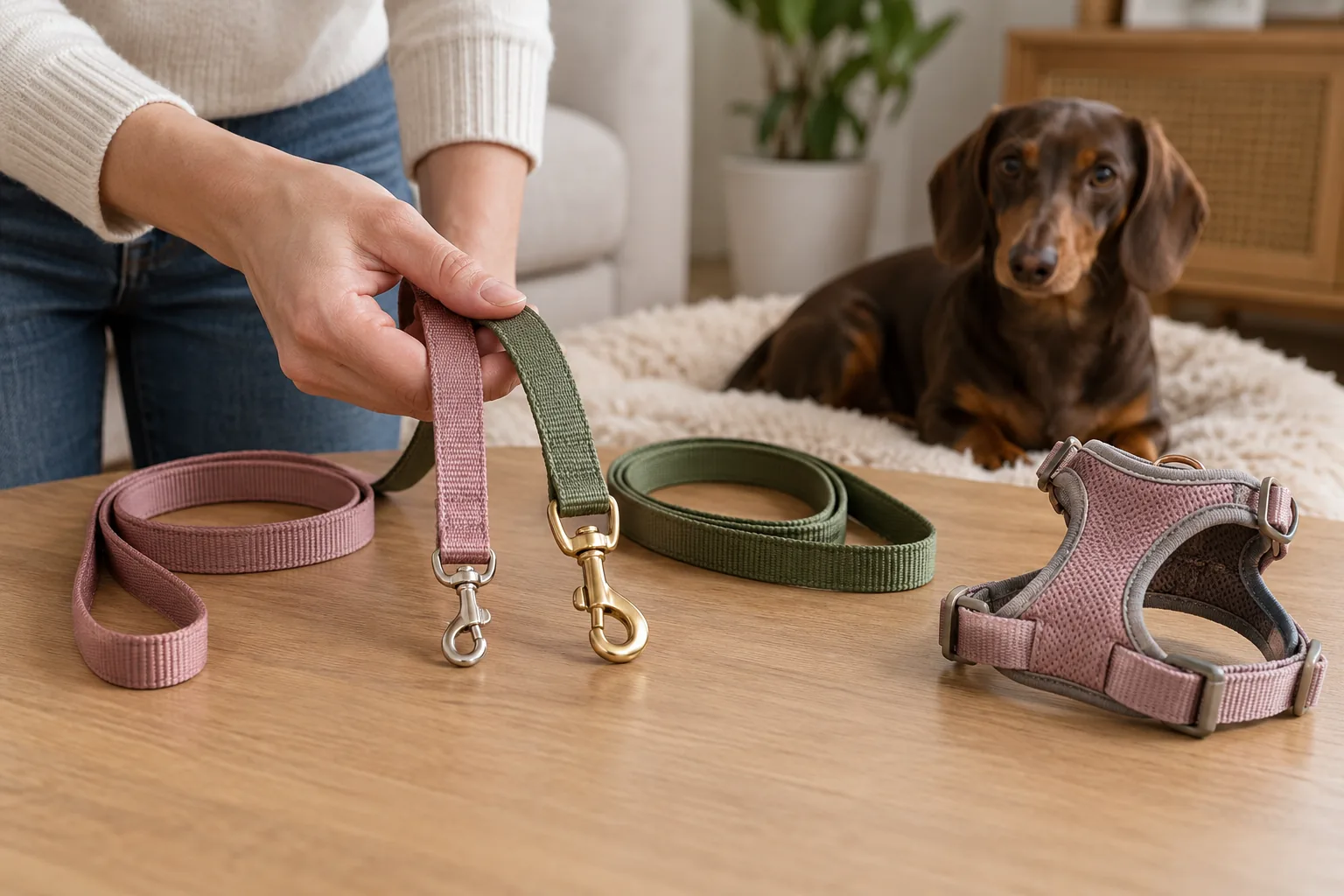
The clip needs to be strong enough for the dog’s movements but not disproportionately heavy. Check the spring or locking action, any sharp edge, and whether the connector can rotate freely on the harness ring. A clip that can catch fur or fail to close is not acceptable. Look at the stitching where the clip joins the webbing or leather; this is a common wear point.
Test the setup with the dog walking and turning. Does the leash drag under its legs? Does the clip swing into its chest? Does the line twist constantly? These fit issues are more informative than a product title claiming “for small breeds.” Adjust the combination rather than buying more of the same style.
Replace a leash with frayed material, damaged stitching, a bent clip, or a handle that no longer closes. Do not rely on a repair knot for ordinary walks near traffic. A spare leash in the car or by the door can prevent a damaged one from being used “just this once.”
Material, visibility, and maintenance
Nylon webbing, leather, and coated webbing have different grip and cleaning characteristics. Choose the material you can hold and maintain. In rain, some smooth surfaces become slippery; in dirt, some fabrics take longer to dry. Wash and dry according to the maker’s guidance and inspect after beach or muddy trips. Reflective detail can improve visibility under light, but it does not replace a lit, safe walking route.
Avoid buying only by maximum advertised strength. The Dachshund still needs a leash that is light and flexible enough to move naturally. The owner needs a dependable grip and compatible clip. If the dog chews leashes, manage the situation and teach an alternative; no label can promise chew-proof safety during unsupervised use.
A five-point in-store or at-home test
- Clip it to the dog’s actual harness and check size, swivel, and closure.
- Walk ten steps, turn, and stop; watch for tangles or repeated clip impact.
- Grip the handle with dry and damp hands or gloves as relevant.
- Practice shortening the usable length before a doorway or crossing.
- Inspect stitching, line condition, and visibility in your normal light.
Do this in a safe enclosed area before relying on new equipment in traffic. If the dog pulls, use the test to check comfort and control, then work on loose-leash skills separately. AKC’s leash guidance links equipment choice with training readiness.
Three use-case decisions
Urban walker: choose a manageable fixed leash with a comfortable handle and light compatible clip. Keep the dog close at crossings and when people pass, without holding the line taut the whole walk.
Quiet-park explorer: a longer fixed line can provide sniffing room if rules permit and the handler can prevent tangles. Switch to a shorter usable length near other people, wildlife, or obstacles.
Puppy learning leash manners: start with simple predictable equipment and short positive sessions. A retractable line can reward pulling as more line unspools, so it is not the best default teaching tool according to AKC.
A practical example
An owner buys a long retractable leash because it promises freedom. Near a crosswalk, the Dachshund reaches a curb before the handle lock stops the line; when the owner drops the bulky handle, it startles the dog. They switch to a fixed leash for city walks and reserve open-space sniffing for a separate longer line. They also practice a calm return cue. The improvement comes from matching tool and environment, not from declaring one leash universally best.
Frequently asked questions
What leash length is best for a Dachshund?
There is no single perfect length. Choose enough for a comfortable walk but short enough to manage the most common route. A standard leash is a sensible starting point around streets and crowds; a longer line is a separate open-space tool.
Are retractable leashes bad?
They have limited appropriate uses but are poor choices near traffic, crowded paths, and unfamiliar dogs. AKC explains both useful contexts and control hazards.
Should I attach the leash to a collar or harness?
Consider pulling, neck comfort, and secure fit. A properly fitted harness may reduce neck pressure for a puller; a collar can carry ID. See the separate harness and collar guides for fitting.
Does a leash stop pulling?
No. It helps manage distance and safety. Loose-leash walking is trained through consistent practice, not purchased as a material feature.