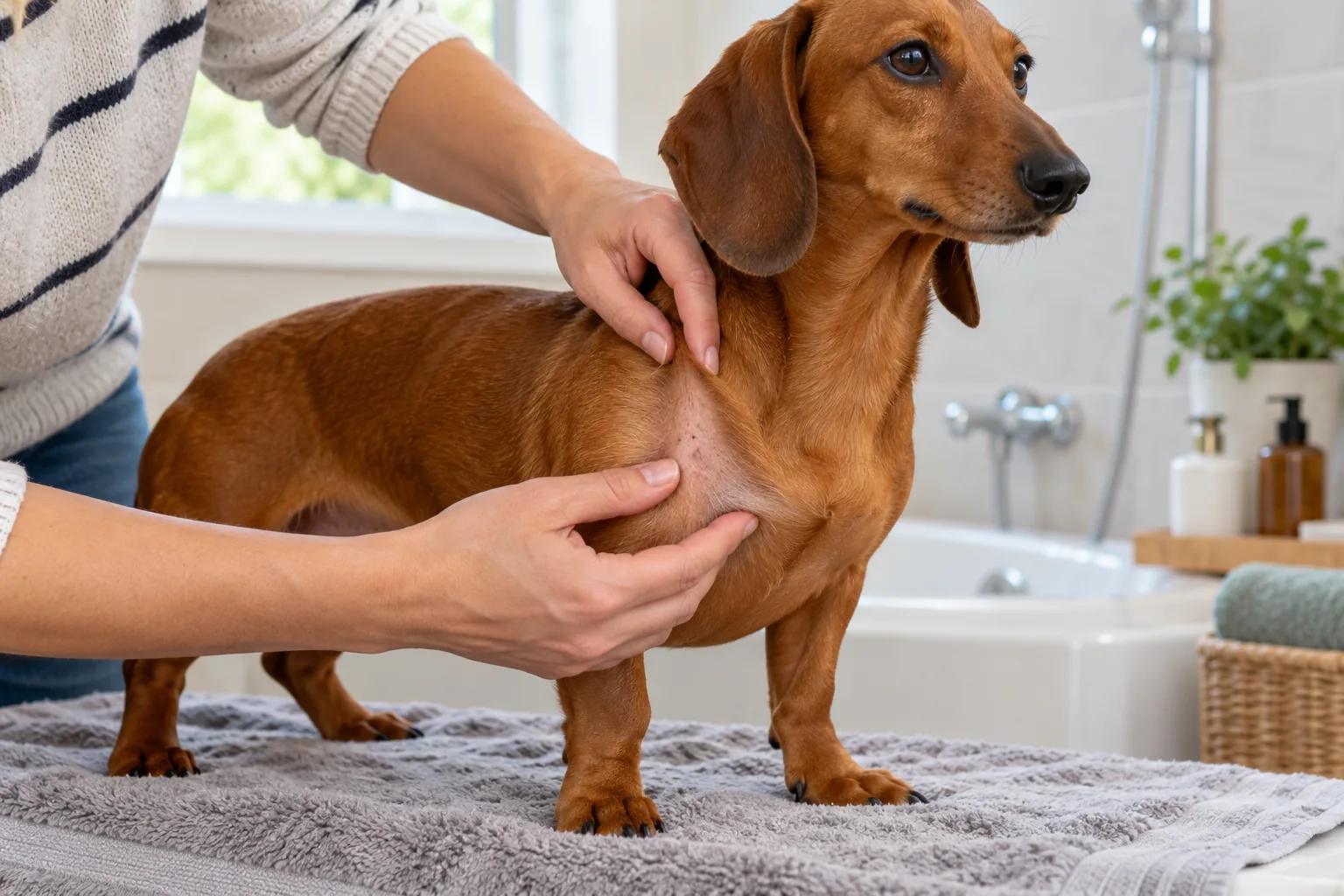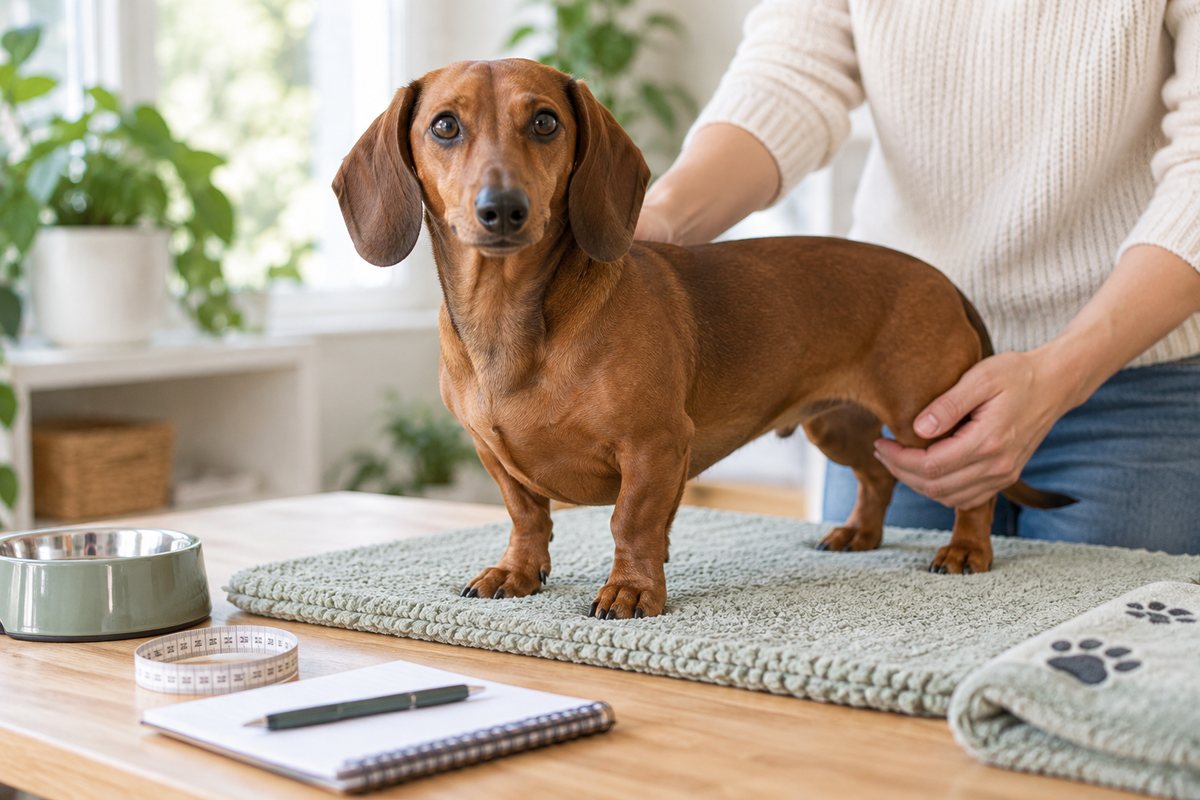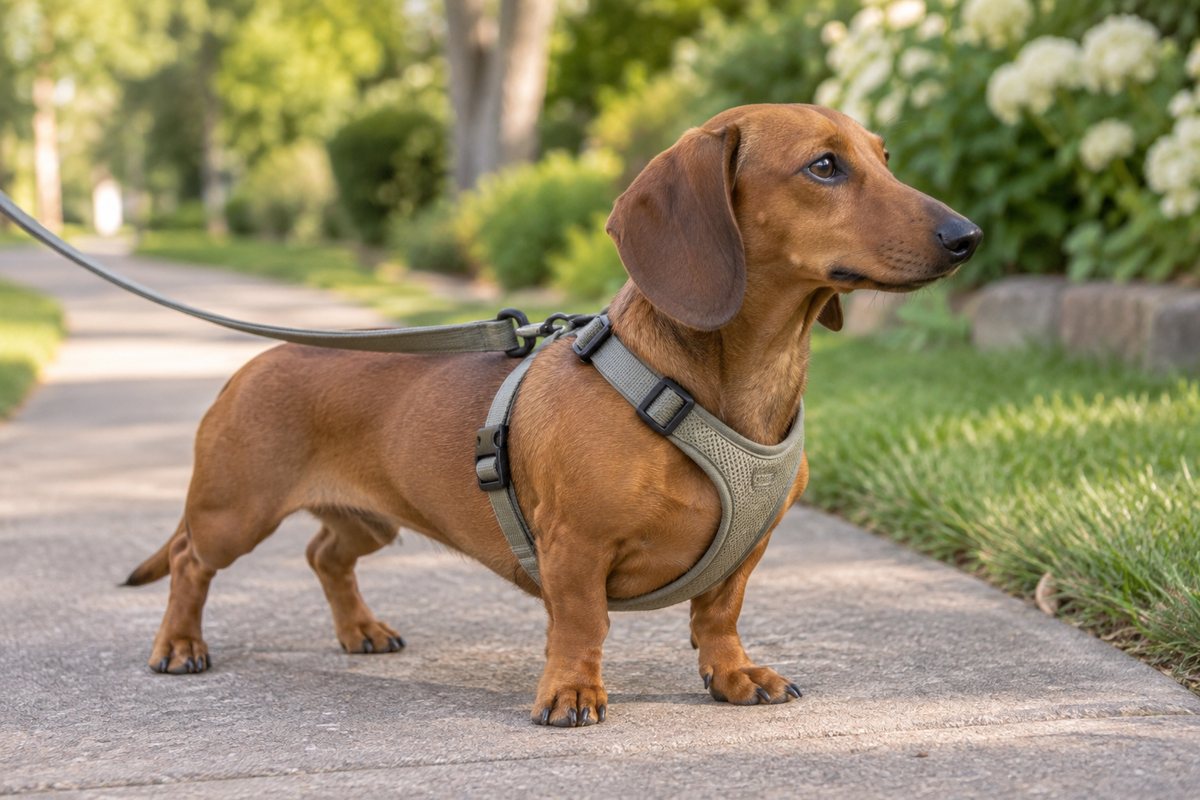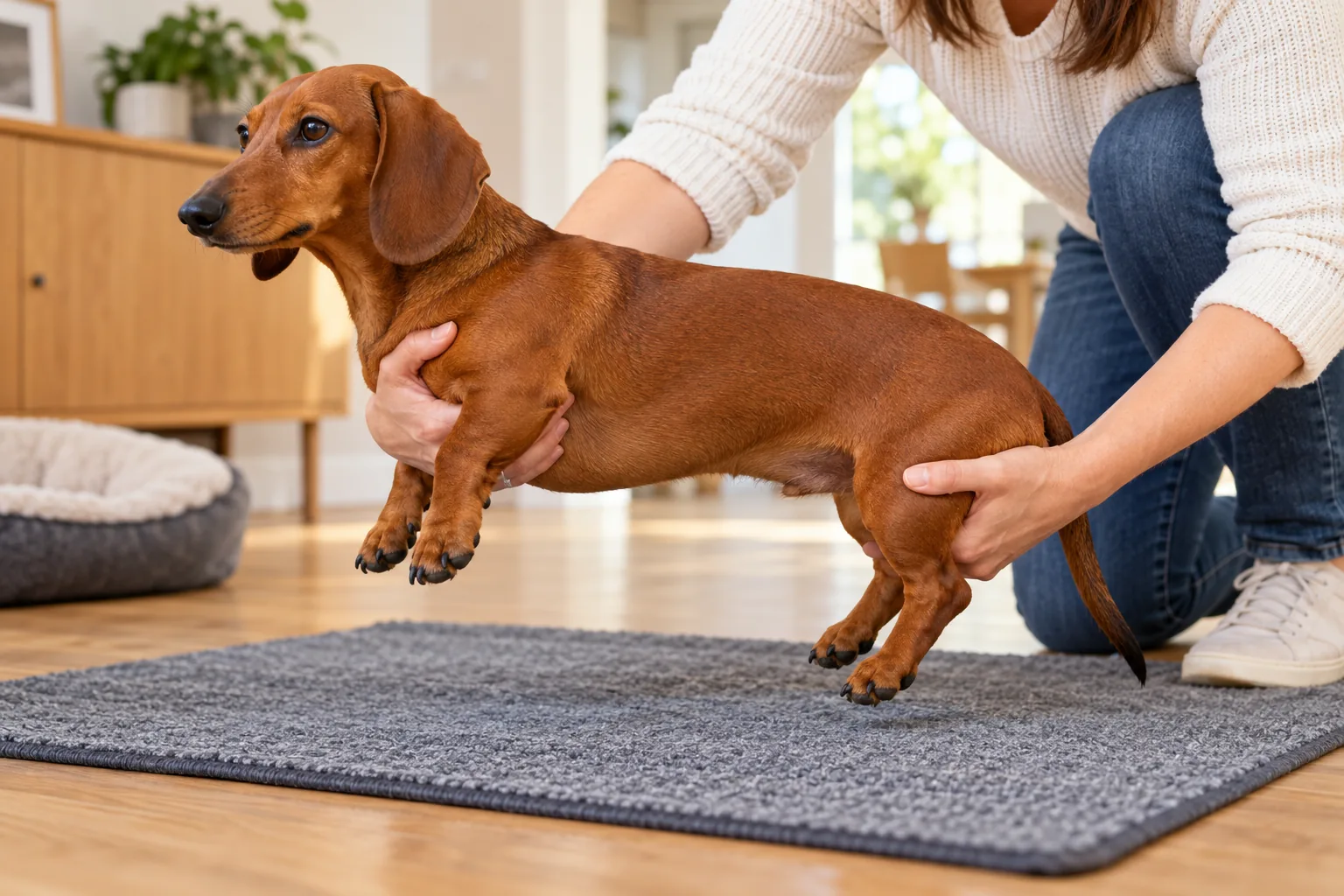
How to carry a Dachshund: approach calmly, place one hand beneath the chest and the other beneath the hindquarters, and lift the dog as one supported, level body. Keep that two-point support while you hold the dog, then lower it slowly until the paws meet a stable surface. Dachshund IVDD Support Australia (DISA) recommends chest-and-rump support, a level body, and a controlled set-down. This is a routine handling method for a comfortable dog; a dog that cries out or cannot move normally needs veterinary advice, not more practice lifts.
Dachshunds are long-bodied and short-legged, so lifting only at the front leaves the rear hanging. The aim is not to make the spine perfectly rigid or to promise that proper lifting prevents every back problem. It is to avoid unnecessary dangling, twisting, and dropping during a movement you repeat every day. DISA’s handling advice explicitly warns against lifting by the upper body alone or letting the dog twist. The AKC Dachshund breed profile also emphasizes monitoring activities that could injure the back.
How to carry a Dachshund: when to pick up and when to let the dog walk
You do not need to carry a healthy Dachshund everywhere. Walking and appropriate exercise help maintain fitness; the AKC breed profile stresses exercise and avoiding excess weight. Carrying is useful when you must move the dog across a barrier, place it safely in a car, prevent a jump from a high surface, or remove it from an immediate hazard. The decision is about the situation, not a rule that the dog should never use its own legs.
Before lifting, ask whether the destination is ready. Clear a stable landing spot, open a gate or car door, and move slippery objects out of the way. If you are carrying the dog up a step or across a room, keep the route short enough that you can maintain both supports. A person struggling to balance bags and a dog should set the bags down first. These are practical handling precautions inferred from DISA’s instruction to keep the dog supported throughout the movement.
A dog already showing pain, weakness, wobbliness, or reluctance to stand is a different case. Do not repeatedly lift and set it down to test the back. Contact a veterinarian promptly for individualized transport instructions. DISA’s handling page flags a yelp when lifted as a distress sign that should not be ignored.
The two-hand lift, step by step
- Get close and speak to the dog so it is not startled. Let it stand or settle on a stable, non-slip surface.
- Bend your knees enough to bring your hands to the dog’s level rather than reaching from far above.
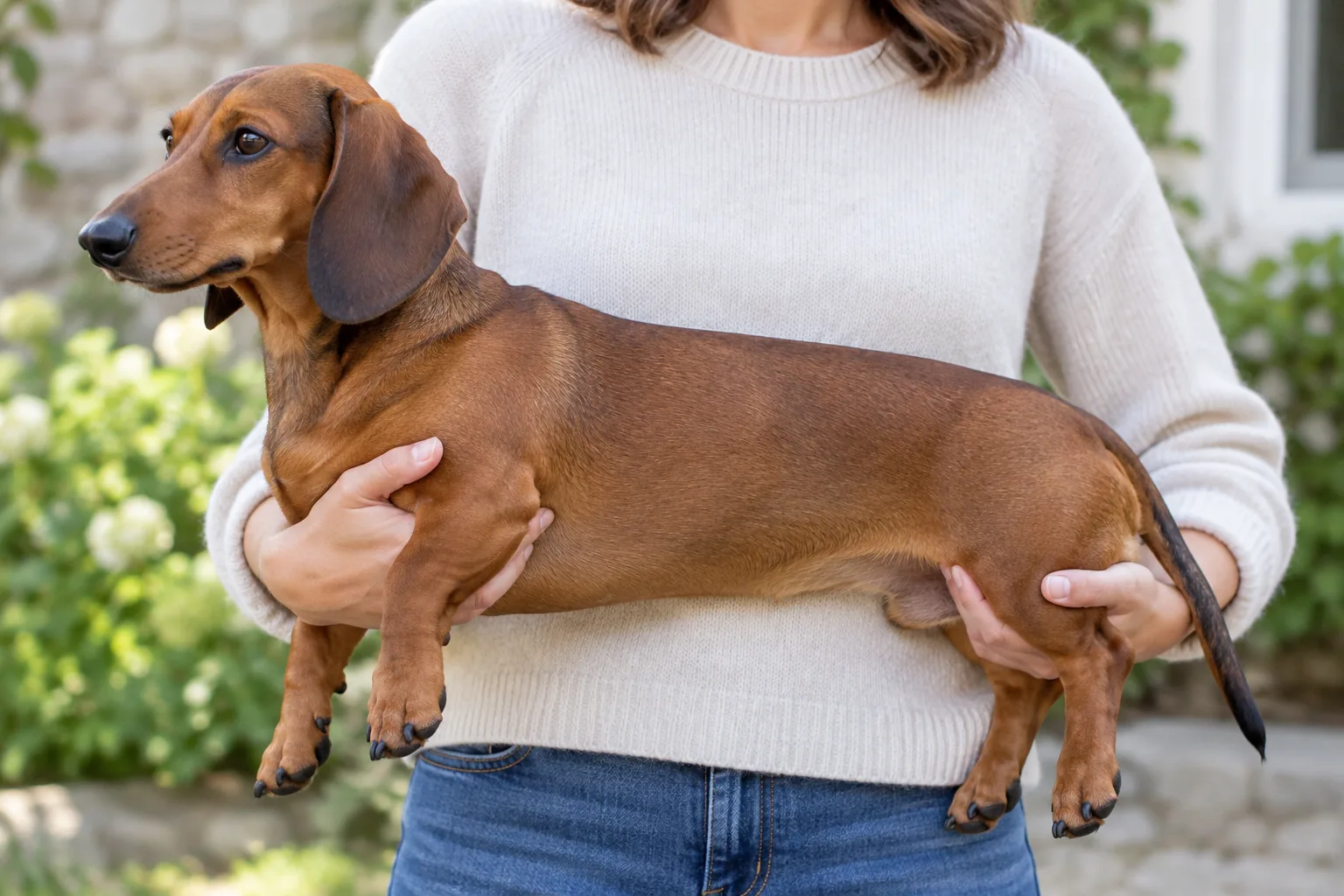
- Slide one hand or forearm under the chest, behind the front legs. Place the other under the rump and pelvis, not just around the tail.
- Lift both ends together. Keep the body roughly level and bring the dog close to your torso.
- Keep supporting both ends as you turn or walk. Turn your own feet instead of twisting the dog’s body.
- To set down, lower the whole dog slowly until the feet meet the floor; release only when it has balance.
The core support points and level lift are DISA’s published guidance. The details about preparing the route and turning your own body are practical extensions of keeping the dog level and secure. Use a secure grip, not a squeeze that makes breathing or movement uncomfortable. If the dog wriggles, pause and get closer to a safe landing rather than trying to restrain it in midair.
Try the motion at floor level first. Some dogs dislike unexpected handling, so a calm cue and a predictable sequence can help. Reward a cooperative stand or still moment, then lift only briefly and set down before the dog struggles. This is a training adaptation, not a substitute for checking pain. The AKC advice on handling small dogs treats picking up as a choice in context, not something owners must do reflexively whenever a small dog hesitates.
Holding the dog while walking
Bring the Dachshund close enough to your body that your arms do not tire immediately. One arm should continue to support the front and the other the rear. A dog held out at arm’s length is harder to control and more likely to wiggle. Keep your eyes on the path so you do not trip while concentrating on the dog. If you need a longer carry and cannot reliably support both ends, ask another adult for help or change the route.
Do not hold the dog upright like a human child with its lower body dangling. Do not swing it by the front legs, scruff, or collar. The DISA handling guide warns against unsupported upper-body lifts, and an AKC discussion of dog handling specifically warns against carrying an adult dog by the scruff. If you cannot get a secure two-hand hold because the dog is frightened or snapping, stop and seek safer assistance instead of escalating the struggle.
How to set a Dachshund down
Choose a low, non-slip surface. Bend your knees and lower the dog as one supported unit. Let all four paws approach the floor rather than releasing the dog from a height. Keep a hand at the rear until the dog is steady. DISA advises slowly lowering a Dachshund to the ground and never dropping it.
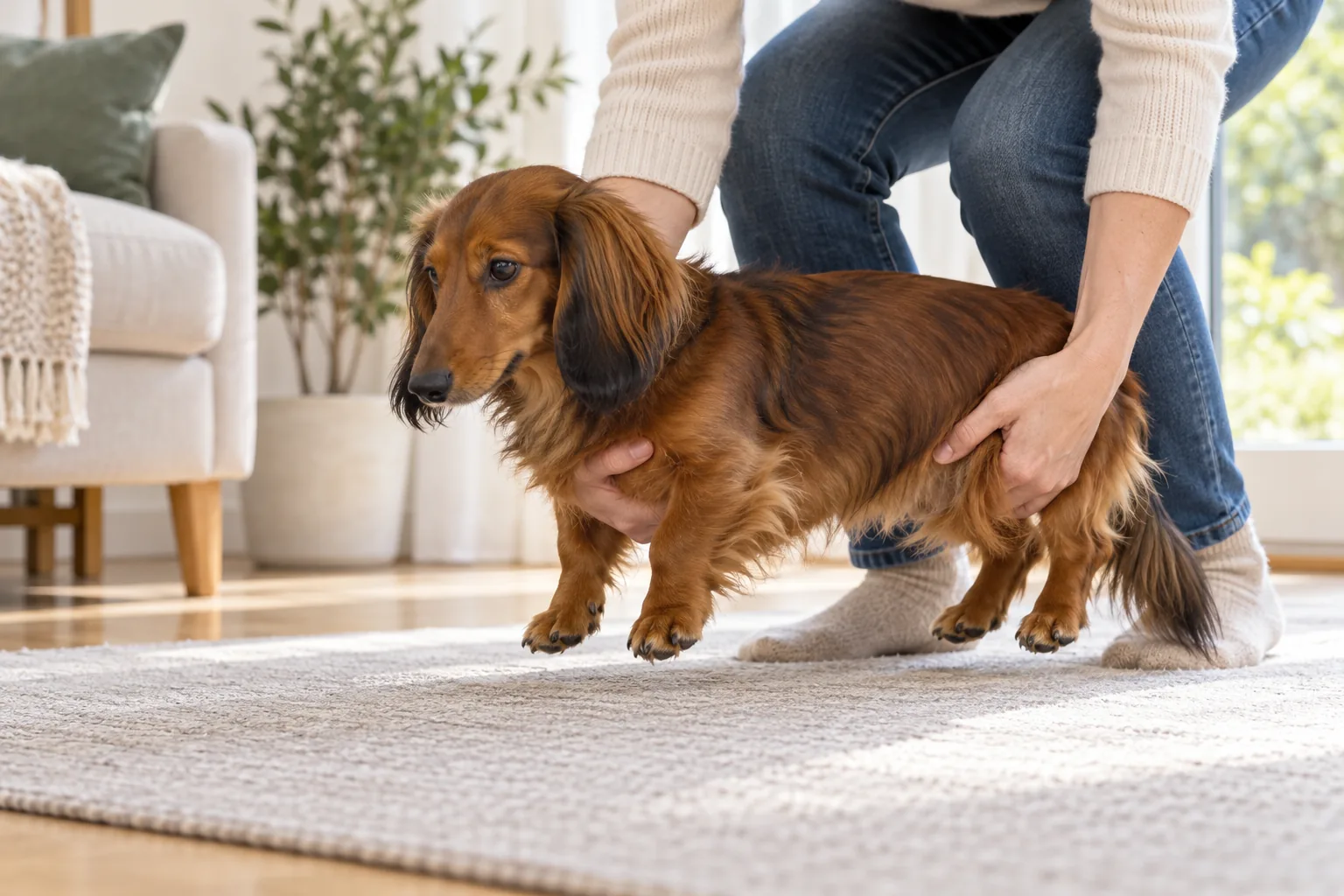
A couch or bed is not a good landing target if the dog will immediately jump back down. Set it on the floor or a stable surface with a safe exit route. The AKC breed profile cautions against jumping on and off furniture because of back-injury risk. This article deals with how to handle the lift; a separate home-layout guide should address access to furniture in more detail.
Common mistakes and a better alternative
| Mistake | Why to change it | Better action |
|---|---|---|
| Lifting only beneath the front legs | Rear body dangles and the dog may twist | Support chest and rump together |
| Scooping suddenly from behind | Startles a dog that cannot see the approach | Give a calm cue and come alongside |
| Carrying one-handed while holding objects | Support can shift if the dog wriggles | Put objects down and use both hands |
| Holding the dog vertically | Long body is not supported level | Bring it horizontal and close to the torso |
| Releasing above the floor | Dog has to absorb a drop | Lower until the paws are supported |
The first, fourth, and fifth points follow DISA’s explicit handling instructions. The other points are practical safety inferences. This table is not an exercise for a dog that is already painful, weak, or under veterinary movement restrictions.
Children, visitors, and inconsistent handling
A child may love holding a small dog but lack the strength or steadiness to support both ends. Teach children to interact at floor level unless an adult has confirmed they can follow the support method and supervise closely. Show visitors where to place each hand before they lift. DISA’s guide specifically recommends showing family and friends how to handle a Dachshund before they interact with it.
Do not let someone demonstrate by repeatedly lifting the dog. One calm explanation, perhaps with an adult showing the motion once, is enough. If a guest cannot follow the method or the dog is uncomfortable, the dog can remain on the floor. A dog’s small size does not mean it must accept being carried by everyone.
Puppies, seniors, and dogs with pain
A puppy may squirm because handling is unfamiliar; keep lifts brief and low, and build comfort gradually. An older dog may have arthritis, poor vision, or another source of discomfort that changes what it tolerates. Do not assume every reaction is a back problem, but do not ignore repeated discomfort. For a dog with known IVDD or post-surgical restrictions, follow the treating veterinarian’s instructions rather than a general web guide.
A yelp when picked up, a hunched posture, reluctance to move, wobbling, weakness, or loss of normal walking needs urgent veterinary evaluation. This is not a moment to compare lifting techniques. DISA’s handling advice says to take distress on pickup seriously, and the AKC breed profile notes the breed’s back-injury concern. The article does not diagnose IVDD or specify emergency treatment.
Frequently asked questions
Can I pick up a Dachshund under the armpits?
Do not lift by the front alone while the rear hangs. DISA recommends one support under the chest and another under the rump so the long body stays level.
Is a carrier or sling better than carrying in my arms?
For routine short lifts, two-hand support may be enough. A carrier can be useful for a longer trip if it fits, is secure, and the dog is comfortable, but it does not remove the need to place the dog in and out carefully. A medical support sling for a weak or injured dog is a different device and should be chosen with veterinary guidance; DISA’s sling-walking resource addresses rehabilitation cases rather than everyday carrying.
What if my Dachshund squirms?
Lower it to a safe surface as soon as you can do so without dropping it. Practice shorter, predictable handling only if the dog appears comfortable and healthy. A sudden new reaction, yelp, or movement problem is a veterinary question. DISA warns against ignoring signs of distress on pickup.
Does correct lifting prevent IVDD?
No handling technique can promise that. It is a sensible way to avoid leaving the rear dangling or twisting during a lift. DISA presents support while carrying as one of several risk-reduction practices, not a guarantee. Weight management, fitness, and veterinary advice also matter.
Related guides and editorial boundary
This guide focuses on how to pick up, hold, and set down a Dachshund. Safe handling is one part of a broader home routine that may also involve stable walking surfaces, controlled furniture access, and a plan for stairs. If a dog shows pain, weakness, or loss of coordination, seek veterinary advice rather than using a handling tutorial to investigate a possible spinal problem.