Author: Sk Raju

  • Can Dachshunds Swim? A Safety-First Guide to Water

    Can Dachshunds Swim? A Safety-First Guide to Water

    Direct answer

    Can Dachshunds swim? Some can, but the ability to paddle is not a guarantee of safety or enjoyment. An individual dog may be comfortable in shallow, still water yet tire quickly in deeper water. Treat swimming as a supervised activity, not an instinct that needs no preparation. Begin where the dog can enter and leave easily, use a properly fitted canine life jacket for swimming, stay close enough to assist, and end while the dog is still comfortable. AKC’s water-safety guidance recommends gradual introductions, flotation, close supervision, rest breaks, and fresh drinking water.

    Whether Dachshunds can swim safely depends on the dog, environment, and supervision. There is no universal rule that every Dachshund enjoys water. If yours chooses to stay dry, a sniffing walk near the shore can be the entire outing. Our separate guide to whether Dachshunds like water covers that preference question; this page addresses swimming conditions and response to risk.

    First decide whether this water is suitable

    Look at the entry, exit, water movement, depth, footing, temperature, and water quality before the dog approaches. A gentle slope in calm water gives a novice a way back to land. A pool with sheer walls, a river with current, surf, a steep bank, or slippery rocks creates a different risk. If you cannot identify a reliable exit, do not start. AKC’s swimming introduction favors a gradual slope and supervised practice.

    Do not rely on a dog to recognize current or fatigue. Wind, waves, and boat wake can change conditions suddenly. Keep a person close enough to help rather than watching from a distant chair. Never throw a dog into water, pull it beyond its confidence, or treat a panicked paddle as proof of learning. A dog that hesitates or turns away is giving useful information.

    Natural water can carry hazards beyond depth. Provide fresh drinking water so the dog is not encouraged to drink lake or salt water. Avoid visibly contaminated or suspicious water and follow local advisories. If a dog becomes ill after water exposure, tell the veterinarian where it swam. AKC’s water-safety article advises bringing fresh water and preventing consumption of lake or ocean water.

    Fit a life jacket, then supervise anyway
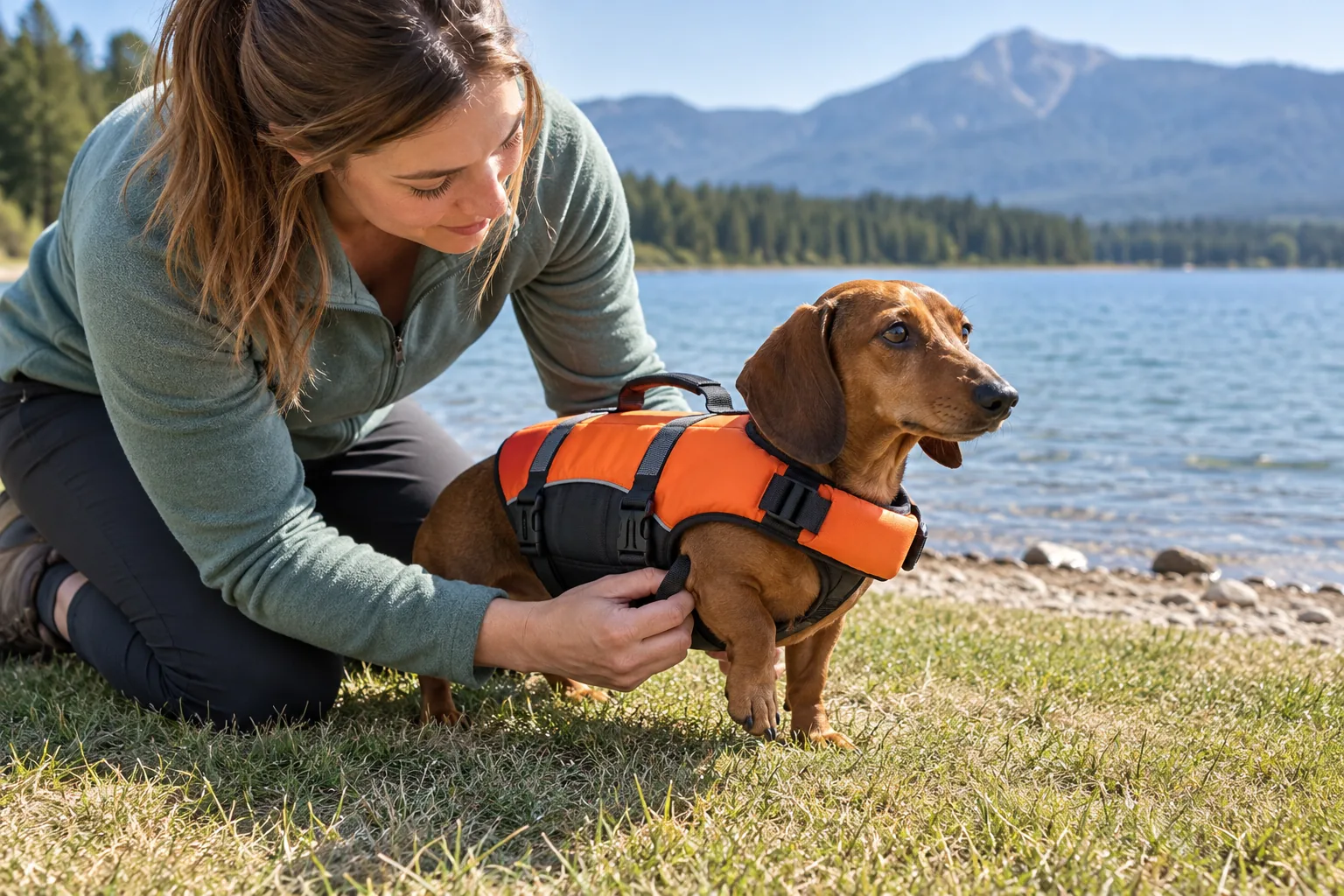
    Can Dachshunds swim safely? Checking a fitted Dachshund life jacket on dry ground

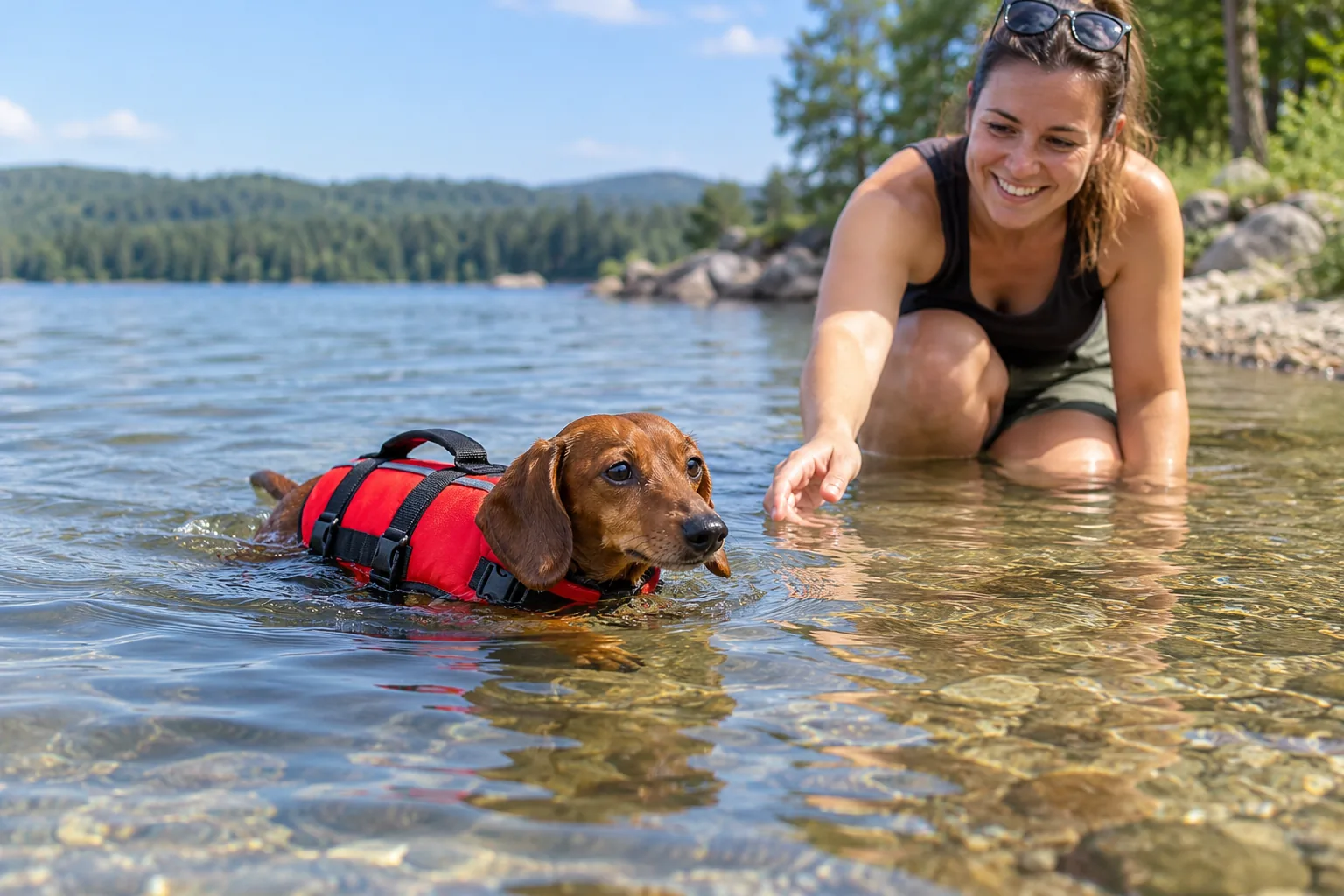
    A canine life jacket adds buoyancy and can make a tired dog easier to assist. It is not permission to enter rough water or leave the dog alone. Before each outing, check buckles, straps, wear, and whether the jacket stays secure without restricting breathing or limb movement. A handle can help guide a dog to the exit, but it is not a substitute for a rescue plan. AKC warns that a loose or worn jacket can itself create problems.

    Try the jacket on dry land first. Allow the dog to walk, turn, and rest; check for rubbing at the chest and under the forelegs. If it shifts, catches a leg, or presses on the throat, change the fit before swimming. Our separate life-jacket guide compares features and sizing; this article is about using flotation during an outing.

    Even a dog that previously swam successfully needs continuous observation. Fatigue may appear as a slower paddle, lower posture, repeated attempts to climb onto a person, disorientation, or trouble reaching shore. Take the dog out before those signs become severe. Build in rest on dry ground; do not extend distance by throwing a ball farther and farther. AKC’s hydrotherapy overview notes that experienced dogs can tire and recommends properly fitted flotation in water.

    Make the first session short and voluntary

    Start at a calm, shallow place with a gently sloping exit. Let the Dachshund sniff the edge and step in or step back. Reward calm investigation on land. If the dog chooses to enter, stay beside it and keep the first water time brief. Leave the water together, allow a rest, and judge comfort before another short try. Do not make a particular distance the goal.

    If the dog seems tense, circles without finding the bank, scratches at you, or refuses to re-enter, stop. That is not a training failure. Plenty of Dachshunds have enjoyable outdoor lives without swimming. If you hope to use water activity for a dog with a back or joint condition, ask the treating veterinarian whether supervised rehabilitation is appropriate. Recreational swimming and prescribed hydrotherapy are not interchangeable; AKC’s hydrotherapy overview distinguishes therapeutic use from play.

    Pools, lakes, and boats need different plans

    Setting Main question Safer decision
    Pool Can the dog locate and use a reliable exit? Teach the exit under direct supervision; block unsupervised access.
    Lake or pond Is the bank gradual, water still, and water quality acceptable? Choose a shallow section and follow local advisories.
    River or surf Can current or waves move the dog away? Skip swimming when flow, surf, or footing is uncertain.
    Boat Could the dog fall overboard or become separated? Fit a life jacket, plan retrieval, and keep the dog under control.

    These are decision prompts, not promises that any location is safe. The same lake can change with weather. Do not tether a dog in a way that could trap it underwater or leave a leash dragging where it might snag. Ask a qualified local instructor for help if unsure how to practice an exit safely.

    After the water
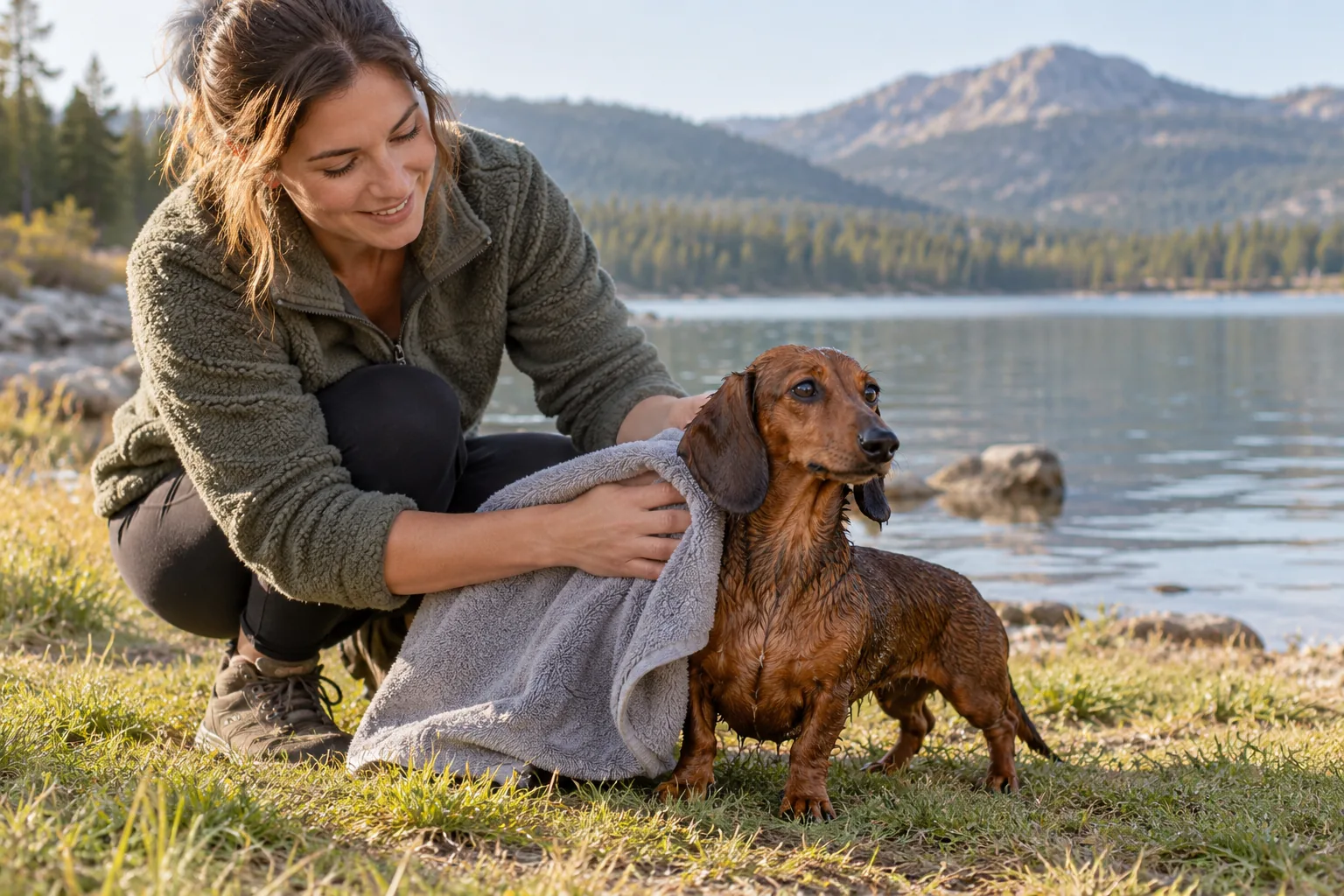
    Owner gently drying a Dachshund on shore after a supervised swim

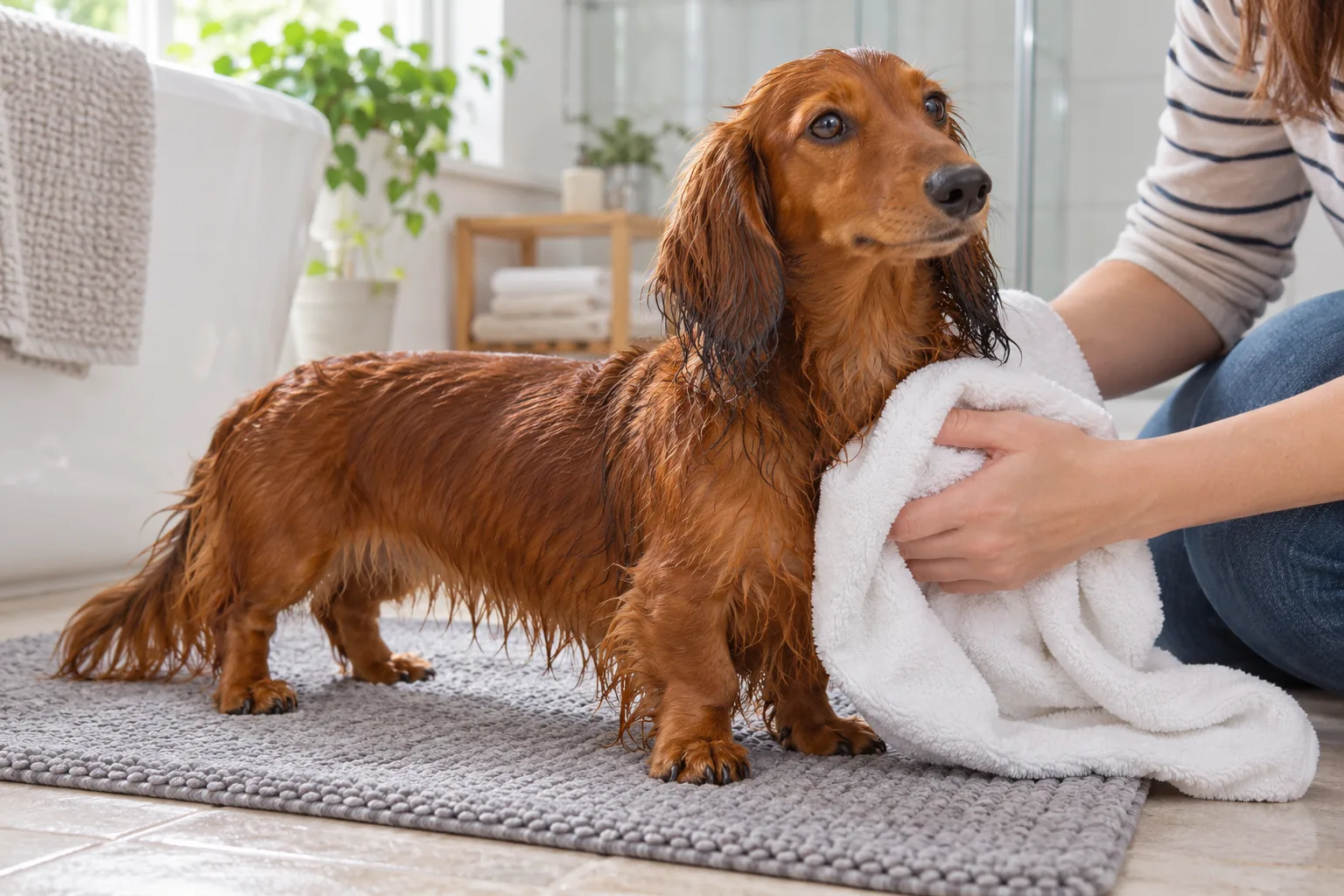
    Bring the dog to dry, stable ground, offer fresh water, and dry the coat and ears gently. Rinse off pool chemicals or salt as appropriate, and check for debris around paws and skin. Watch for coughing, unusual breathing, marked lethargy, repeated vomiting, or difficulty walking. Contact a veterinarian promptly if these develop rather than assuming the dog is merely tired. AKC’s pool-safety advice includes rinsing after pool exposure.

    Do not prolong a session because the dog still seems eager; excited dogs can exceed their comfortable effort. Note how the dog moves and rests later that day. A successful first visit may be a few relaxed minutes near the edge, not a swim across open water.

    A practical example

    An adult Dachshund has enjoyed walking at a lake but has never swum. Its owner chooses a quiet shore with a gradual bank, checks that dogs are allowed and no water-quality warning is posted, fits the life jacket on land, and stays within reach. The dog wades in and paddles a short distance, then returns with guidance to the same easy exit. The owner ends the water time, dries the dog, and watches recovery. If the dog had refused to enter, the outing could still have been a pleasant lakeside walk.

    Frequently asked questions

    Are Dachshunds natural swimmers?

    Some paddle readily; others do not. Breed and body shape do not establish that an individual can safely handle depth, distance, current, or an unfamiliar exit. Supervision and a suitable environment matter more than the label “natural swimmer.”

    Does a life jacket make deep water safe?

    No. It adds flotation but cannot remove current, cold, fatigue, poor fit, or an inaccessible exit. Keep the dog within reach and choose calm water. AKC pairs a life jacket with human supervision.

    Can swimming replace walking?

    Swimming may be enjoyable for a healthy dog that likes water, but it is not a universal replacement for daily movement. For a dog with pain or a diagnosed condition, ask a veterinarian about an individualized exercise plan.

    What if my dog coughs afterward?

    Move the dog out of the water. Persistent coughing, breathing changes, vomiting, or unusual weakness warrant prompt veterinary advice. Tell the clinician where the dog swam and what you observed.

    Sources

  • Are Dachshunds Good With Other Dogs? A Cohabitation Guide

    Are Dachshunds Good With Other Dogs? A Cohabitation Guide

    Direct answer

    Are Dachshunds good with other dogs? A Dachshund can live well with another dog, but the match depends on both individuals and careful management. Breed alone cannot predict whether two dogs will share space comfortably. Ask about each dog’s history with other dogs, begin on neutral ground, and watch whether both can relax and disengage. Humane World for Animals recommends a neutral outdoor introduction with separate handlers and attention to body language. The AKC’s new-dog guidance similarly advises a neutral first meeting and supervised transitions at home.

    Are Dachshunds good with other dogs when they share a home? It depends on the household pairing and management. This article is about living together, not barking at passing dogs on walks. A Dachshund may be sociable outdoors but guard a bed or food bowl indoors; another may be noisy on lead yet settle near a housemate. The household relationship must be assessed in the situations where the dogs will actually live.

    Evaluate both dogs before arranging a meeting

    Ask the breeder, shelter, or foster home what the Dachshund has done around dogs of different sizes, ages, and energy levels. Has it lived with another dog, only met dogs briefly, or struggled when one approached a resource? Ask the same questions about the resident dog. A friendly greeting at a park is useful information, but it is not a guarantee of sharing a kitchen and family attention.

    Look at age and physical comfort. A young, energetic dog may overwhelm a senior Dachshund. A dog with back pain may react defensively when bumped or chased. If either dog has pain, sudden irritability, or a history of biting, consult a veterinarian and a qualified behavior professional before staging introductions. Dog-dog selectivity varies with individual genetics, socialization, and experience, as AKC’s discussion of selectivity notes.

    Size is not a compatibility test. A larger dog may play gently, while two similarly sized dogs may conflict. For a Dachshund, pay attention to play style and whether each dog can stop when the other needs space. Do not assume a second Dachshund is automatically the easiest companion.

    Meet on neutral ground

    Choose a quiet outdoor place unfamiliar to both dogs. Have one calm adult handle each dog on a secure lead. Begin far enough apart that both can notice the other and still respond to their handlers. Walk in the same direction, allow sniffing of the environment, and reward calm check-ins. Humane World recommends rewarding calm observation rather than forcing immediate contact.

    If both dogs remain loose-bodied and interested, decrease distance gradually. A brief greeting can be followed by moving apart again. Watch for stiff posture, prolonged staring, blocking, growling, or one dog repeatedly trying to get away. Those signs call for more distance or ending the session, not insisting that the dogs “work it out.” If the dogs cannot relax even with distance, seek professional guidance before deciding to house them together.

    Avoid a first meeting at the resident dog’s front door or over a food bowl. The AKC advises neutral territory because a home entrance can add pressure. A good first walk is a beginning, not permission to remove every barrier indoors.

    Prepare the house before the newcomer arrives

    Are Dachshunds good with other dogs? Separate comfortable rest spaces at home

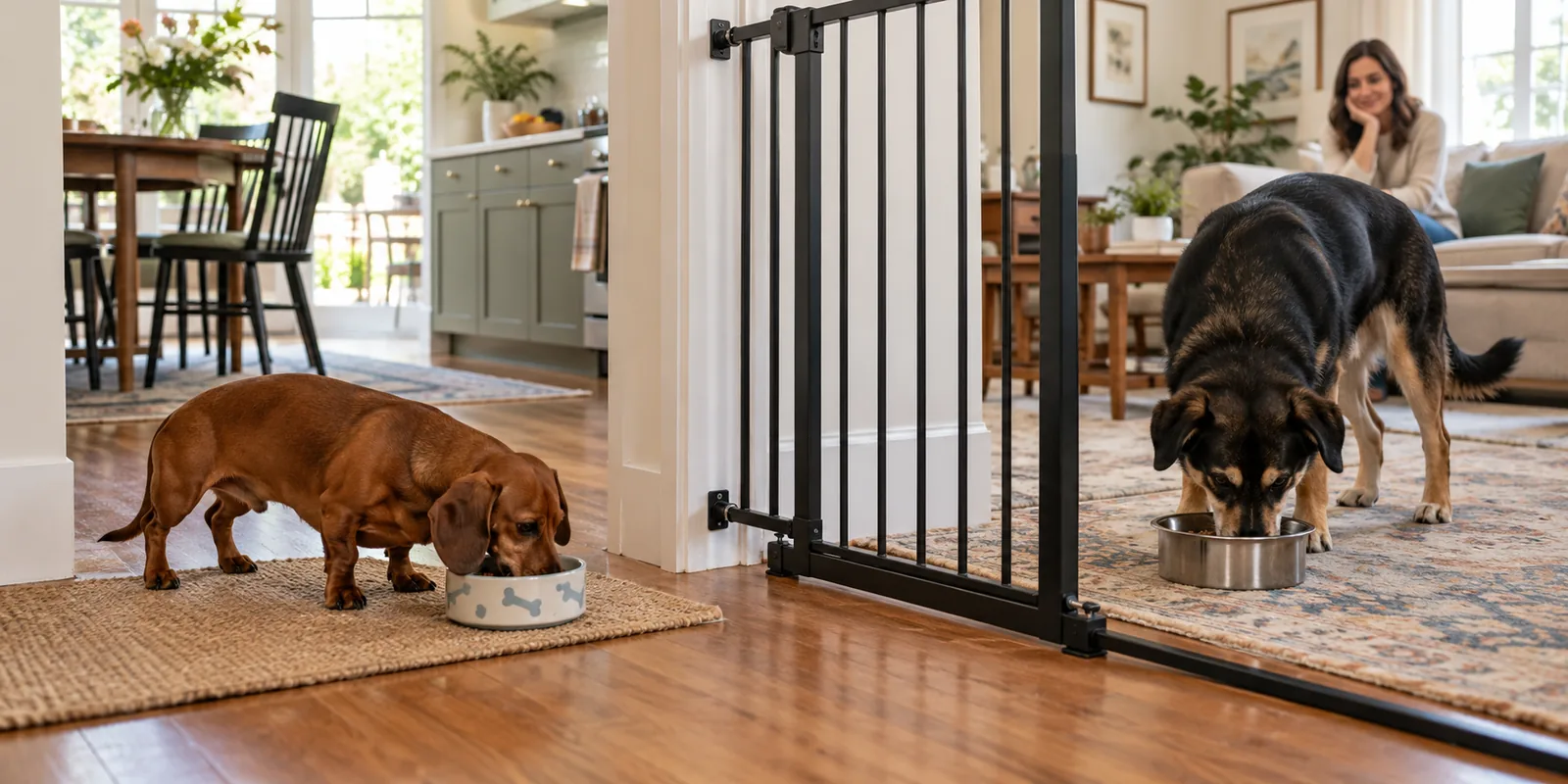
    Give each dog its own bed, feeding place, and quiet area. Pick up high-value chews, favorite toys, and food bowls during early shared time. Use gates or pens so the dogs can rest separately and so an adult can manage transitions. AKC’s introduction guidance specifically recommends gates, crates, or pens as management tools and close supervision.

    Feed separately at first, with doors or barriers closed if needed. A dog that has never guarded a bowl may still feel pressure when a stranger enters its home. Avoid testing whether the dogs can share a chew. Keep human attention predictable too; a dog should not have to push another away to access its owner.

    Walk the dogs separately sometimes, even after they become housemates. Each needs individual training and rest. A second dog is not a substitute for the first dog’s enrichment or companionship from people.

    Read the relationship over weeks

    Two dogs eating in separate spaces with a safety barrier between them

    Look beyond whether the dogs play. Can they stop play and rest? Can one walk past the other without tension? Does either block doorways, follow relentlessly, or prevent access to water or a resting place? Does the resident dog’s appetite or sleep change? An apparently quiet dog may be avoiding conflict rather than enjoying the arrangement.

    Short supervised sessions with breaks are often easier than a full day together. Increase freedom only after repeated calm behavior in several contexts. Return to separation if stress rises. The AKC notes that puppies may not understand an older dog’s communication, so adult management is important even when the puppy wants to play.

    Some pairs become close companions; others coexist peacefully with separate spaces; some should not share a home. Accepting that range is more humane than forcing a “best friends” story.

    Play, conflict, and when to get help

    Healthy play often includes loose bodies, pauses, and role changes. Intervene if one dog continually chases or pins the other, if the smaller dog cannot escape, or if play continues despite clear avoidance. Do not put hands between fighting dogs. Make a safety plan with a qualified professional if there has been serious conflict.

    Growling or a stiff body is information. Separate and investigate the trigger instead of punishing the warning. The AVSAB humane-training statement favors reward-based behavior support and discourages aversive methods. Repeated guarding, bites, or inability to settle deserve veterinary and professional behavior input; online advice cannot assess the dogs in person.

    A practical example

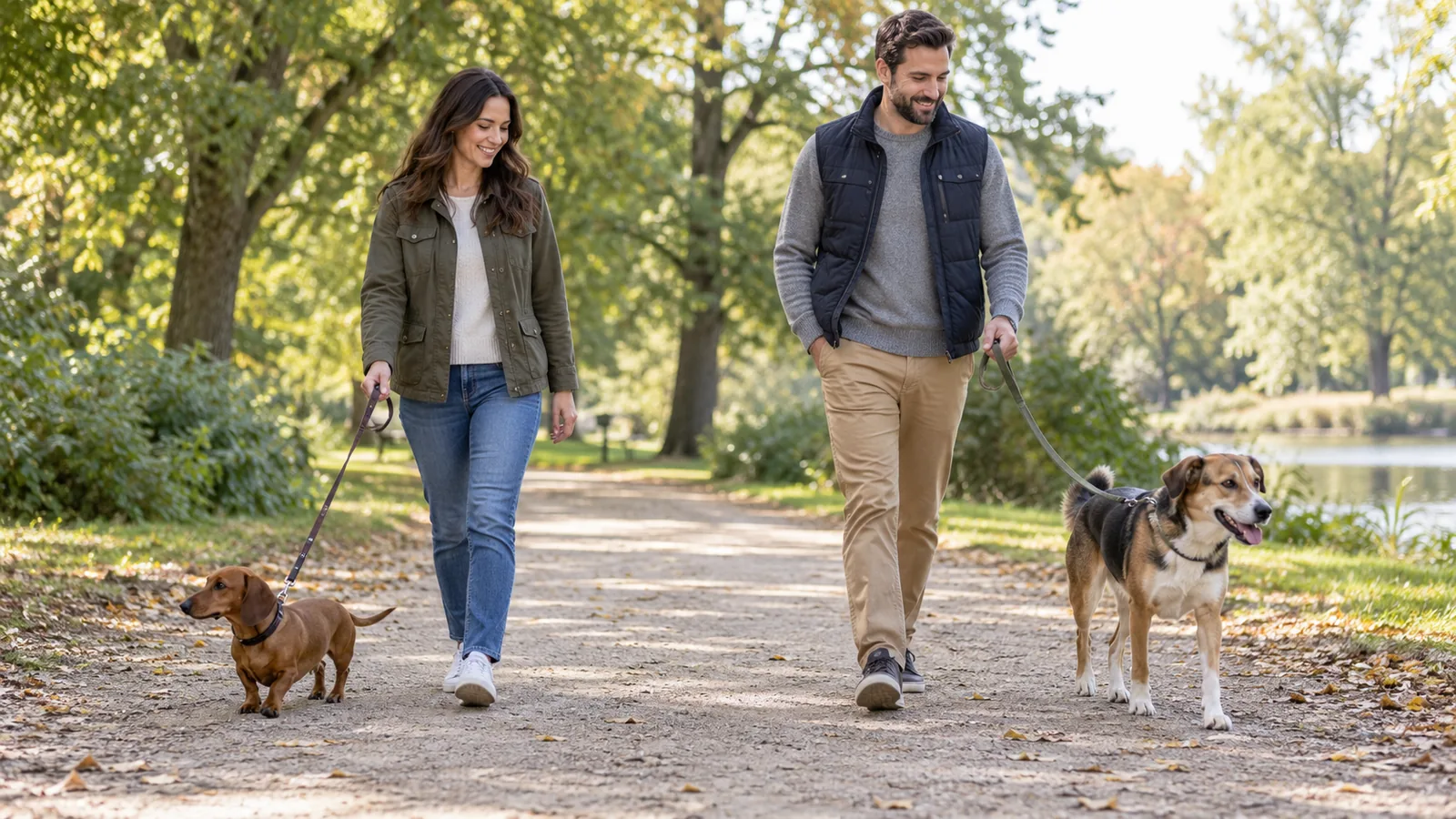
    Two dogs walk calmly side by side in a park. At home, the new Dachshund freezes whenever the resident dog approaches a sofa. Their outdoor meeting did not reveal a conflict over indoor resting space. The owner should separate the dogs, provide distinct beds, prevent competition around the sofa, and rebuild short calm sessions. Ignoring the freezing because “they got along outside” would miss a useful early signal.

    Frequently asked questions

    Are Dachshunds better with another Dachshund?

    Not necessarily. Similar size or breed does not guarantee compatible play, resource sharing, or rest. Evaluate both individuals and their histories.

    Should dogs meet off lead for the first time?

    Not by default. Humane World recommends separate handlers and controlled, neutral introductions. A qualified professional can advise when greater freedom is appropriate.

    Can I leave them alone after one good meeting?

    No. Use separate spaces when no one can supervise until a stable relationship has been observed over time. Some pairs may always need separation during absences.

    What if my Dachshund barks at dogs on walks?

    That is a separate trigger and training question. See the existing barking-at-other-dogs guide, while assessing household compatibility independently.

    Sources

  • Are Dachshunds Good With Cats? A Gradual Introduction Plan

    Are Dachshunds Good With Cats? A Gradual Introduction Plan

    Direct answer

    Are Dachshunds good with cats? Some can live peacefully with cats, but compatibility must be assessed and introductions managed. The breed’s hunting background means movement may capture a dog’s attention; that does not prove every Dachshund will chase a cat. Start with separate safe areas, let both animals settle, and progress through scent and controlled visual exposure before any close contact. Cats Protection recommends a cat-only safe room and gradual introductions rather than forcing the animals together.

    Whether Dachshunds are good with cats depends on the individual dog, cat, and management plan. The success standard is calm coexistence, not a dramatic photo of them cuddling on day one. Some pairs may never be safe without barriers when unsupervised. The individual dog’s history and ability to disengage, along with the cat’s comfort, matter more than a simple “good with cats” breed label.

    Check the dog’s history before adoption

    Ask the breeder, rescue, or foster home what the Dachshund has actually done around cats. Has it lived with a cat calmly, only seen one outdoors, or never been assessed? Did it stare, stalk, lunge, bark, or ignore the cat? A dog that is quiet while fixed on a cat is not necessarily relaxed. Ask how it responds when redirected and whether the cat had an escape route during any previous test.

    The Dachshund Club of America breed standard describes a hunting dog with a good nose and persistence. That history makes careful management sensible, but it cannot predict one dog’s behavior. A puppy that is gentle today still needs practice and supervision as it matures. An adult with a proven calm history may offer clearer information, though a new home changes context.

    Ask about the cat too. A confident adult cat with high resting places may cope differently from a fearful cat or fragile kitten. Do not expect the cat to “teach the dog a lesson.” Cats Protection advises against that kind of forced confrontation because it can stress both animals.

    Prepare the home before they meet

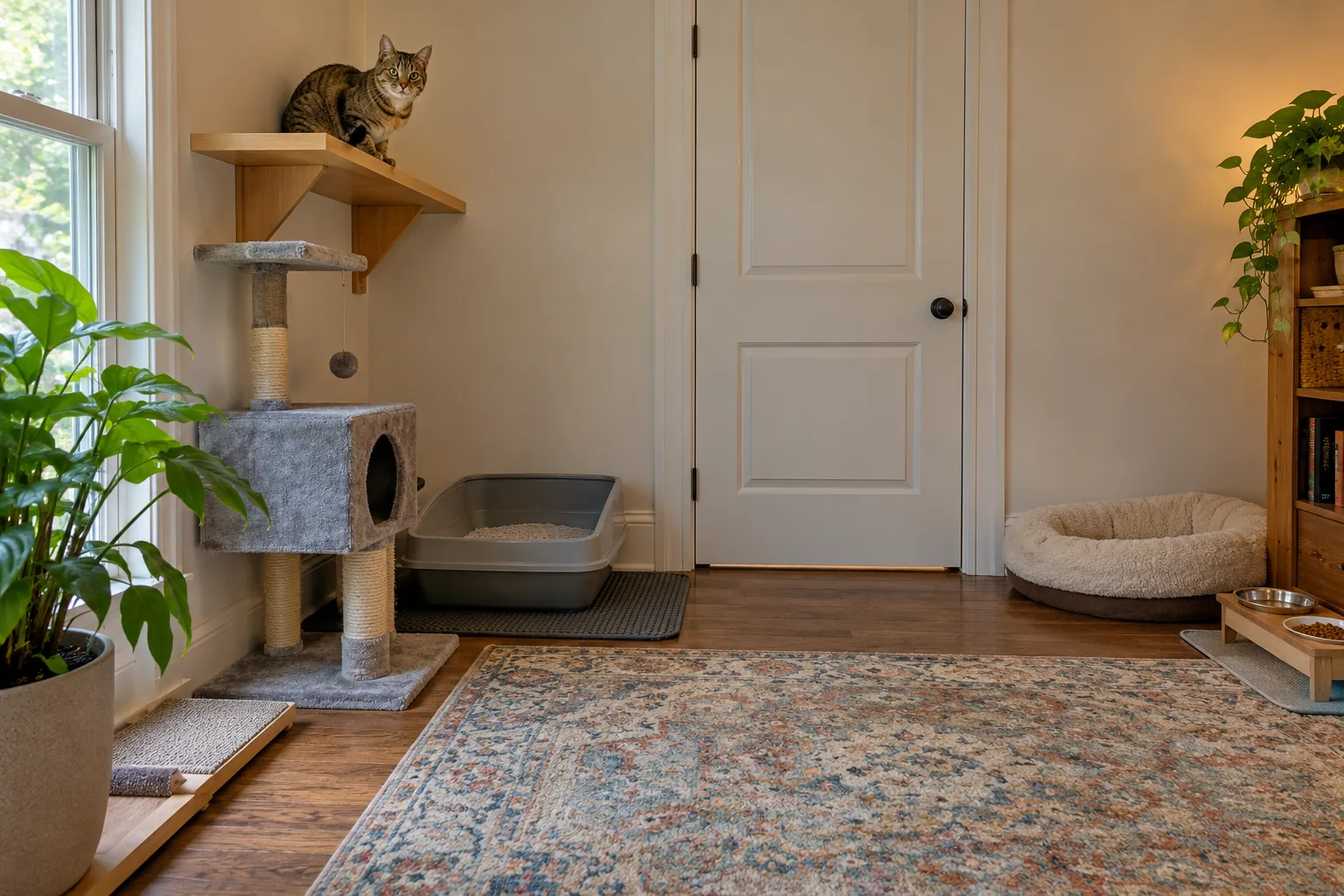
    Set up a cat-only room with food, water, litter tray, resting place, and hiding options. The dog should not be able to enter. Provide secure high routes or shelves in shared areas so the cat can leave without running past the dog. Use a door or well-fitted gate to control access; check that a small Dachshund cannot squeeze through gaps. Cats Protection recommends distinct spaces so a new cat can settle safely.

    The dog also needs its own rest area and routine. Keep the cat’s food and litter inaccessible to the dog. Plan where each animal will be when you are cooking, working, or asleep. Management is not a failure of training; it keeps both animals from rehearsing a frightening encounter while trust develops.

    If the dog is new to the home, allow it to settle before expecting cat introductions. If the cat is new, let it establish its safe room. Cats Protection’s introduction guidance recommends separation in the initial stages. There is no fixed number of days that suits every pair.

    Are Dachshunds good with cats? Start with a cat-only room and secure separation

    Stage the introduction

    Stage 1: Separate routines and scent. Let each animal eat, rest, and explore its own space. Exchange bedding or allow supervised access to a room after the other animal has left. If either stops eating or seems distressed, pause and reduce intensity.

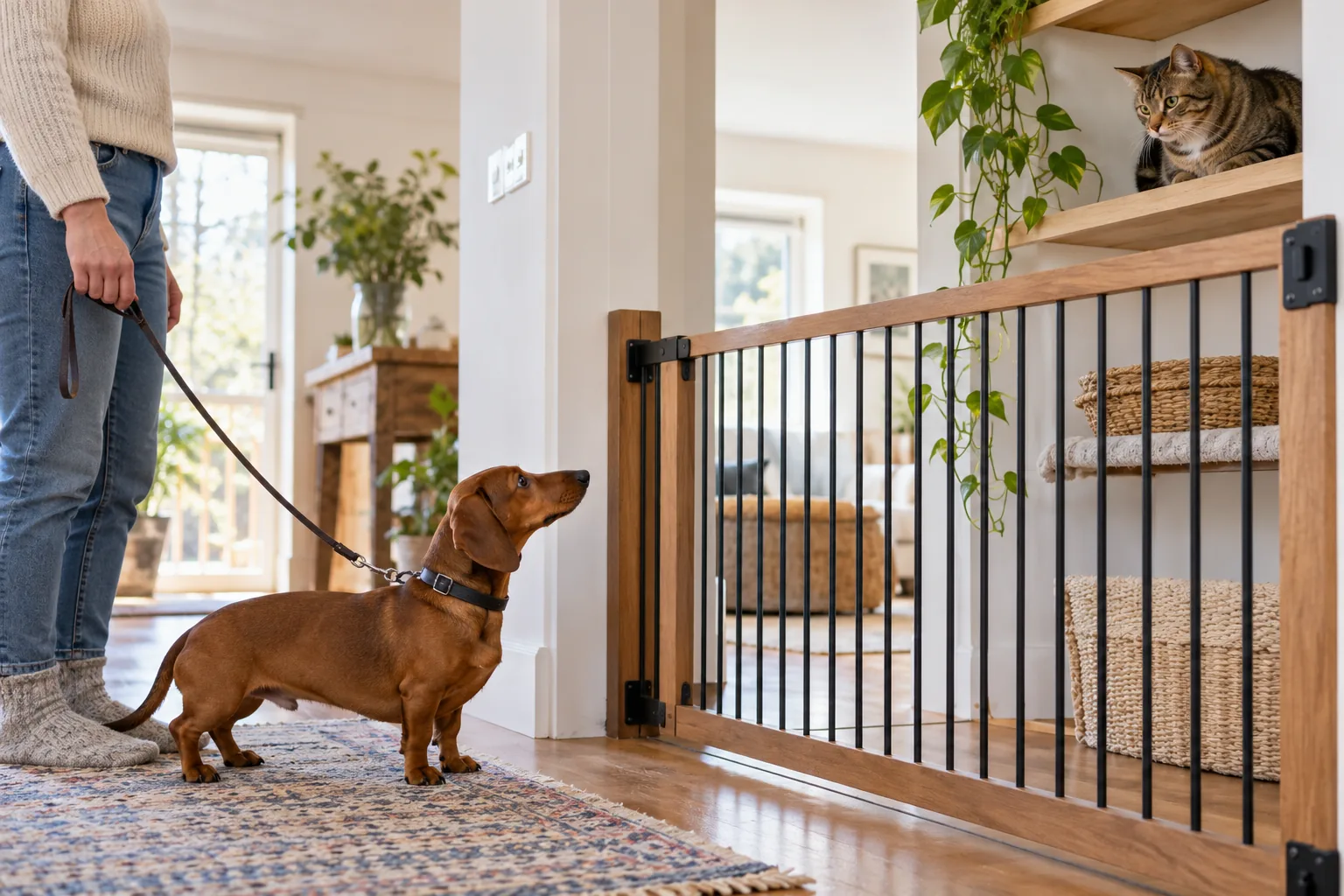
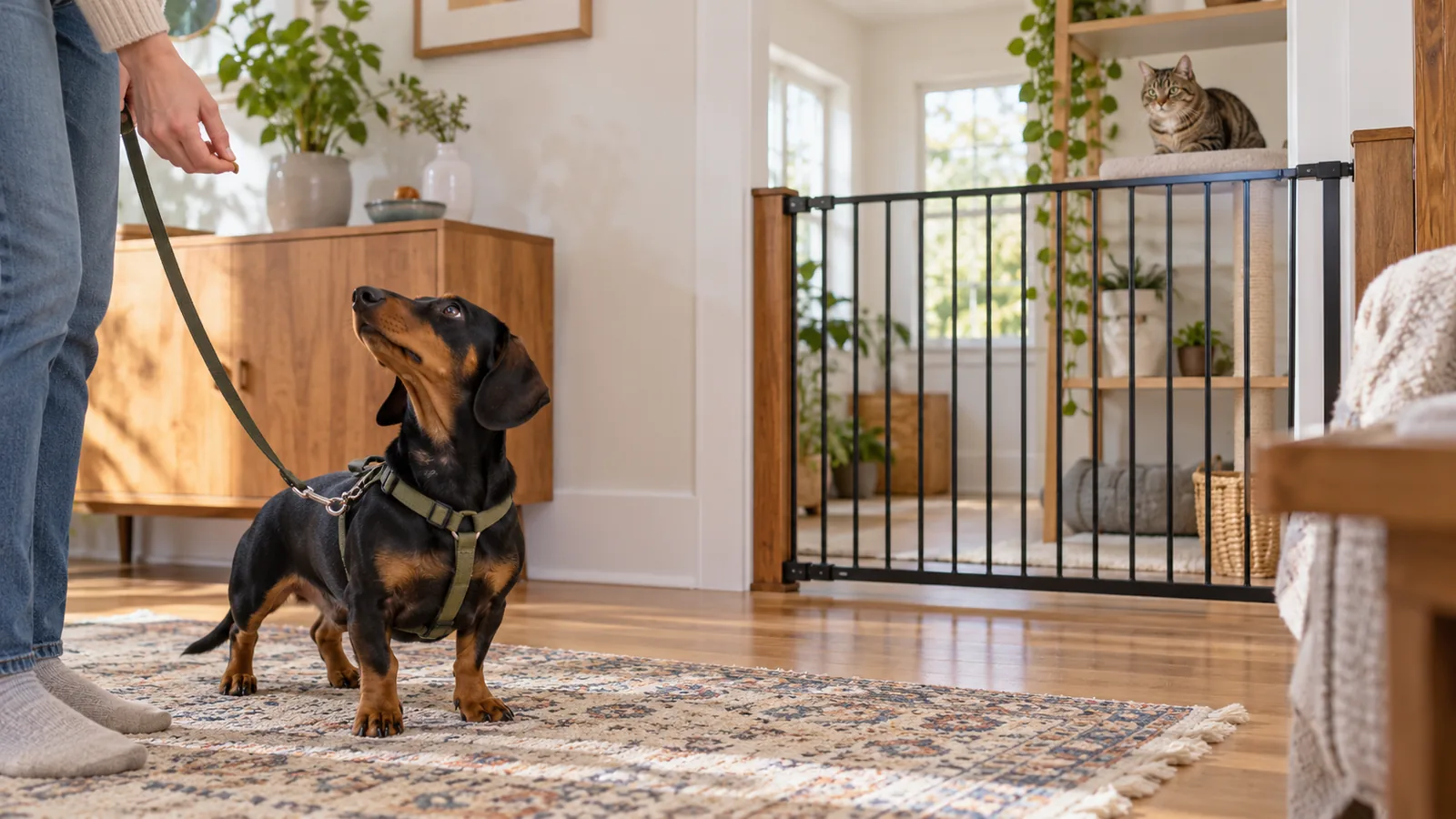
    Stage 2: Brief visual contact through a secure barrier. Let the cat choose whether to approach or leave. Keep the dog on lead or behind a secure barrier and reward calm attention to the handler. End sessions while both animals are still coping. Do not hold the cat in someone’s arms for a forced face-to-face meeting.

    Stage 3: Carefully managed shared space. Only when repeated barrier sessions are calm, allow a short session with the dog controlled and the cat free to retreat. Maintain distance. Reward the dog for looking away from the cat or settling. End before excitement rises. Return to the previous stage if either animal becomes tense.

    The Cats Protection guide supports gradual introductions, escape routes, and ongoing supervision. A successful moment does not justify leaving them loose together when no one is present.

    Watch both animals, not just the dog

    For the Dachshund, watch for fixed staring, stalking, lunging, repeated chasing attempts, or inability to respond to a familiar cue. A wagging tail alone does not prove harmless intent. For the cat, watch for persistent hiding, not using normal resources, crouching, hissing, or frantic attempts to escape. Stress may show in appetite and toileting routines, so check those as well.

    If either animal is overwhelmed, increase distance or return to separate rooms. Do not scold the dog for noticing the cat; teach and reward disengagement at a distance where learning is possible. The AVSAB humane-training statement supports reward-based behavior change rather than aversive methods. If the dog has chased or grabbed cats before, or cannot disengage even at a safe distance, consult a qualified behavior professional. Management may remain permanent.

    Dachshund turning toward its owner for a reward while a cat remains behind a gate

    Prevent the first chase

    Chasing can be exciting for a dog and terrifying for a cat. Do not wait for a chase to learn whether the animals are compatible. Check doors and gates before each session, use a secure lead where appropriate, and have one adult focus on the dog while another monitors the cat’s exits. Avoid introductions in a narrow hallway where the cat could be trapped.

    If a chase happens, separate calmly and check for injury. Do not immediately repeat the encounter to “end on a good note.” Give both animals time to settle and reassess the setup. The cat may need a veterinary check after contact even if no wound is obvious. A behavior professional can help create a safer plan, but no plan can guarantee every pair will become friends.

    Life after introductions

    Once the pair is calm in several settings, maintain separate resources and the cat’s escape options. Continue to supervise shared time. Cats Protection advises that dogs and cats should not be left together unsupervised. Households differ in how they use barriers over the long term; base your decision on observed behavior and professional guidance, not wishful thinking.

    Changes can unsettle a previously stable relationship: a new kitten, visitors, illness, pain, or a move. Reintroduce management when needed. A cat that suddenly hides or a dog that newly stalks deserves a closer look, including veterinary assessment where behavior changes abruptly.

    A practical example

    A resident cat watches from a high shelf while a newly adopted Dachshund explores the living room on lead behind a gate. The dog notices the cat, then takes a treat and turns back to the handler. After a short calm session, the dog leaves and the cat continues its normal routine. That is a better first step than placing them nose to nose. If the dog fixates and cannot turn away, increase distance and slow the plan.

    Frequently asked questions

    Are Dachshunds naturally bad with cats?

    No breed label determines every outcome. Their hunting history makes careful introductions sensible, but individual experience and management matter. Ask for actual cat history rather than a generic promise.

    How long should introductions take?

    There is no universal timetable. Progress only when both animals remain comfortable at the current stage. Cats Protection emphasizes settling and gradual exposure.

    Can a Dachshund and cat be left alone together?

    Do not assume so after a few calm meetings. Cats Protection recommends supervision and separate safe spaces. Some households will need permanent barriers during absences.

    What if my Dachshund chases the cat?

    Separate safely, check for injury, stop further rehearsal, and return to a more distant stage. Seek qualified help if the dog fixates, grabs, or repeatedly chases. Do not punish either animal for being frightened.

    Sources

  • Long-Haired vs Short-Haired Dachshund: Which Coat Fits Your Life?

    Long-Haired vs Short-Haired Dachshund: Which Coat Fits Your Life?

    Direct answer

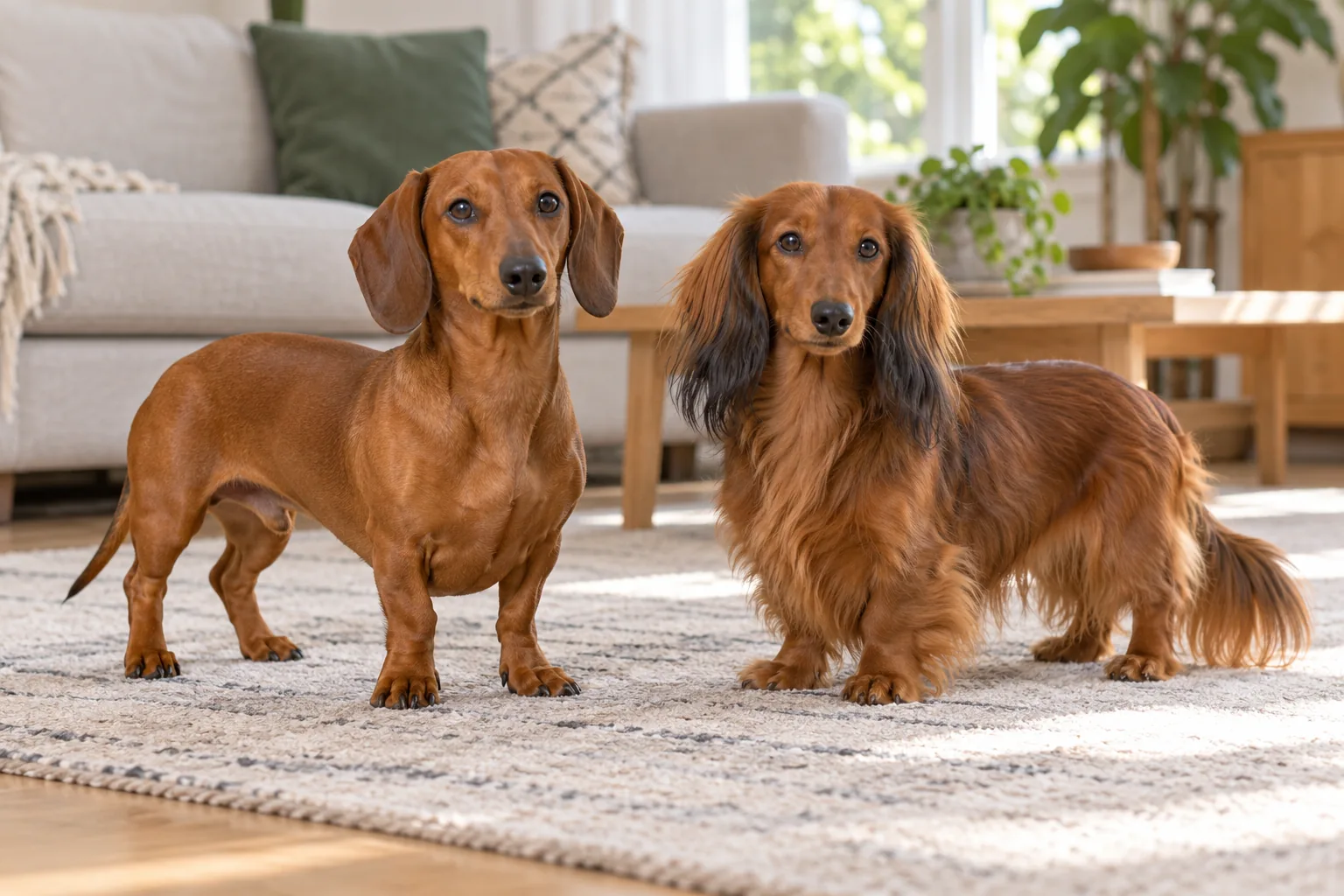
    Long haired vs short haired Dachshund is mainly a grooming-time decision, not a different breed. A smooth (short-haired) Dachshund has a short, close coat that is quick to wipe and inspect. A long-haired Dachshund has longer, often silky hair with feathering that needs more frequent attention, especially behind the ears, under the legs, and along the tail. Both need nail care, skin checks, suitable exercise, and back-aware handling. The Dachshund Club of America breed standard defines these as two of the breed’s three coat varieties; the AKC breed guide distinguishes their everyday grooming needs.

    Do not choose by a claim that long-haired Dachshunds are always calmer or smooth dogs are always bolder. The breed standard describes one Dachshund temperament across varieties. Individual personality, early experience, health, and training matter more to a household than a coat label alone.

    Question Smooth / short-haired Long-haired
    Daily look Close, smooth coat Longer, often silky hair with feathering
    Main maintenance Wipe, occasional brushing, skin inspection Brush and comb feathering; inspect for tangles
    After a wet walk Dry low chest, belly, and feet Dry those areas plus hair around ears, legs, and tail
    Visible debris Easy to spot on the surface Can hide in longer hair
    Best fit Owner who wants a simpler coat routine Owner willing to maintain a longer coat consistently

    These are care tendencies, not fixed schedules. Coat density and lifestyle vary from dog to dog.

    Coat feel

    The Dachshund Club of America standard describes the smooth coat as short, smooth, and shining. Long-haired dogs have a sleek coat with longer hair and feathering, not a uniformly floor-length coat. Those details matter because the hair most likely to tangle is often where a harness rubs or where a low Dachshund brushes against grass and mud.

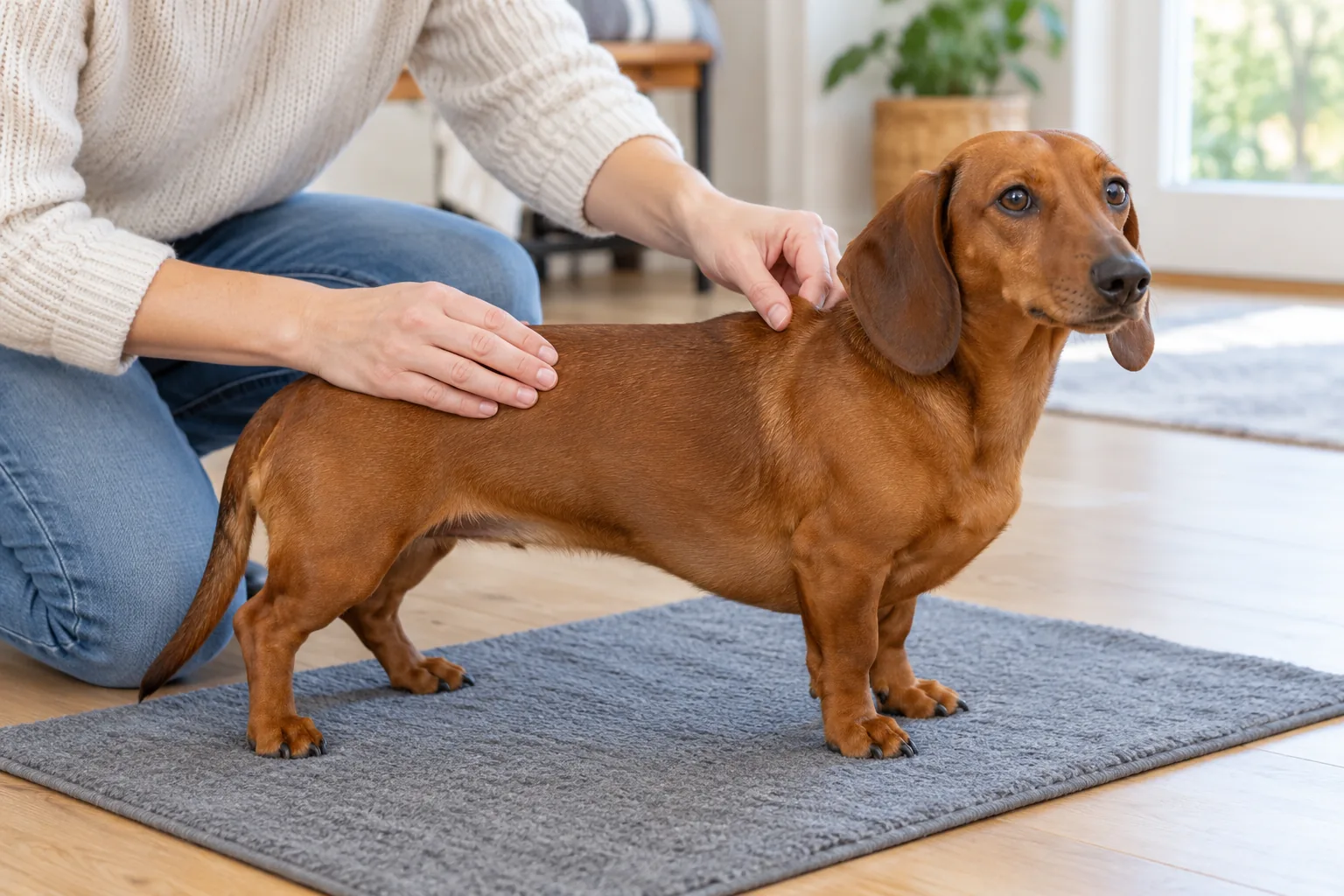
    Both varieties share the breed’s general body shape and needs, but their coats create different routines. A smooth coat is quicker to inspect for dirt or skin changes after a walk. Run a hand along the chest, belly, and ears rather than assuming short hair means no grooming. The AKC breed guide describes a smooth Dachshund as relatively low maintenance, often needing a wipe or hound glove to look tidy.

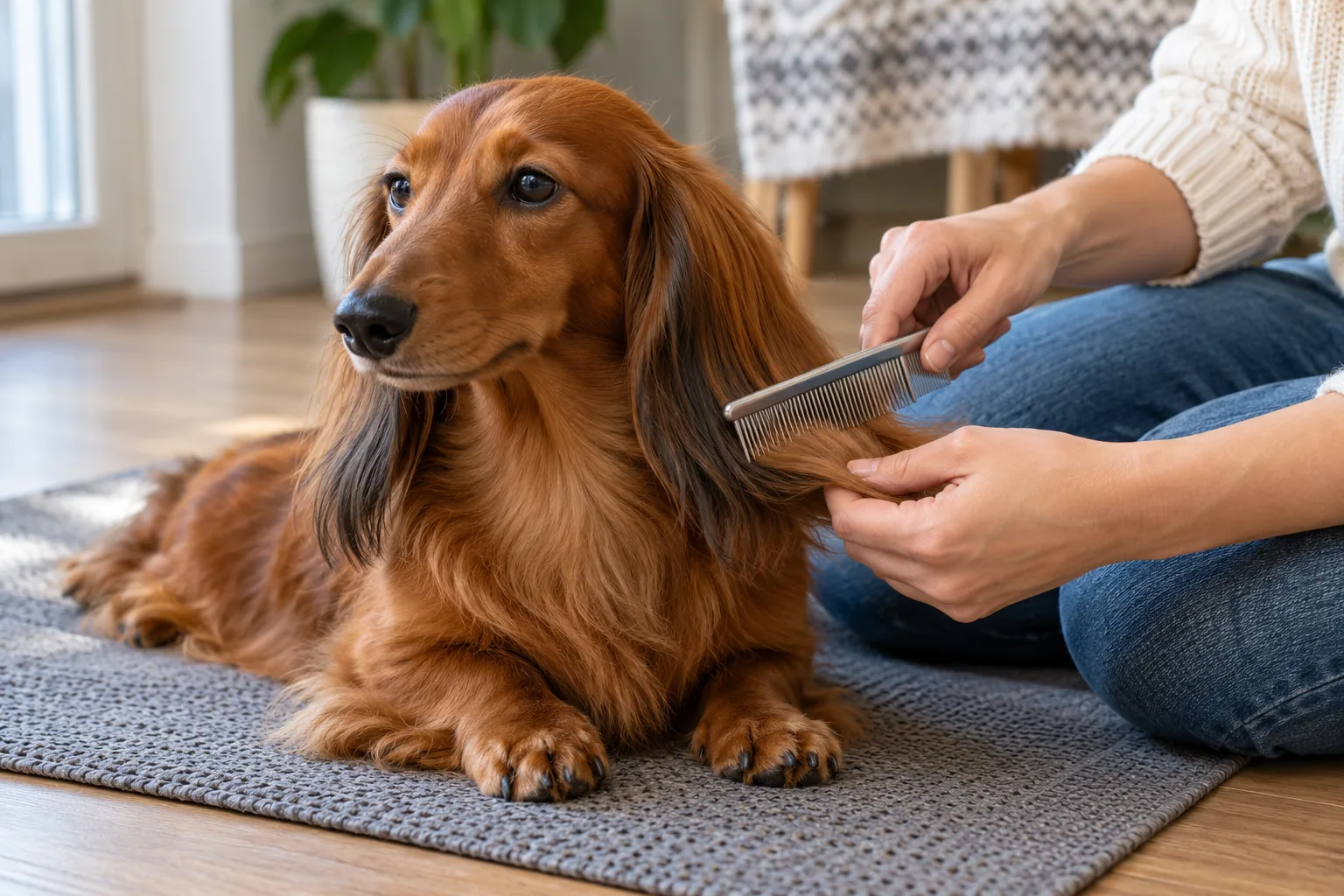
    For the long-haired dog, check the ears, armpits, chest feathering, backs of legs, and tail after wet or brushy walks. Separate the hair gently to look for debris or early knots. A small tangle is easier to address before it tightens into a mat. If the dog resists grooming or has painful skin, stop and ask a groomer or veterinarian how to proceed rather than pulling through it.

    Long haired vs short haired Dachshund: owner gently combing the feathering behind a long-haired Dachshund's ear

    A realistic weekly routine

    For a long haired vs short haired Dachshund comparison, a smooth-coat routine can be brief: wipe after muddy walks, use a soft grooming tool when loose hair builds up, inspect the skin, and check nails and ears. Short hair still sheds; “low maintenance” does not mean “hypoallergenic.” The AKC Dachshund guide calls Dachshunds moderate shedders across the breed and notes that grooming differs by variety.

    A long-haired routine needs more deliberate brush-and-comb sessions. Focus on feathering instead of repeatedly brushing the easy-to-reach back while missing hidden knots. Use a tool suited to the coat and follow with a comb to confirm it moves through the hair without snagging. The separate brush-selection guide covers tools; add its public link only after that article is live.

    Do not promise a universal number of brushing sessions per week. An adult with light feathering that walks on pavement may need less than one with a heavy coat that explores wet grass daily. Check the dog, then adjust the routine. A groomer can demonstrate a gentle technique for the individual coat.

    Grooming workload

    Choose based on the grooming work the household can sustain, not a promise that one coat has a better personality. A long-haired dog may benefit from regular brush-and-comb sessions and occasional professional help; a smooth dog still needs nail care, bathing when needed, and skin checks. The AKC’s lifestyle overview says long-haired and wire-haired varieties require more regular grooming than smooth dogs.

    Long haired vs short haired Dachshund: owner inspecting a smooth coat after a walk

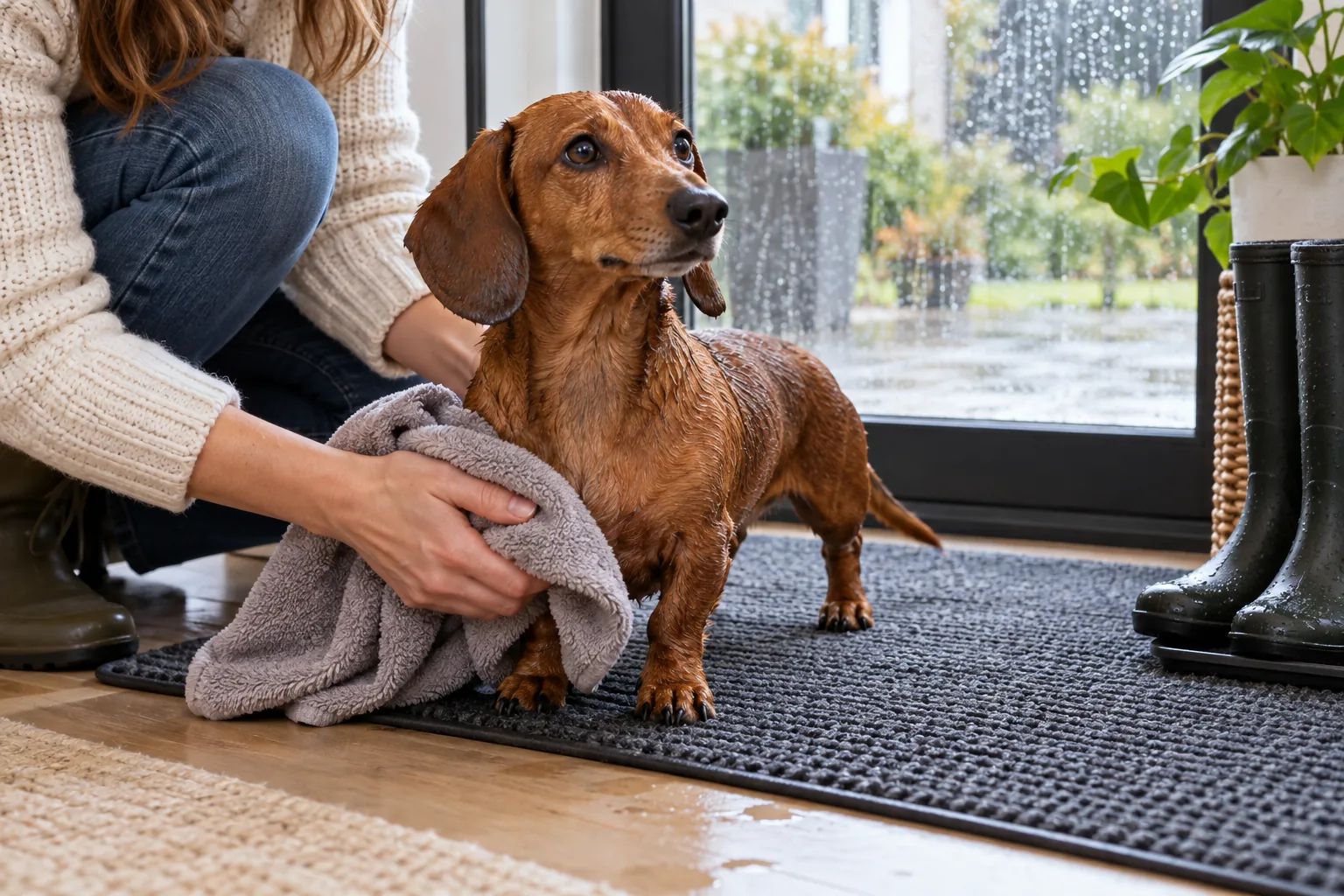
    In both coats, short legs put the chest and belly close to rain, mud, and road debris. A smooth dog may dry quickly after a light shower, while longer feathering can stay damp or hold grit. Towel the paws and underside, feel close to the skin, and let the coat dry fully. The separate rain-care guide can provide the step-by-step routine after that article is live.

    Cold or hot weather needs individual judgment. A long coat does not make a Dachshund immune to cold, and a smooth coat does not mean the dog always needs clothing. Watch for shivering, overheating, reluctance to walk, and discomfort. Dry wet clothing and coat rather than leaving moisture trapped under a jacket. Ask a veterinarian when weather tolerance or skin health is a concern.

    Choosing a match

    Meet adult examples of both coats if possible. Ask a breeder or rescue how often the particular dog needs brushing, whether the coat tangles, and how the dog responds to handling. For a puppy, plan for the adult coat rather than judging by one photo. The Dachshund Club of America’s breed standard can help you recognize what “smooth” and “long-haired” mean, but a breed standard does not tell you the exact grooming workload of one dog.

    Ask to watch a routine grooming session. Can the person show you how they check behind the ears and beneath the harness area? What does the dog do during brushing? Has the dog had ear or skin problems that require veterinary care? These questions are more useful than asking which coat is universally “better.”

    For a rescue dog, observe the current coat and comfort with touch rather than assuming a history from appearance. A neglected smooth dog may need medical skin care; a well-maintained long-haired dog may have an easy routine. Coat type is one part of the adoption decision, not a substitute for health and behavior assessment.

    A practical example

    An owner who walks in brushy parks might spend more time removing debris from a long coat than expected. Another may enjoy the routine and the appearance. Suppose two families both have 20 minutes before work: one wants a quick wipe after a city walk, while the other is happy to comb feathering after a park outing. Smooth may suit the first family’s routine, long-haired the second. Neither choice changes the need for training, exercise, weight management, or veterinary care.

    Frequently asked questions

    Do smooth Dachshunds shed?

    Yes. Their hair is shorter, but that does not mean a shed-free home. The AKC Dachshund guide describes the breed as moderate shedders. Regular cleaning and grooming still matter.

    Is a long-haired Dachshund always calmer?

    No coat label guarantees a temperament. The Dachshund Club of America standard sets a common breed temperament, not a separate personality for each coat. Meet the individual dog and ask about its behavior and upbringing.

    Which coat is easiest for a first-time owner?

    Smooth is usually the simpler grooming commitment, but the easiest dog depends on temperament, training needs, and household fit. A long-haired Dachshund is manageable if the owner can maintain the coat and seek grooming help when needed.

    Is this the same choice as miniature versus standard?

    No. Coat variety and size are separate breed dimensions. The breed standard recognizes three coats and two sizes. Compare size, exercise, handling, and housing needs separately.

    Sources

  • Dachshund Rain Care: A Calm Post-Walk Drying Routine

    Dachshund Rain Care: A Calm Post-Walk Drying Routine

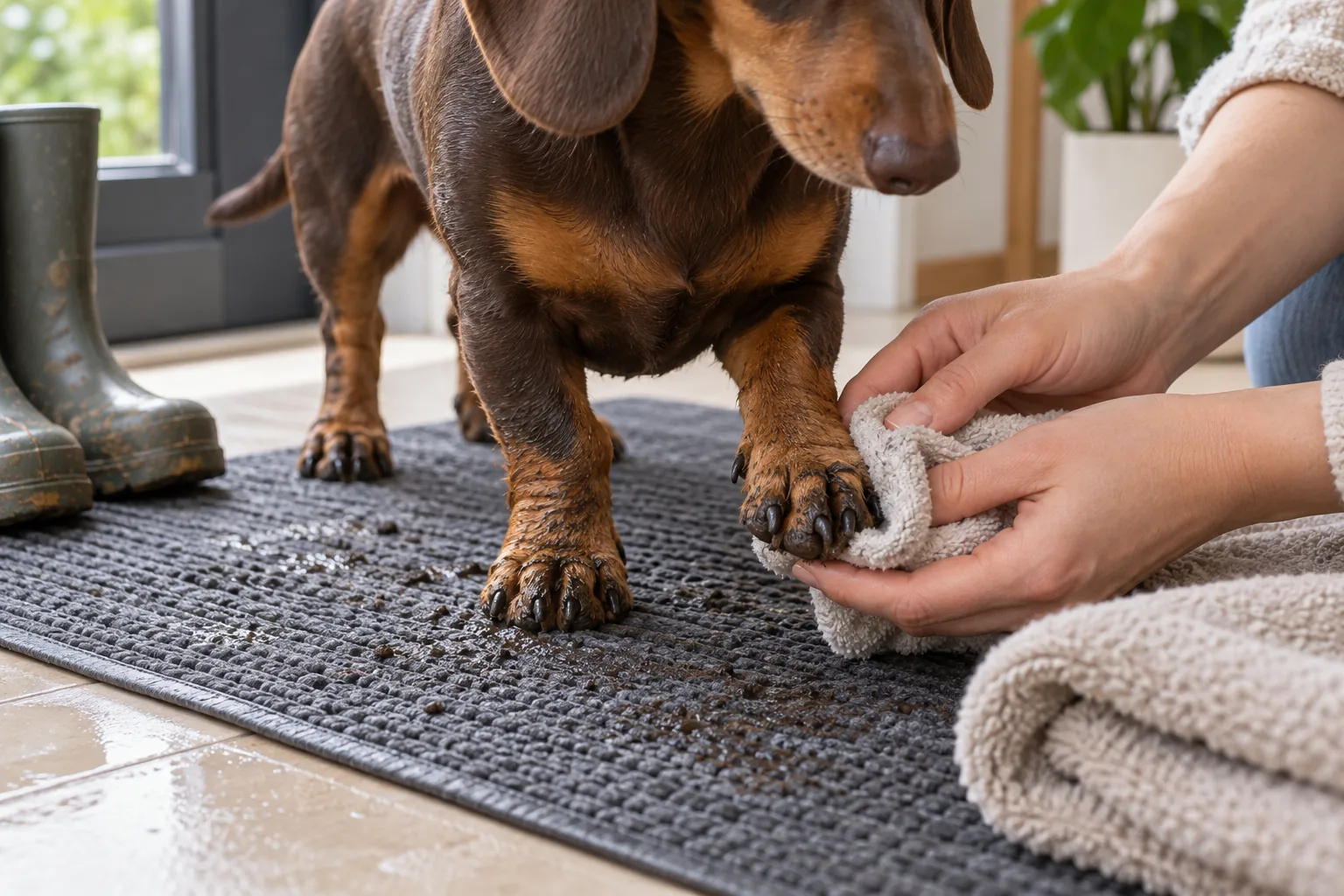
    Dachshund rain care does not require a full bath after every rainy walk. Most of the time, the useful routine is simpler: remove mud from the paws and low underside, dry the coat all the way through, check the outer ears, and keep the dog somewhere warm until dry. A long-haired dog needs particular attention to damp feathering that can tangle. The AKC guide to drying dogs explains that drying after damp-weather walks helps with comfort and gives owners a chance to inspect the skin.

    This Dachshund rain care guide is about wet-weather care after going outside, not about entertaining a dog indoors on a rainy day or treating a skin condition. If your dog has persistent itching, a strong odor, sore skin, head shaking, or ear discharge, cleaning alone is not an answer. The AKC at-home grooming guide identifies ear redness, swelling, debris, discharge, and bad odor as reasons to contact a veterinarian.

    Before the walk: make the return easy

    Place a towel and a non-slip mat by the door before you go out. Keep a second dry towel nearby if the rain is heavy or the dog has long feathering. Having supplies at the entryway means you can stop muddy paws from crossing the home without holding an anxious dog in place while searching for a cloth. It also gives a low, secure surface for a Dachshund’s long back and short legs; there is no need to lift the dog onto a slippery counter.

    Look at the conditions, not just the forecast label. Light rain on a mild day is different from cold wind, standing water, or a thunderstorm. Shorten or postpone the walk when conditions make the dog cold, frightened, or unsafe. A properly fitted waterproof coat may make some dogs more comfortable for a necessary toilet trip. The AKC guidance on toileting in bad weather suggests a waterproof coat as one possible way to reduce rain discomfort, but it is optional rather than a requirement.

    Fit matters more than the clothing label. A coat should not rub the underarms, restrict the shoulders, trap muddy water against the belly, or prevent the dog from toileting. Remove it when you come inside and dry the hair beneath it. A coat can reduce how wet the back becomes; it cannot replace cleaning the paws and low chest. If the dog freezes or struggles in clothing, work on gradual acceptance or skip the coat and make the outdoor trip shorter.

    Choose the least messy, safest route available. Avoid puddles of unknown depth and places where a small dog cannot step securely. In cold-weather regions, de-icing chemicals are an additional paw concern; the ASPCA’s cold-weather advice warns about salt and chemicals on paws and recommends cleaning them after walks. The same post-walk habit is useful for ordinary mud even when no chemicals are present.

    A five-minute return-home sequence

    1. Let the dog stand on the non-slip mat and remove any wet coat or harness.
    2. Wipe or rinse visible mud from each paw, including between the toes and around the pads, then dry it.
    3. Towel the low chest, belly, underarms, legs, and tail before the dog lies down on furniture.
    4. Check the outer ears and dry visible moisture gently; do not insert a swab into the ear canal.
    5. Feel the coat close to the skin in damp patches, and continue drying until it is no longer clammy.

    This is a sequence, not a rigid timer. A short-haired Dachshund caught in a brief shower may be dry quickly; a long-haired dog soaked through its chest and tail needs more attention. The AKC drying guide distinguishes towel drying from the extra drying that a longer or thicker coat may need. The AKC bathing guidance also recommends keeping a wet dog warm until completely dry.

    Paws: clean first, then dry

    Start with the feet because mud and grit can be carried into the house and held between toes. Use a soft damp cloth for ordinary dirt, or a small amount of clean, comfortably warm water if the mud is thick. Spread the toes gently enough to see what you are cleaning; do not dig at the skin. Blot each paw with a dry towel, paying attention to the spaces between toes. The AKC discussion of yeast dermatitis specifically recommends cleaning and drying feet after rain or mud.

    Dachshund rain care: wiping muddy paws on a non-slip entryway mat

    While cleaning, look for a pebble, thorn, cut, swelling, or a dog that repeatedly licks one foot. If a foreign object is embedded or the dog is clearly painful, ask a veterinarian for help. The AKC at-home grooming guide recommends veterinary advice rather than trying to remove foreign material from paw pads yourself.

    There is no reason to shampoo healthy paws every time they get wet. Frequent washing with an unsuitable product can complicate a skin-care routine, and clean water or a damp cloth is usually enough for simple mud. If the dog walked through salt, chemicals, or an unknown substance, rinse the feet thoroughly and prevent licking until clean; ASPCA cold-weather guidance is particularly clear about the risk from ice melts. Call a veterinarian or pet poison service promptly if you suspect exposure to a hazardous substance.

    Dry the Dachshund’s low underside, not just its back

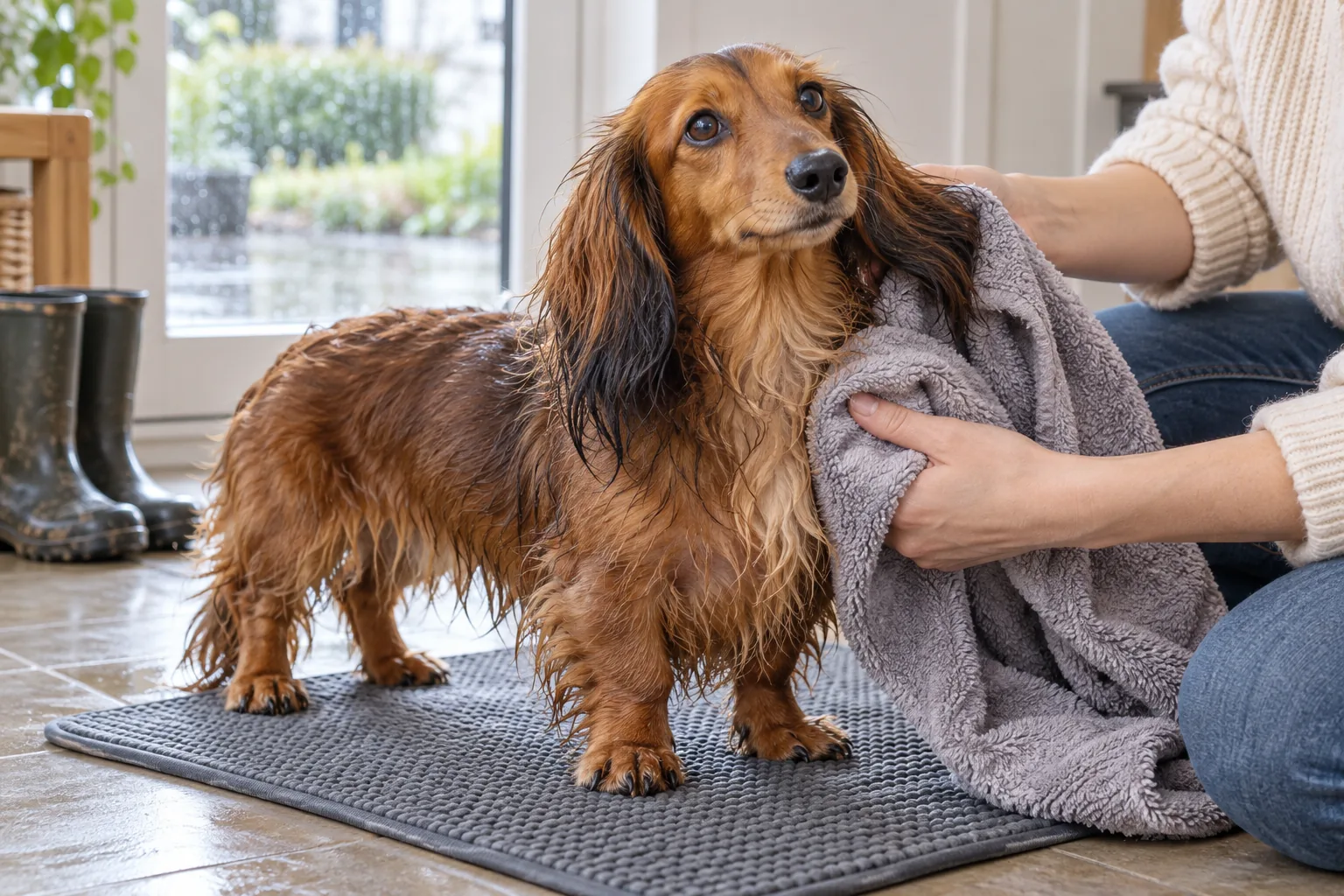
    Because a Dachshund is low to the ground, the chest, belly, forelegs, and tail can be wetter than the back. Work from the upper coat down and blot rather than rubbing vigorously. Lift the front leg only as much as the dog comfortably allows so you can reach the underarm. Keep the dog standing securely instead of twisting its body to reach a patch. AKC’s drying guide recommends towel drying in a way that reaches the coat thoroughly and uses the process to inspect the skin.

    On a smooth-haired Dachshund, a towel may be enough after a light shower. Feel the low chest and belly to be sure. On a long-haired Dachshund, separate the hair gently at the chest, underarms, behind the ears, and tail feathering; those areas can remain damp beneath a dry-looking surface. The AKC guide notes that longer, thicker coats may need a towel first and a suitable dog dryer to finish. Use only a setting and distance the dog tolerates, and never aim hot air at the skin.

    Owner towel-drying the chest feathering and outer ears of a long-haired Dachshund after rain

    Once the coat is dry enough to handle comfortably, check feathering for tangles. Damp hair can mat when it is rubbed by a harness or left bunched against the body. Do not pull through a knot. The AKC drying article identifies mat prevention as one reason to dry thoroughly. For the brushing routine and tools, see the existing long-haired Dachshund brushing guide.

    Ears: dry the outside and watch for symptoms

    Dachshunds have hanging ears that can hold moisture on the outer flap. After rain, blot the visible outer ear and the hair around it with a soft towel. Do not push cotton swabs into the canal or pour in a cleaning solution simply because the dog was outdoors. The AKC at-home grooming guide says ears should be dried after they get wet and lists signs that warrant veterinary assessment.

    An occasional head shake immediately after a damp walk may simply be the dog clearing water from its coat, but repeated head shaking, scratching, marked redness, discharge, swelling, or a strong smell is different. Contact a veterinarian rather than trying to mask the odor. The AKC ear-care discussion links those signs with possible ear trouble requiring examination.

    Does the dog need a bath after rain?

    Not automatically. A shower that wets an otherwise clean coat calls for drying, not necessarily shampoo. A dog covered in sticky mud or an unknown contaminant may need a more thorough rinse or bath. Use a dog-formulated shampoo according to its instructions and rinse completely; the AKC bathing guide stresses thorough rinsing and drying. Avoid turning every wet walk into a full bath that the dog dreads.

    If the coat repeatedly smells strong after drying, the skin is greasy, or the dog scratches a great deal, do not solve it by bathing more often. Those are reasons for a veterinary conversation. The AKC yeast-dermatitis article describes how moist environments and underlying conditions can contribute to skin problems; it is not a basis for diagnosing your own dog from a smell alone.

    When weather changes the plan

    A dog that hates rain still needs humane, predictable toilet opportunities. Try a sheltered spot, a shorter trip, or a coat that the dog accepts. The AKC bad-weather potty guide discusses helping dogs feel comfortable outdoors rather than punishing avoidance. A frightening storm or dangerous conditions are reasons to prioritize safety and resume the routine when conditions improve.

    Watch for shivering, reluctance to move, or a dog that seems unwell after getting soaked, particularly in cold wind. Move the dog to a warm dry place and seek veterinary advice if symptoms persist or are severe. The ASPCA cold-weather safety guidance notes that cold rain and winter exposure can be hard on pets; it does not supply a single temperature threshold for every Dachshund.

    Frequently asked questions

    Should I use a hair dryer after every rainy walk?

    No. A towel may be sufficient for a lightly wet smooth coat. A longer or soaked coat may need further drying, using equipment and settings the dog tolerates. AKC’s drying guide describes both methods. Avoid hot air close to skin.

    Is a raincoat enough to keep my Dachshund dry?

    A coat may reduce water on the back, but the paws, low chest, belly, and hair beneath straps can still be wet. Remove the coat and check those areas after the walk. AKC’s rainy potty-training advice frames a coat as a comfort aid, not a replacement for post-walk care.

    Can I leave a wet harness on while the dog dries?

    Remove a wet harness when you get inside so you can check and dry the coat beneath it. This is a practical inference from the AKC’s recommendation to dry the coat thoroughly, especially where fabric holds moisture against the chest and underarms.

    What if the dog keeps licking a paw after a muddy walk?

    Clean and dry the paw, look for visible irritation or debris, and contact a veterinarian if licking continues, there is pain, swelling, a wound, or something embedded. The AKC grooming guide advises veterinary help for foreign objects in paw pads.

    Use how often to bathe a Dachshund for routine bath frequency and Dachshund grooming for the broader coat-care routine. This page answers a narrower question: what to do before and after a wet, muddy outing. is about indoor activities on rainy days, not cleaning the dog after going outside.

  • Best Shampoo for Dachshunds: Choose for Skin, Coat, and Bath Routine

    Best Shampoo for Dachshunds: Choose for Skin, Coat, and Bath Routine

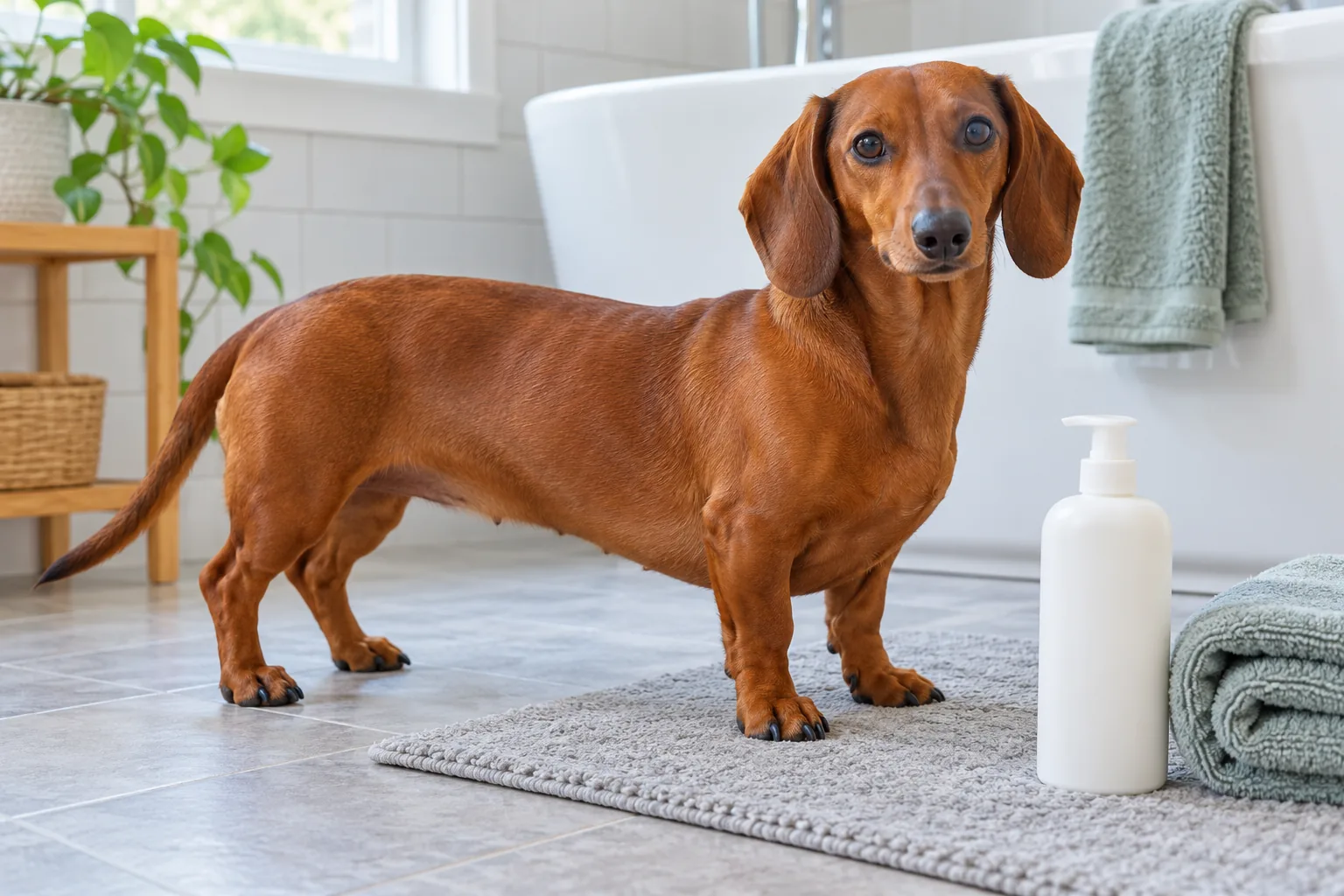
    The best shampoo for Dachshunds is a dog-formulated product that cleans without leaving the individual dog’s skin irritated. Start with a gentle routine formula if the skin is healthy. A dog with persistent itching, redness, greasy patches, a recurring odor, or repeated ear trouble needs a veterinary assessment before you try to solve the problem by switching shampoos. The American Kennel Club’s shampoo guide recommends matching the product to the dog’s skin needs and rinsing it out thoroughly; the AAHA allergy guide explains why persistent itch can have several underlying causes.

    There is no one bottle that is best for every Dachshund. A smooth coat, a long coat that holds water around the chest and tail, and a wire coat with furnishings can all be washed, but the brushing and drying work around the bath differs. The AKC Dachshund breed profile identifies the three coat varieties and their different grooming needs. That is a reason to plan the whole bath, not a reason to buy three different shampoos automatically.

    A quick selection guide

    Your Dachshund Sensible starting point What would change the decision
    Healthy skin, occasional dirt Gentle dog shampoo with clear directions and a scent you can tolerate Redness, scratching, or a coat that feels dry after a well-rinsed bath
    Long-haired coat with tangles Brush and separate knots before bathing; choose a formula that rinses easily Tight mats, persistent dampness near skin, or discomfort during grooming
    Sensitive or itchy skin Ask your veterinarian whether a fragrance-free routine product is appropriate Recurrent itch, rash, ear signs, odor, or suspected infection
    Diagnosed skin disease Follow the veterinarian’s prescribed product and contact time Worsening symptoms or uncertainty about whether to combine products

    This table is a selection framework, not a diagnosis. Merck Veterinary Manual notes that medicated products have specific directions and that shampoo residue can irritate skin. The important distinction is routine cleaning versus treatment: a cosmetic label cannot tell you which infection, allergy, or other condition a dog has.

    Read the label before the price tag

    When comparing the best shampoo for Dachshunds, look first for a product intended for dogs and directions you can follow. Check whether it is a routine cleanser, a medicated product, or a concentrate that needs dilution. A pleasant fragrance is not evidence that it will suit your dog. Strong scent can also make it harder to notice a recurring odor after bathing. AKC explains why shampoos formulated for people are a poor default for repeated dog baths and recommends a dog-specific product.

    Next, read how long the product should remain on the coat. Routine shampoos are generally rinsed after washing, while a prescribed medicated shampoo may have a contact time chosen for a particular skin problem. Do not copy a medicated schedule from another dog or an old bottle. If your Dachshund is already under treatment, ask the prescribing veterinarian whether any additional routine shampoo is appropriate. Merck’s skin-treatment guidance describes why application and thorough rinsing matter.

    Finally, assess practical details. Can you wet the coat completely, distribute the product without a large amount, and rinse every area? Is the bottle easy to handle with one hand while the other supports a small dog on a non-slip surface? A product that is difficult to rinse may be a poor fit for a long-haired dog even if its marketing sounds appealing.

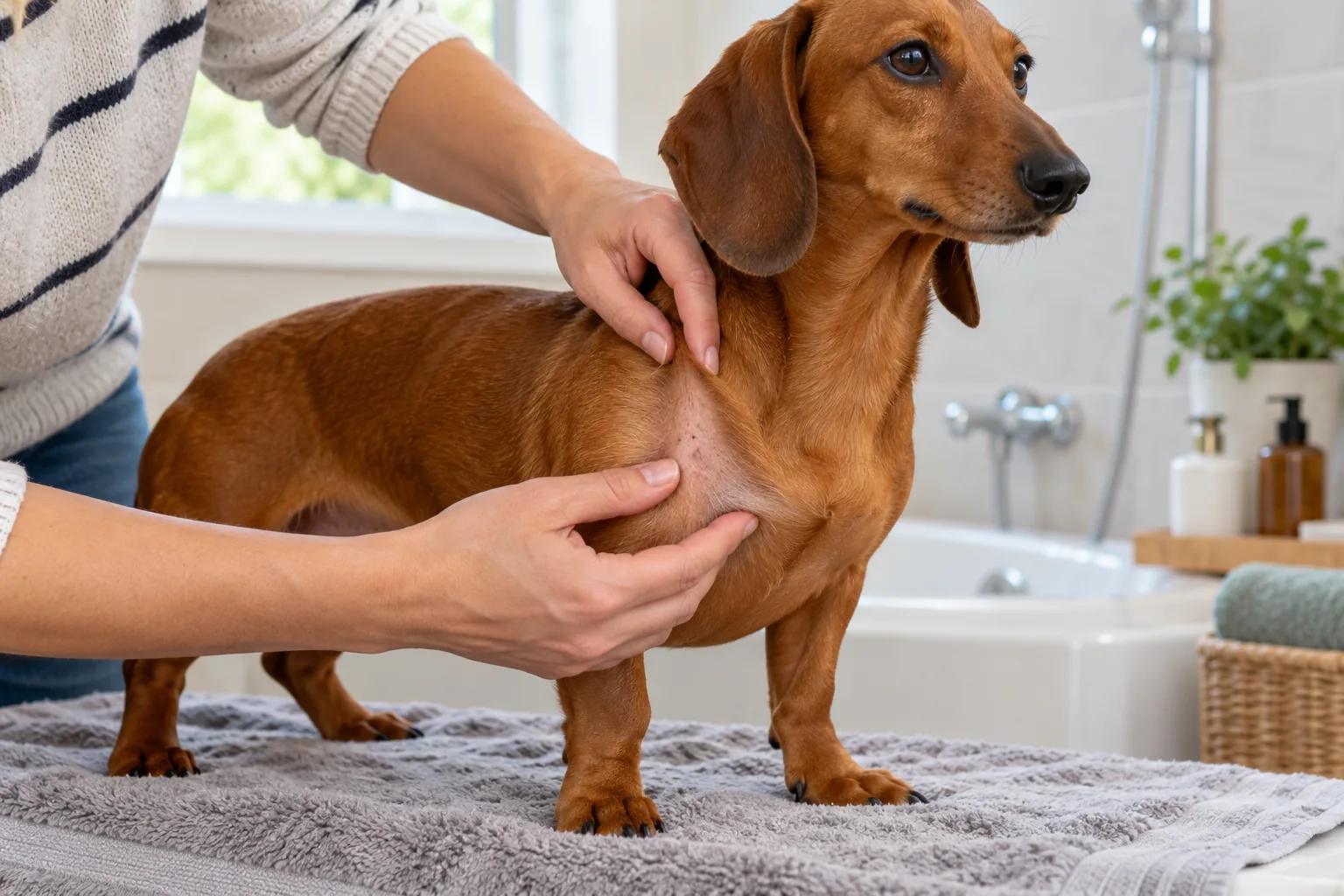
    Check the skin before bathing

    Part the coat at the chest, belly, underarms, and around any area your dog scratches. Look for redness, flaky or greasy patches, sores, unusual hair loss, or a strong odor. Note whether the ears are red or the dog shakes its head. A bath may remove surface dirt, but it does not identify the cause of a skin or ear problem. AAHA’s overview of canine allergies describes itching and recurrent ear or skin problems as reasons to seek veterinary care.

    Best shampoo for Dachshunds: owner checking a calm Dachshund skin and coat before bathing

    If the skin looks healthy and the dog simply needs cleaning, brush out loose hair and tangles first. Water can tighten an existing mat, and a wet knot is harder to work through without pulling. The AKC bathing guide advises brushing before a bath. A painful, tight mat close to the skin is a reason to ask a groomer for help rather than cutting at it with household scissors.

    Wash and rinse without leaving residue

    Prepare towels, a non-slip surface, and the product before bringing the dog into the bathing area. Use comfortably warm water, wet the body, and work the shampoo through the coat as directed on its label. Keep lather away from the eyes and avoid flooding the ear canals. Move slowly enough that the dog can stand securely; a Dachshund should not need to twist or leap to escape the tub.

    Rinsing is often the deciding step. Work from the upper body down, then check the low chest, belly, underarms, feet, and tail where foam can remain. On a long-haired dog, separate feathering gently so water reaches through the hair. Continue until the coat no longer feels slippery and you cannot find trapped suds. Merck specifically warns that leftover shampoo can irritate skin.

    There is no useful universal rule that every Dachshund must be bathed on a fixed calendar date. Dirt, coat type, activity, skin health, and any veterinary treatment plan all matter. If a dog becomes itchy after frequent bathing, review the product and routine with a veterinarian rather than simply increasing the number of baths.

    Dry the whole coat, not only the back

    Blot with a towel instead of rubbing long feathering into knots. Check the chest, belly, feet, tail, and behind the ears. Let the dog finish drying in a warm, comfortable space and replace damp bedding. A smooth coat may feel dry quickly while a long coat remains damp close to the skin. The AKC Dachshund profile notes that long-haired dogs can require more brushing; post-bath detangling should be gentle and done when the dog is comfortable.

    Owner using a soft towel to dry the chest and long feathering of a Dachshund after a bath

    Watch the dog after the bath. A brief shake is ordinary, but persistent scratching, new redness, a return of strong odor, or discomfort when a particular area is touched needs attention. Record the shampoo name and the timing of the signs so the veterinary team can assess the pattern. Do not cover a returning odor with perfume.

    Three common buying mistakes

    Choosing by fragrance alone. A scented coat can still be irritated or damp underneath. Judge the result by comfort, skin appearance, and how thoroughly the product rinses.

    Using a medicated shampoo without a diagnosis. Different problems need different approaches. A label that says “antifungal” or “allergy relief” is not proof that it matches your dog’s condition. See your veterinarian for recurrent signs; AAHA outlines why allergy-like symptoms need a proper workup.

    Blaming the formula for a rushed bath. Even a suitable shampoo can leave the dog uncomfortable if knots were not brushed, suds remain, or a long coat stays damp. Check the whole process before buying another bottle.

    Frequently asked questions

    Can I use human shampoo once?

    A dog-formulated shampoo is the better routine choice. Human shampoos are formulated for different skin conditions and may contain additives that irritate canine skin. If you have already used one and your dog shows redness or itch, rinse thoroughly and seek veterinary advice if symptoms persist. AKC discusses the distinction here.

    Does a long-haired Dachshund need a special shampoo?

    Not automatically. The long coat changes the amount of brushing, rinsing, and drying you may need to do. Start with the individual dog’s skin condition and choose a dog shampoo you can rinse completely. Use the long-haired brushing guide for coat technique; this article focuses on shampoo selection.

    What if the dog still smells after bathing?

    Check whether the coat or bedding stayed damp and whether the odor comes from one area, such as the ears, mouth, or skin. A recurring or strong odor, especially with itch or redness, deserves a veterinary exam. The site’s Dachshund grooming guide covers routine care, while this guide helps choose and use shampoo.

    The decision in one minute

    For a Dachshund with healthy skin, buy a gentle dog shampoo whose directions you can follow, brush before bathing, rinse fully, and dry the entire coat. If itch, redness, recurring odor, or ear signs are already present, make the veterinary question the first step. The best shampoo is the one that fits this dog’s skin and this owner’s bath routine, not the bottle with the loudest promise.

  • Dachshund Dental Problems: Complete Dachshund Owner Guide

    Dachshund Dental Problems: Complete Dachshund Owner Guide

    Dachshund Dental Problems: Complete Dachshund Owner Guide is a health article, so it needs a careful, source-backed, veterinary-first tone. The focus keyword is dachshund dental problems. This local draft should help owners recognize patterns, protect the dog, and know when to call a veterinarian, not diagnose from a blog post.

    Dachshund health check context for dachshund dental problems

    Quick answer

    Dachshund dental problems often show up as bad breath, tartar, red gums, chewing changes, drooling, pawing at the mouth, or tooth pain. Daily care and veterinary dental exams matter because dental disease can hide until it hurts.

    SignOwner actionDo not
    Mild or gradual signTrack timing, activity, appetite, and comfortSchedule a veterinary check if it persists
    Sudden pain or weaknessRestrict movement and call your vetDo not wait to see if it passes
    Back or leg changeAvoid stairs, jumping, and rough handlingUse a carrier if needed
    Emergency red flagCollapse, paralysis, severe pain, eye trauma, or loss of bladder controlGo to emergency care

    Search intent boundary

    This page should answer the exact health concern in the keyword. It should not duplicate the general Dachshund health hub, the feeding chart, the weight chart, or the back-problems article. When the query is urgent, the article should route to veterinary care quickly.

    Calm recovery setup for dachshund dental problems

    What to check first

    1. Is the problem sudden, painful, worsening, or linked to weakness?
    2. Can your Dachshund walk normally, eat, drink, rest, and toilet?
    3. Did the sign appear after jumping, stairs, play, grooming, chewing, or an accident?
    4. Are there changes in appetite, stool, urination, eyes, gums, breathing, or energy?
    5. Can you safely restrict activity while you call your veterinarian?

    Dachshund-specific risk context

    Dachshunds are long-backed dogs, so movement changes deserve respect. Limping, wobbling, reluctance to move, sudden hiding, pain when lifted, or a change in toileting can be more than a minor training issue. Protect the dog from stairs, jumping, and rough handling until you know what is happening.

    Weight also affects comfort. A small gain can matter for a small dog. If the article topic involves obesity, healthy weight, or overweight signs, the practical path is measured meals, treat accounting, body-condition scoring, and veterinary guidance rather than guessing from photos.

    When to call the vet

    Call soonCall urgentlyEmergency now
    Mild limp lasting more than a daySudden painful limp or repeated skippingCannot walk or drags legs
    Bad breath or tartarMouth pain, swelling, or not eatingTrauma or heavy bleeding
    Gradual weight gainRapid weight change or appetite shiftCollapse or severe weakness
    Mild eye dischargeSquinting, redness, cloudinessEye trauma or sudden vision loss

    Common mistakes

    • Waiting too long when a Dachshund suddenly cannot walk normally.
    • Letting the dog use stairs or jump while movement is abnormal.
    • Assuming weight or dental issues are only cosmetic.
    • Trying supplements or home remedies before a diagnosis.
    • Using this narrow health page to answer every Dachshund health query.
    Body condition and health planning for dachshund dental problems

    Read next: dachshund health problems, dachshund back problems, Dachshund health problems, Dachshund weight chart. These pages should support the health cluster while this draft stays focused on the exact concern.

    FAQ

    Can I diagnose this at home?

    No. You can observe signs and protect your Dachshund, but diagnosis and treatment should come from a veterinarian, especially for pain, weakness, eyes, teeth, or movement changes.

    Should I restrict activity?

    For limping, weakness, back concern, sudden pain, or not walking, restrict movement and prevent stairs or jumping while contacting your veterinarian.

    Is weight really part of health?

    Yes. Body condition can affect comfort, stamina, mobility, and long-term risk. Use measured feeding and veterinary guidance rather than guessing.

    Publish-ready owner workflow

    To make dachshund dental problems publish-ready, the article should stay veterinary-first. It can help owners observe signs, protect the dog, and decide how urgent the situation is, but it should not diagnose or prescribe treatment. Dachshunds have breed-specific movement and weight considerations, so sudden changes deserve a cautious tone.

    The strongest health content is specific about red flags. Pain, weakness, paralysis, eye trauma, severe dental pain, rapid weight change, and sudden inability to walk should be routed to veterinary care quickly. Milder signs can still be tracked, but the article should make clear when waiting is risky.

    Health content layerWhat the article can doWhat it should not do
    ObservationList signs and timing to recordClaim a diagnosis from symptoms
    ProtectionSuggest rest, movement restriction, and safer handling when appropriateEncourage stairs or jumping through pain
    UrgencyExplain red flags and when to callMinimize sudden neurologic or eye signs
    Follow-upLink to weight, back, dental, or vet-care pagesReplace veterinary care

    Extra examples for safer decisions

    If a Dachshund is suddenly reluctant to move, the article should not frame that as stubbornness. The safer first step is to restrict activity and call a veterinarian. If the topic is weight, the owner should measure meals and treats before making aggressive changes. If the topic is dental or eye discomfort, visible signs may already mean the dog needs care.

    A publish-ready health page should also avoid alarming readers unnecessarily. It can say that some signs are mild and some are urgent, then give a clear decision path. That balance is more useful than either panic or reassurance without context.

    Pre-upload QA checklist

    QA itemPass conditionWhy it matters
    Keyword focusTitle, intro, H2s, FAQ, and meta can support dachshund dental problemsImproves Rank Math alignment
    CannibalizationIntent boundary is clear and internal links route to sibling pagesAvoids competing with existing URLs
    MediaAt least three relevant images with keyword-aware alt textMeets site image standard
    WordPress QACategory, slug, featured image, preview, and public 200 checkedKeeps upload workflow consistent

    Before publishing dachshund dental problems, compare it against the closest existing article in the same cluster. If the new draft answers the same primary question as an existing URL, merge the useful sections into the stronger URL and do not publish a second competing page. If the intent is distinct, keep the slug, title, meta description, featured image, and internal links aligned with this page’s narrower job.

    Final depth pass before upload

    For dachshund dental problems, the final editorial check should put safety first. Health pages should help owners observe and act, not self-diagnose. The page should tell readers what to record, what to prevent, and when the next step is a veterinarian or emergency clinic. That is especially important for Dachshunds because movement changes, back pain, eye signs, dental pain, and weight problems can affect comfort quickly.

    The article should use calm urgency. Not every sign is an emergency, but sudden inability to walk, severe pain, dragging legs, eye trauma, collapse, heavy bleeding, or loss of bladder control should never be softened into a wait-and-see suggestion. For slower concerns like weight or dental buildup, the article can give measured next steps and explain why prevention matters.

    Before upload, compare the article against the health hub and related weight, back, dental, or eye pages. If this draft answers a narrower symptom or decision, keep it. If it merely repeats the hub, merge the useful sections into the stronger URL instead of publishing a duplicate.

    Final review questionKeep as separate article ifMerge or revise if
    IntentThe page answers a distinct search jobIt gives the same answer as an existing URL
    DepthExamples and steps match the exact keywordSections are generic and could fit any page
    RiskWarnings and vet/trainer guidance are clearAdvice could delay needed help
    Internal linksLinks point to true next stepsLinks are only added for SEO

    After this depth pass, dachshund dental problems should be treated as a local draft ready for WordPress QA, not automatic publication. The next workflow is still: check duplicate slug, compare closest keyword, assign category, set Rank Math focus keyword and meta, choose featured image, preview, then publish only after the page passes visual and cannibalization checks.

    Editorial note for upload

    For WordPress upload, treat dachshund dental problems as a finished local draft but not an automatic publish. The final editor should compare the live search intent against the nearest existing Dachshund Compass URL, keep the stronger page if two URLs answer the same primary question, and only publish when the article adds a distinct job for the reader. That final check is especially important in close clusters such as food, size, training, behavior, and health, where a small wording overlap can turn into keyword cannibalization after indexing.

    Short upload note

    This short upload note also helps the final reviewer confirm that the draft has enough standalone value for readers before it is moved from local storage to WordPress. Keep the page focused, useful, and distinct.

    Sources

    Bottom line

    dachshund dental problems should be a focused health page with clear next steps. Protect the dog, avoid risky movement, document signs, and contact a veterinarian when pain, weakness, eyes, teeth, weight, or sudden changes are involved.


    Related Dachshund guides

  • Dachshund Eye Problems: Complete Dachshund Owner Guide

    Dachshund Eye Problems: Complete Dachshund Owner Guide

    Dachshund Eye Problems: Complete Dachshund Owner Guide is a health article, so it needs a careful, source-backed, veterinary-first tone. The focus keyword is dachshund eye problems. This local draft should help owners recognize patterns, protect the dog, and know when to call a veterinarian, not diagnose from a blog post.

    Dachshund health check context for dachshund eye problems

    Quick answer

    Dachshund eye problems can include redness, squinting, discharge, cloudiness, rubbing, vision changes, or sudden pain. Eye issues can worsen quickly, so contact your veterinarian promptly for pain, trauma, cloudiness, or sudden vision changes.

    SignOwner actionDo not
    Mild or gradual signTrack timing, activity, appetite, and comfortSchedule a veterinary check if it persists
    Sudden pain or weaknessRestrict movement and call your vetDo not wait to see if it passes
    Back or leg changeAvoid stairs, jumping, and rough handlingUse a carrier if needed
    Emergency red flagCollapse, paralysis, severe pain, eye trauma, or loss of bladder controlGo to emergency care

    Search intent boundary

    This page should answer the exact health concern in the keyword. It should not duplicate the general Dachshund health hub, the feeding chart, the weight chart, or the back-problems article. When the query is urgent, the article should route to veterinary care quickly.

    Calm recovery setup for dachshund eye problems

    What to check first

    1. Is the problem sudden, painful, worsening, or linked to weakness?
    2. Can your Dachshund walk normally, eat, drink, rest, and toilet?
    3. Did the sign appear after jumping, stairs, play, grooming, chewing, or an accident?
    4. Are there changes in appetite, stool, urination, eyes, gums, breathing, or energy?
    5. Can you safely restrict activity while you call your veterinarian?

    Dachshund-specific risk context

    Dachshunds are long-backed dogs, so movement changes deserve respect. Limping, wobbling, reluctance to move, sudden hiding, pain when lifted, or a change in toileting can be more than a minor training issue. Protect the dog from stairs, jumping, and rough handling until you know what is happening.

    Weight also affects comfort. A small gain can matter for a small dog. If the article topic involves obesity, healthy weight, or overweight signs, the practical path is measured meals, treat accounting, body-condition scoring, and veterinary guidance rather than guessing from photos.

    When to call the vet

    Call soonCall urgentlyEmergency now
    Mild limp lasting more than a daySudden painful limp or repeated skippingCannot walk or drags legs
    Bad breath or tartarMouth pain, swelling, or not eatingTrauma or heavy bleeding
    Gradual weight gainRapid weight change or appetite shiftCollapse or severe weakness
    Mild eye dischargeSquinting, redness, cloudinessEye trauma or sudden vision loss

    Common mistakes

    • Waiting too long when a Dachshund suddenly cannot walk normally.
    • Letting the dog use stairs or jump while movement is abnormal.
    • Assuming weight or dental issues are only cosmetic.
    • Trying supplements or home remedies before a diagnosis.
    • Using this narrow health page to answer every Dachshund health query.
    Body condition and health planning for dachshund eye problems

    Read next: dachshund health problems, dachshund luxating patella, dachshund back problems, Dachshund health problems. These pages should support the health cluster while this draft stays focused on the exact concern.

    FAQ

    Can I diagnose this at home?

    No. You can observe signs and protect your Dachshund, but diagnosis and treatment should come from a veterinarian, especially for pain, weakness, eyes, teeth, or movement changes.

    Should I restrict activity?

    For limping, weakness, back concern, sudden pain, or not walking, restrict movement and prevent stairs or jumping while contacting your veterinarian.

    Is weight really part of health?

    Yes. Body condition can affect comfort, stamina, mobility, and long-term risk. Use measured feeding and veterinary guidance rather than guessing.

    Publish-ready owner workflow

    To make dachshund eye problems publish-ready, the article should stay veterinary-first. It can help owners observe signs, protect the dog, and decide how urgent the situation is, but it should not diagnose or prescribe treatment. Dachshunds have breed-specific movement and weight considerations, so sudden changes deserve a cautious tone.

    The strongest health content is specific about red flags. Pain, weakness, paralysis, eye trauma, severe dental pain, rapid weight change, and sudden inability to walk should be routed to veterinary care quickly. Milder signs can still be tracked, but the article should make clear when waiting is risky.

    Health content layerWhat the article can doWhat it should not do
    ObservationList signs and timing to recordClaim a diagnosis from symptoms
    ProtectionSuggest rest, movement restriction, and safer handling when appropriateEncourage stairs or jumping through pain
    UrgencyExplain red flags and when to callMinimize sudden neurologic or eye signs
    Follow-upLink to weight, back, dental, or vet-care pagesReplace veterinary care

    Extra examples for safer decisions

    If a Dachshund is suddenly reluctant to move, the article should not frame that as stubbornness. The safer first step is to restrict activity and call a veterinarian. If the topic is weight, the owner should measure meals and treats before making aggressive changes. If the topic is dental or eye discomfort, visible signs may already mean the dog needs care.

    A publish-ready health page should also avoid alarming readers unnecessarily. It can say that some signs are mild and some are urgent, then give a clear decision path. That balance is more useful than either panic or reassurance without context.

    Pre-upload QA checklist

    QA itemPass conditionWhy it matters
    Keyword focusTitle, intro, H2s, FAQ, and meta can support dachshund eye problemsImproves Rank Math alignment
    CannibalizationIntent boundary is clear and internal links route to sibling pagesAvoids competing with existing URLs
    MediaAt least three relevant images with keyword-aware alt textMeets site image standard
    WordPress QACategory, slug, featured image, preview, and public 200 checkedKeeps upload workflow consistent

    Before publishing dachshund eye problems, compare it against the closest existing article in the same cluster. If the new draft answers the same primary question as an existing URL, merge the useful sections into the stronger URL and do not publish a second competing page. If the intent is distinct, keep the slug, title, meta description, featured image, and internal links aligned with this page’s narrower job.

    Final depth pass before upload

    For dachshund eye problems, the final editorial check should put safety first. Health pages should help owners observe and act, not self-diagnose. The page should tell readers what to record, what to prevent, and when the next step is a veterinarian or emergency clinic. That is especially important for Dachshunds because movement changes, back pain, eye signs, dental pain, and weight problems can affect comfort quickly.

    The article should use calm urgency. Not every sign is an emergency, but sudden inability to walk, severe pain, dragging legs, eye trauma, collapse, heavy bleeding, or loss of bladder control should never be softened into a wait-and-see suggestion. For slower concerns like weight or dental buildup, the article can give measured next steps and explain why prevention matters.

    Before upload, compare the article against the health hub and related weight, back, dental, or eye pages. If this draft answers a narrower symptom or decision, keep it. If it merely repeats the hub, merge the useful sections into the stronger URL instead of publishing a duplicate.

    Final review questionKeep as separate article ifMerge or revise if
    IntentThe page answers a distinct search jobIt gives the same answer as an existing URL
    DepthExamples and steps match the exact keywordSections are generic and could fit any page
    RiskWarnings and vet/trainer guidance are clearAdvice could delay needed help
    Internal linksLinks point to true next stepsLinks are only added for SEO

    After this depth pass, dachshund eye problems should be treated as a local draft ready for WordPress QA, not automatic publication. The next workflow is still: check duplicate slug, compare closest keyword, assign category, set Rank Math focus keyword and meta, choose featured image, preview, then publish only after the page passes visual and cannibalization checks.

    Editorial note for upload

    For WordPress upload, treat dachshund eye problems as a finished local draft but not an automatic publish. The final editor should compare the live search intent against the nearest existing Dachshund Compass URL, keep the stronger page if two URLs answer the same primary question, and only publish when the article adds a distinct job for the reader. That final check is especially important in close clusters such as food, size, training, behavior, and health, where a small wording overlap can turn into keyword cannibalization after indexing.

    Short upload note

    This short upload note also helps the final reviewer confirm that the draft has enough standalone value for readers before it is moved from local storage to WordPress. Keep the page focused, useful, and distinct.

    Sources

    Bottom line

    dachshund eye problems should be a focused health page with clear next steps. Protect the dog, avoid risky movement, document signs, and contact a veterinarian when pain, weakness, eyes, teeth, weight, or sudden changes are involved.


    Related Dachshund guides

  • Dachshund Luxating Patella: Complete Dachshund Owner Guide

    Dachshund Luxating Patella: Complete Dachshund Owner Guide

    Dachshund Luxating Patella: Complete Dachshund Owner Guide is a health article, so it needs a careful, source-backed, veterinary-first tone. The focus keyword is dachshund luxating patella. This local draft should help owners recognize patterns, protect the dog, and know when to call a veterinarian, not diagnose from a blog post.

    Dachshund health check context for dachshund luxating patella

    Quick answer

    Dachshund luxating patella means the kneecap can move out of normal position. Signs can include skipping, intermittent limping, holding a leg up, or gait changes. A veterinarian should diagnose severity and discuss management or surgery when needed.

    SignOwner actionDo not
    Mild or gradual signTrack timing, activity, appetite, and comfortSchedule a veterinary check if it persists
    Sudden pain or weaknessRestrict movement and call your vetDo not wait to see if it passes
    Back or leg changeAvoid stairs, jumping, and rough handlingUse a carrier if needed
    Emergency red flagCollapse, paralysis, severe pain, eye trauma, or loss of bladder controlGo to emergency care

    Search intent boundary

    This page should answer the exact health concern in the keyword. It should not duplicate the general Dachshund health hub, the feeding chart, the weight chart, or the back-problems article. When the query is urgent, the article should route to veterinary care quickly.

    Calm recovery setup for dachshund luxating patella

    What to check first

    1. Is the problem sudden, painful, worsening, or linked to weakness?
    2. Can your Dachshund walk normally, eat, drink, rest, and toilet?
    3. Did the sign appear after jumping, stairs, play, grooming, chewing, or an accident?
    4. Are there changes in appetite, stool, urination, eyes, gums, breathing, or energy?
    5. Can you safely restrict activity while you call your veterinarian?

    Dachshund-specific risk context

    Dachshunds are long-backed dogs, so movement changes deserve respect. Limping, wobbling, reluctance to move, sudden hiding, pain when lifted, or a change in toileting can be more than a minor training issue. Protect the dog from stairs, jumping, and rough handling until you know what is happening.

    Weight also affects comfort. A small gain can matter for a small dog. If the article topic involves obesity, healthy weight, or overweight signs, the practical path is measured meals, treat accounting, body-condition scoring, and veterinary guidance rather than guessing from photos.

    When to call the vet

    Call soonCall urgentlyEmergency now
    Mild limp lasting more than a daySudden painful limp or repeated skippingCannot walk or drags legs
    Bad breath or tartarMouth pain, swelling, or not eatingTrauma or heavy bleeding
    Gradual weight gainRapid weight change or appetite shiftCollapse or severe weakness
    Mild eye dischargeSquinting, redness, cloudinessEye trauma or sudden vision loss

    Common mistakes

    • Waiting too long when a Dachshund suddenly cannot walk normally.
    • Letting the dog use stairs or jump while movement is abnormal.
    • Assuming weight or dental issues are only cosmetic.
    • Trying supplements or home remedies before a diagnosis.
    • Using this narrow health page to answer every Dachshund health query.
    Body condition and health planning for dachshund luxating patella

    Read next: dachshund health problems, dachshund eye problems, dachshund back problems, Dachshund health problems. These pages should support the health cluster while this draft stays focused on the exact concern.

    FAQ

    Can I diagnose this at home?

    No. You can observe signs and protect your Dachshund, but diagnosis and treatment should come from a veterinarian, especially for pain, weakness, eyes, teeth, or movement changes.

    Should I restrict activity?

    For limping, weakness, back concern, sudden pain, or not walking, restrict movement and prevent stairs or jumping while contacting your veterinarian.

    Is weight really part of health?

    Yes. Body condition can affect comfort, stamina, mobility, and long-term risk. Use measured feeding and veterinary guidance rather than guessing.

    Publish-ready owner workflow

    To make dachshund luxating patella publish-ready, the article should stay veterinary-first. It can help owners observe signs, protect the dog, and decide how urgent the situation is, but it should not diagnose or prescribe treatment. Dachshunds have breed-specific movement and weight considerations, so sudden changes deserve a cautious tone.

    The strongest health content is specific about red flags. Pain, weakness, paralysis, eye trauma, severe dental pain, rapid weight change, and sudden inability to walk should be routed to veterinary care quickly. Milder signs can still be tracked, but the article should make clear when waiting is risky.

    Health content layerWhat the article can doWhat it should not do
    ObservationList signs and timing to recordClaim a diagnosis from symptoms
    ProtectionSuggest rest, movement restriction, and safer handling when appropriateEncourage stairs or jumping through pain
    UrgencyExplain red flags and when to callMinimize sudden neurologic or eye signs
    Follow-upLink to weight, back, dental, or vet-care pagesReplace veterinary care

    Extra examples for safer decisions

    If a Dachshund is suddenly reluctant to move, the article should not frame that as stubbornness. The safer first step is to restrict activity and call a veterinarian. If the topic is weight, the owner should measure meals and treats before making aggressive changes. If the topic is dental or eye discomfort, visible signs may already mean the dog needs care.

    A publish-ready health page should also avoid alarming readers unnecessarily. It can say that some signs are mild and some are urgent, then give a clear decision path. That balance is more useful than either panic or reassurance without context.

    Pre-upload QA checklist

    QA itemPass conditionWhy it matters
    Keyword focusTitle, intro, H2s, FAQ, and meta can support dachshund luxating patellaImproves Rank Math alignment
    CannibalizationIntent boundary is clear and internal links route to sibling pagesAvoids competing with existing URLs
    MediaAt least three relevant images with keyword-aware alt textMeets site image standard
    WordPress QACategory, slug, featured image, preview, and public 200 checkedKeeps upload workflow consistent

    Before publishing dachshund luxating patella, compare it against the closest existing article in the same cluster. If the new draft answers the same primary question as an existing URL, merge the useful sections into the stronger URL and do not publish a second competing page. If the intent is distinct, keep the slug, title, meta description, featured image, and internal links aligned with this page’s narrower job.

    Final depth pass before upload

    For dachshund luxating patella, the final editorial check should put safety first. Health pages should help owners observe and act, not self-diagnose. The page should tell readers what to record, what to prevent, and when the next step is a veterinarian or emergency clinic. That is especially important for Dachshunds because movement changes, back pain, eye signs, dental pain, and weight problems can affect comfort quickly.

    The article should use calm urgency. Not every sign is an emergency, but sudden inability to walk, severe pain, dragging legs, eye trauma, collapse, heavy bleeding, or loss of bladder control should never be softened into a wait-and-see suggestion. For slower concerns like weight or dental buildup, the article can give measured next steps and explain why prevention matters.

    Before upload, compare the article against the health hub and related weight, back, dental, or eye pages. If this draft answers a narrower symptom or decision, keep it. If it merely repeats the hub, merge the useful sections into the stronger URL instead of publishing a duplicate.

    Final review questionKeep as separate article ifMerge or revise if
    IntentThe page answers a distinct search jobIt gives the same answer as an existing URL
    DepthExamples and steps match the exact keywordSections are generic and could fit any page
    RiskWarnings and vet/trainer guidance are clearAdvice could delay needed help
    Internal linksLinks point to true next stepsLinks are only added for SEO

    After this depth pass, dachshund luxating patella should be treated as a local draft ready for WordPress QA, not automatic publication. The next workflow is still: check duplicate slug, compare closest keyword, assign category, set Rank Math focus keyword and meta, choose featured image, preview, then publish only after the page passes visual and cannibalization checks.

    Editorial note for upload

    For WordPress upload, treat dachshund luxating patella as a finished local draft but not an automatic publish. The final editor should compare the live search intent against the nearest existing Dachshund Compass URL, keep the stronger page if two URLs answer the same primary question, and only publish when the article adds a distinct job for the reader. That final check is especially important in close clusters such as food, size, training, behavior, and health, where a small wording overlap can turn into keyword cannibalization after indexing.

    Short upload note

    This short upload note also helps the final reviewer confirm that the draft has enough standalone value for readers before it is moved from local storage to WordPress. Keep the page focused, useful, and distinct.

    Sources

    Bottom line

    dachshund luxating patella should be a focused health page with clear next steps. Protect the dog, avoid risky movement, document signs, and contact a veterinarian when pain, weakness, eyes, teeth, weight, or sudden changes are involved.


    Related Dachshund guides

  • Overweight Dachshund Signs: Complete Dachshund Owner Guide

    Overweight Dachshund Signs: Complete Dachshund Owner Guide

    Overweight Dachshund Signs: Complete Dachshund Owner Guide is a health article, so it needs a careful, source-backed, veterinary-first tone. The focus keyword is overweight dachshund signs. This local draft should help owners recognize patterns, protect the dog, and know when to call a veterinarian, not diagnose from a blog post.

    Dachshund health check context for overweight dachshund signs

    Quick answer

    A healthy weight for a Dachshund is best judged by body condition, waist, rib feel, muscle, age, and veterinary guidance, not by one number on a chart. Watch trends and adjust meals before small gains become larger problems.

    SignOwner actionDo not
    Mild or gradual signTrack timing, activity, appetite, and comfortSchedule a veterinary check if it persists
    Sudden pain or weaknessRestrict movement and call your vetDo not wait to see if it passes
    Back or leg changeAvoid stairs, jumping, and rough handlingUse a carrier if needed
    Emergency red flagCollapse, paralysis, severe pain, eye trauma, or loss of bladder controlGo to emergency care

    Search intent boundary

    This page should answer the exact health concern in the keyword. It should not duplicate the general Dachshund health hub, the feeding chart, the weight chart, or the back-problems article. When the query is urgent, the article should route to veterinary care quickly.

    Calm recovery setup for overweight dachshund signs

    What to check first

    1. Is the problem sudden, painful, worsening, or linked to weakness?
    2. Can your Dachshund walk normally, eat, drink, rest, and toilet?
    3. Did the sign appear after jumping, stairs, play, grooming, chewing, or an accident?
    4. Are there changes in appetite, stool, urination, eyes, gums, breathing, or energy?
    5. Can you safely restrict activity while you call your veterinarian?

    Dachshund-specific risk context

    Dachshunds are long-backed dogs, so movement changes deserve respect. Limping, wobbling, reluctance to move, sudden hiding, pain when lifted, or a change in toileting can be more than a minor training issue. Protect the dog from stairs, jumping, and rough handling until you know what is happening.

    Weight also affects comfort. A small gain can matter for a small dog. If the article topic involves obesity, healthy weight, or overweight signs, the practical path is measured meals, treat accounting, body-condition scoring, and veterinary guidance rather than guessing from photos.

    When to call the vet

    Call soonCall urgentlyEmergency now
    Mild limp lasting more than a daySudden painful limp or repeated skippingCannot walk or drags legs
    Bad breath or tartarMouth pain, swelling, or not eatingTrauma or heavy bleeding
    Gradual weight gainRapid weight change or appetite shiftCollapse or severe weakness
    Mild eye dischargeSquinting, redness, cloudinessEye trauma or sudden vision loss

    Common mistakes

    • Waiting too long when a Dachshund suddenly cannot walk normally.
    • Letting the dog use stairs or jump while movement is abnormal.
    • Assuming weight or dental issues are only cosmetic.
    • Trying supplements or home remedies before a diagnosis.
    • Using this narrow health page to answer every Dachshund health query.
    Body condition and health planning for overweight dachshund signs

    Read next: dachshund health problems, healthy weight for dachshund, dachshund back problems, Dachshund health problems. These pages should support the health cluster while this draft stays focused on the exact concern.

    FAQ

    Can I diagnose this at home?

    No. You can observe signs and protect your Dachshund, but diagnosis and treatment should come from a veterinarian, especially for pain, weakness, eyes, teeth, or movement changes.

    Should I restrict activity?

    For limping, weakness, back concern, sudden pain, or not walking, restrict movement and prevent stairs or jumping while contacting your veterinarian.

    Is weight really part of health?

    Yes. Body condition can affect comfort, stamina, mobility, and long-term risk. Use measured feeding and veterinary guidance rather than guessing.

    Publish-ready owner workflow

    To make overweight dachshund signs publish-ready, the article should stay veterinary-first. It can help owners observe signs, protect the dog, and decide how urgent the situation is, but it should not diagnose or prescribe treatment. Dachshunds have breed-specific movement and weight considerations, so sudden changes deserve a cautious tone.

    The strongest health content is specific about red flags. Pain, weakness, paralysis, eye trauma, severe dental pain, rapid weight change, and sudden inability to walk should be routed to veterinary care quickly. Milder signs can still be tracked, but the article should make clear when waiting is risky.

    Health content layerWhat the article can doWhat it should not do
    ObservationList signs and timing to recordClaim a diagnosis from symptoms
    ProtectionSuggest rest, movement restriction, and safer handling when appropriateEncourage stairs or jumping through pain
    UrgencyExplain red flags and when to callMinimize sudden neurologic or eye signs
    Follow-upLink to weight, back, dental, or vet-care pagesReplace veterinary care

    Extra examples for safer decisions

    If a Dachshund is suddenly reluctant to move, the article should not frame that as stubbornness. The safer first step is to restrict activity and call a veterinarian. If the topic is weight, the owner should measure meals and treats before making aggressive changes. If the topic is dental or eye discomfort, visible signs may already mean the dog needs care.

    A publish-ready health page should also avoid alarming readers unnecessarily. It can say that some signs are mild and some are urgent, then give a clear decision path. That balance is more useful than either panic or reassurance without context.

    Pre-upload QA checklist

    QA itemPass conditionWhy it matters
    Keyword focusTitle, intro, H2s, FAQ, and meta can support overweight dachshund signsImproves Rank Math alignment
    CannibalizationIntent boundary is clear and internal links route to sibling pagesAvoids competing with existing URLs
    MediaAt least three relevant images with keyword-aware alt textMeets site image standard
    WordPress QACategory, slug, featured image, preview, and public 200 checkedKeeps upload workflow consistent

    Before publishing overweight dachshund signs, compare it against the closest existing article in the same cluster. If the new draft answers the same primary question as an existing URL, merge the useful sections into the stronger URL and do not publish a second competing page. If the intent is distinct, keep the slug, title, meta description, featured image, and internal links aligned with this page’s narrower job.

    Final depth pass before upload

    For overweight dachshund signs, the final editorial check should put safety first. Health pages should help owners observe and act, not self-diagnose. The page should tell readers what to record, what to prevent, and when the next step is a veterinarian or emergency clinic. That is especially important for Dachshunds because movement changes, back pain, eye signs, dental pain, and weight problems can affect comfort quickly.

    The article should use calm urgency. Not every sign is an emergency, but sudden inability to walk, severe pain, dragging legs, eye trauma, collapse, heavy bleeding, or loss of bladder control should never be softened into a wait-and-see suggestion. For slower concerns like weight or dental buildup, the article can give measured next steps and explain why prevention matters.

    Before upload, compare the article against the health hub and related weight, back, dental, or eye pages. If this draft answers a narrower symptom or decision, keep it. If it merely repeats the hub, merge the useful sections into the stronger URL instead of publishing a duplicate.

    Final review questionKeep as separate article ifMerge or revise if
    IntentThe page answers a distinct search jobIt gives the same answer as an existing URL
    DepthExamples and steps match the exact keywordSections are generic and could fit any page
    RiskWarnings and vet/trainer guidance are clearAdvice could delay needed help
    Internal linksLinks point to true next stepsLinks are only added for SEO

    After this depth pass, overweight dachshund signs should be treated as a local draft ready for WordPress QA, not automatic publication. The next workflow is still: check duplicate slug, compare closest keyword, assign category, set Rank Math focus keyword and meta, choose featured image, preview, then publish only after the page passes visual and cannibalization checks.

    Editorial note for upload

    For WordPress upload, treat overweight dachshund signs as a finished local draft but not an automatic publish. The final editor should compare the live search intent against the nearest existing Dachshund Compass URL, keep the stronger page if two URLs answer the same primary question, and only publish when the article adds a distinct job for the reader. That final check is especially important in close clusters such as food, size, training, behavior, and health, where a small wording overlap can turn into keyword cannibalization after indexing.

    Short upload note

    This short upload note also helps the final reviewer confirm that the draft has enough standalone value for readers before it is moved from local storage to WordPress. Keep the page focused, useful, and distinct.

    Sources

    Bottom line

    overweight dachshund signs should be a focused health page with clear next steps. Protect the dog, avoid risky movement, document signs, and contact a veterinarian when pain, weakness, eyes, teeth, weight, or sudden changes are involved.


    Related Dachshund guides