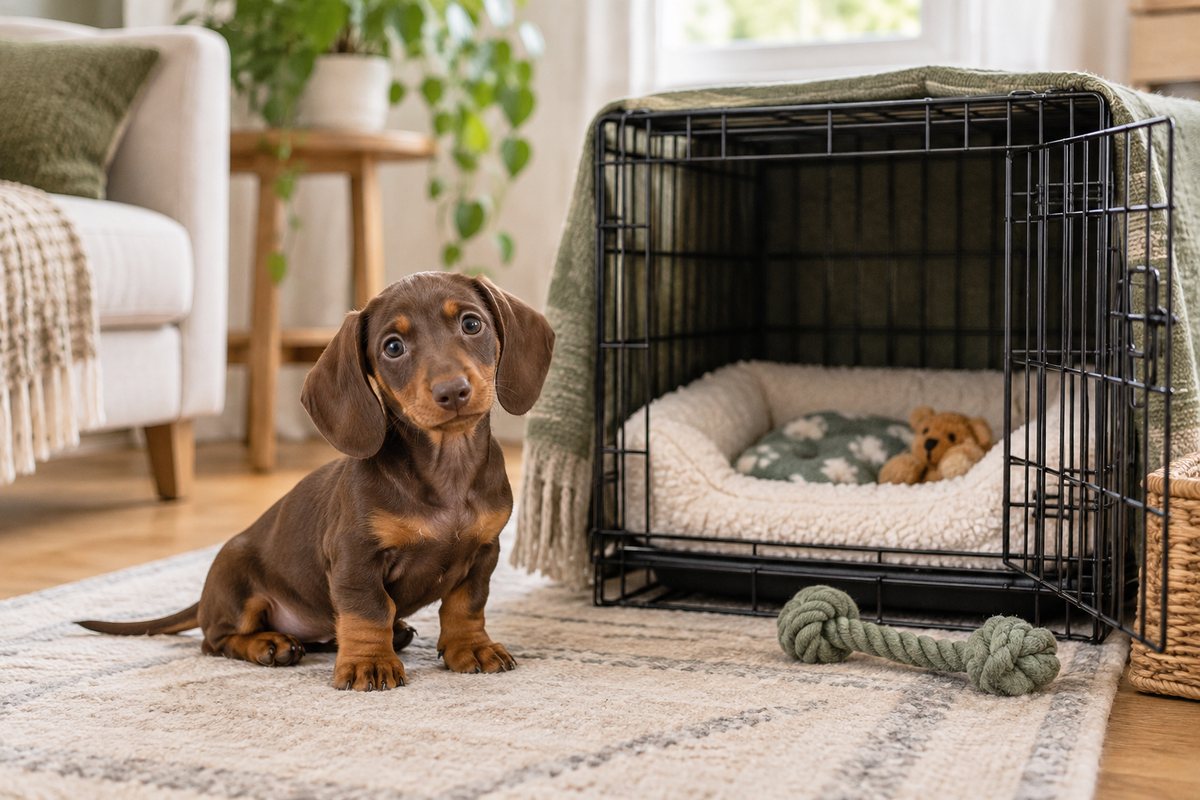
A Dachshund puppy crying in a crate may need to potty, feel lonely, be overtired, dislike confinement, have too much energy, or feel scared because crate training moved too fast. Some whining is normal during adjustment, but panic, nonstop distress, repeated accidents, vomiting, or attempts to escape mean the plan needs to slow down.

Dachshund puppy crying in crate: quick answer
First check potty needs, hunger, temperature, pain, and crate setup. Then teach the crate gradually with meals, chews, naps, short departures, and rewards for calm. AKC crate training guidance recommends making the crate comfortable and increasing time gradually. PetMD notes that puppies who are new to crate training may cry, whine, bark, or howl when left alone in the crate.
| Crying pattern | Possible cause | Response |
|---|---|---|
| After 1 to 2 hours | Potty need | Quiet potty trip |
| Immediately frantic | Too much too soon | Shorter sessions |
| At bedtime | Loneliness or routine change | Crate near bed temporarily |
| After wild play | Overtired | Calm wind-down first |
| With accidents | Schedule or health issue | More potty trips or vet check |

What to do tonight
- Give a final potty trip before crate time.
- Keep the crate comfortable but safe.
- Place it near you at first if the puppy is scared.
- Use a boring potty break if they wake crying.
- Do not turn every cry into playtime.
- Shorten crate sessions the next day and rebuild.
For full crate setup, read Dachshund crate training and how to crate train a Dachshund puppy.

Daytime plan to reduce night crying
Night crate crying often starts earlier in the day. A puppy that never practices calm crate time until bedtime may panic when the room goes dark. Add tiny daytime crate sessions after potty trips, meals, and calm play so the crate becomes normal before the night stretch.
- Feed one meal near or inside the crate.
- Practice 30-second door closes while you stay nearby.
- Use crate naps after potty and play.
- Keep pre-bedtime play calm.
- Use boring nighttime potty trips if your puppy wakes.
- Do not use the crate as punishment.
Red flags
Call your veterinarian if crying comes with vomiting, diarrhea, repeated crate accidents, coughing, weakness, poor appetite, or signs of pain. Ask a qualified trainer for help if your puppy panics, bites the crate, injures themselves, or cannot settle even with gradual training.
Crate crying decision tree
When your puppy cries, pause before reacting. The goal is to meet real needs without teaching that every noise creates play, food, or cuddles. A young puppy may truly need a potty break. A puppy who just went out may need help settling. A puppy who panics may need the training plan made easier.
| Question | If yes | If no |
|---|---|---|
| Has it been long enough for potty? | Quiet potty trip | Wait briefly and listen |
| Did puppy just have wild play? | Add calm wind-down | Check crate comfort |
| Is crying frantic? | Shorten future sessions | Reward calm pauses |
| Are there accidents or illness signs? | Call veterinarian | Continue gradual training |
Crate setup for Dachshund puppies
The crate should be large enough for your puppy to stand, turn, and lie down, but not so large that one end becomes a bathroom. Place it where your puppy can settle. Some puppies do better near the bed at first. Others settle better in a quiet room after daytime practice. Keep bedding safe and remove anything your puppy shreds or swallows.
- Use a divider if the crate is adult-sized.
- Take collars or dangling tags off inside the crate if they can catch.
- Keep the room temperature comfortable.
- Use predictable nap and potty timing.
- Practice calm crate time when you are home, not only when leaving.
First-week night plan for crate crying
The first week should be predictable. Take your puppy out for a quiet potty trip before bed, keep the crate close enough that you can hear real distress, and use boring nighttime potty breaks. No play, no big greetings, and no long cuddling sessions that wake the puppy fully.
- One final potty trip before lights out.
- Place the puppy in the crate with a calm cue.
- If crying starts, listen for a short moment before reacting.
- If potty is likely, carry or leash the puppy outside quietly.
- Return to the crate immediately after potty.
- Shorten daytime crate sessions if night panic repeats.
Crate crying mistakes to avoid
Do not use the crate only when you leave. That teaches the crate predicts isolation. Do not wait until bedtime to do the first practice. Do not ignore frantic panic for long periods. The goal is not to outlast the puppy. The goal is to build a crate routine that balances potty needs, sleep, and gradual confidence.
| Mistake | Better choice |
|---|---|
| Only crating at night | Practice short daytime rests |
| Playing during potty breaks | Keep breaks boring |
| Oversized crate | Use divider for puppy size |
| Ignoring panic | Make the next session easier |
Dachshund puppy crate crying FAQ
Should I ignore my Dachshund puppy crying in the crate?
Do not use one rule for every cry. A young puppy may need potty, comfort, or an easier training step. Brief fussing after needs are met is different from frantic panic. Keep potty breaks boring, reward calm moments, and make daytime crate practice easier if night crying is intense.
Where should the crate be at night?
Many puppies settle better near the bed at first because they can smell and hear you. You can gradually move the crate farther away after the puppy is sleeping more reliably. A distant crate on the first night may work for some puppies, but it can be too abrupt for others.
How long does crate crying last?
Some puppies improve in a few nights. Others need several weeks of steady practice, especially if they are very young, newly rehomed, or had no crate exposure. Progress means shorter crying, faster settling, and fewer panic episodes, not instant silence.
Crate crying decision tree
Crate crying is not one single problem. A Dachshund puppy may cry because they need to potty, feel alone, are overtired, are under-exercised, dislike the crate setup, or have learned that crying brings a big response. Your first job is to identify which version you have.
Use age, timing, and intensity. A young puppy crying after two hours at night may need a potty break. A puppy screaming the moment the door closes during the day may need easier crate games and more gradual independence practice.
| Situation | What it suggests | Best next step |
|---|---|---|
| Cries after waking | Potty need likely | Quiet trip outside, then back in |
| Cries immediately | Crate association too hard | Practice open-door games |
| Cries after wild play | Overtired | Use calmer pre-crate routine |
| Paws at door frantically | Panic or distress | Reduce difficulty and seek guidance |
| Settles then restarts | Schedule or sound trigger | Track timing and environment |
Dachshund puppy crying in crate: practical checklist
- Take a boring potty break before crate time.
- Put the crate near you at first if nights are difficult.
- Reward calm entries with the door open.
- Use short daytime sessions before expecting long nights.
- Avoid releasing during frantic peaks when needs are already met.
- Adjust the schedule before assuming defiance.
When to change course
If crying is panicked, paired with drooling, escape attempts, vomiting, or self-injury, stop pushing longer crate time and get professional help.
Dachshund puppy crying in crate: owner scenarios and fixes
The final step for Dachshund puppy crying in crate is matching the advice to the exact situation in front of you. Dachshunds are small, persistent, routine-sensitive dogs, so a plan that looks correct on paper can fail if the room setup, timing, gear, reward value, or health context is wrong. Before changing everything, choose the one pattern that happens most often and work there first.
This also helps prevent mixed signals. If you sometimes reward the unwanted pattern, sometimes interrupt it, and sometimes ignore it, your Dachshund may keep trying the behavior because the rules are unclear. A simple plan that everyone in the home follows for one week is usually more useful than a complicated plan that changes every day.
| Owner situation | How to handle it |
|---|---|
| When the main issue is cries after waking | Start with the practical fix: quiet trip outside, then back in. Give it several calm repetitions before adding a second change. |
| When the pattern looks like cries immediately | Assume the setup is slightly wrong for your Dachshund and adjust the environment before expecting better behavior. |
| When you see cries after wild play | Slow the plan down. Dachshunds often improve faster when the next step is easier, clearer, and more predictable. |
| When paws at door frantically keeps returning | Look for a trigger that happens before the problem. Changing that trigger usually works better than reacting afterward. |
| When settles then restarts is involved | Treat it as a sign to re-check fit, comfort, schedule, or health rather than assuming your dog is ignoring you. |
How to make the plan easier for your Dachshund
If progress stalls, make the next repetition easier instead of louder or longer. For Dachshund puppy crying in crate, easier can mean more distance, a shorter session, a lower height, a quieter room, softer handling, smaller rewards, or fewer choices. The easier version should let your dog succeed while still practicing the skill you want.
Watch recovery time. A Dachshund who can return to sniffing, eating, resting, or walking normally is usually in a workable zone. A dog who stays frantic, stiff, avoidant, or obsessed with the trigger is telling you the setup is too difficult. That is useful information, not a training failure.
7-day improvement plan
- Day 1: write down when the Dachshund puppy crying in crate problem happens, where it happens, and what happened right before it.
- Day 2: remove the easiest trigger or setup mistake connected to cries after waking.
- Day 3: practice the first checklist step: take a boring potty break before crate time..
- Day 4: repeat the same plan at an easier level instead of adding a new rule.
- Day 5: add one support step from the checklist: put the crate near you at first if nights are difficult..
- Day 6: ask whether your dog recovers faster than earlier in the week.
- Day 7: keep what improved, drop what confused your dog, and decide whether health or professional support is needed.
This seven-day plan will not solve every case of Dachshund puppy crying in crate, but it gives you cleaner information. If the pattern improves, keep building gradually. If it stays the same or worsens, the cause may be discomfort, fear, poor fit, too much freedom, or a trigger that needs a different article-specific plan.
Quality check before you rely on the advice
The safest version of the advice should be specific, observable, and easy to repeat. You should know what you are changing, what success looks like, and when to stop. For Dachshunds, stop signs include pain, limping, yelping, frantic barking, snapping, refusal to eat rewards, vomiting, repeated accidents, or sudden behavior changes.
When in doubt, choose the lower-risk version: more distance, better traction, shorter sessions, calmer rewards, clearer routines, and earlier veterinary input. That keeps the Dachshund puppy crying in crate plan helpful without pushing a small long-backed dog through stress, pain, or confusion.
Sources
- AKC: Step-by-Step Crate Training
- AKC: How to Crate Train Your Dog
- PetMD: Puppy Crying in Crate
- AKC: Puppy Going Potty in Crate