Category: Life

Daily life with Dachshunds, travel, home setup, seasonal care, bonding, enrichment, and owner routines.

  • Are Dachshunds Good With Cats? A Gradual Introduction Plan

    Are Dachshunds Good With Cats? A Gradual Introduction Plan

    Direct answer

    Are Dachshunds good with cats? Some can live peacefully with cats, but compatibility must be assessed and introductions managed. The breed’s hunting background means movement may capture a dog’s attention; that does not prove every Dachshund will chase a cat. Start with separate safe areas, let both animals settle, and progress through scent and controlled visual exposure before any close contact. Cats Protection recommends a cat-only safe room and gradual introductions rather than forcing the animals together.

    Whether Dachshunds are good with cats depends on the individual dog, cat, and management plan. The success standard is calm coexistence, not a dramatic photo of them cuddling on day one. Some pairs may never be safe without barriers when unsupervised. The individual dog’s history and ability to disengage, along with the cat’s comfort, matter more than a simple “good with cats” breed label.

    Check the dog’s history before adoption

    Ask the breeder, rescue, or foster home what the Dachshund has actually done around cats. Has it lived with a cat calmly, only seen one outdoors, or never been assessed? Did it stare, stalk, lunge, bark, or ignore the cat? A dog that is quiet while fixed on a cat is not necessarily relaxed. Ask how it responds when redirected and whether the cat had an escape route during any previous test.

    The Dachshund Club of America breed standard describes a hunting dog with a good nose and persistence. That history makes careful management sensible, but it cannot predict one dog’s behavior. A puppy that is gentle today still needs practice and supervision as it matures. An adult with a proven calm history may offer clearer information, though a new home changes context.

    Ask about the cat too. A confident adult cat with high resting places may cope differently from a fearful cat or fragile kitten. Do not expect the cat to “teach the dog a lesson.” Cats Protection advises against that kind of forced confrontation because it can stress both animals.

    Prepare the home before they meet

    Set up a cat-only room with food, water, litter tray, resting place, and hiding options. The dog should not be able to enter. Provide secure high routes or shelves in shared areas so the cat can leave without running past the dog. Use a door or well-fitted gate to control access; check that a small Dachshund cannot squeeze through gaps. Cats Protection recommends distinct spaces so a new cat can settle safely.

    The dog also needs its own rest area and routine. Keep the cat’s food and litter inaccessible to the dog. Plan where each animal will be when you are cooking, working, or asleep. Management is not a failure of training; it keeps both animals from rehearsing a frightening encounter while trust develops.

    If the dog is new to the home, allow it to settle before expecting cat introductions. If the cat is new, let it establish its safe room. Cats Protection’s introduction guidance recommends separation in the initial stages. There is no fixed number of days that suits every pair.
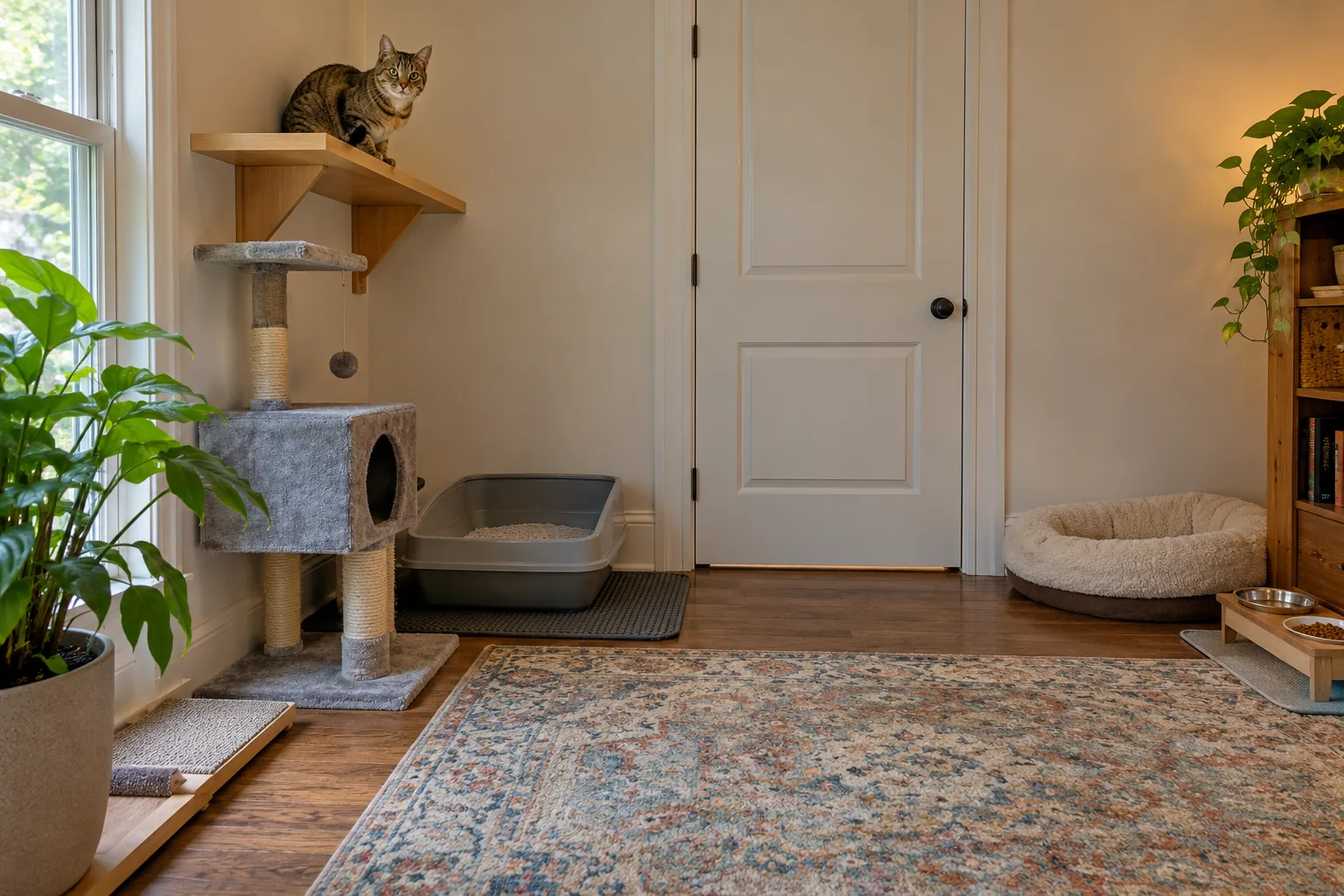
    Are Dachshunds good with cats? Start with a cat-only room and secure separation

    Stage the introduction

    Stage 1: Separate routines and scent. Let each animal eat, rest, and explore its own space. Exchange bedding or allow supervised access to a room after the other animal has left. If either stops eating or seems distressed, pause and reduce intensity.

    Stage 2: Brief visual contact through a secure barrier. Let the cat choose whether to approach or leave. Keep the dog on lead or behind a secure barrier and reward calm attention to the handler. End sessions while both animals are still coping. Do not hold the cat in someone’s arms for a forced face-to-face meeting.

    Stage 3: Carefully managed shared space. Only when repeated barrier sessions are calm, allow a short session with the dog controlled and the cat free to retreat. Maintain distance. Reward the dog for looking away from the cat or settling. End before excitement rises. Return to the previous stage if either animal becomes tense.

    The Cats Protection guide supports gradual introductions, escape routes, and ongoing supervision. A successful moment does not justify leaving them loose together when no one is present.

    Watch both animals, not just the dog

    For the Dachshund, watch for fixed staring, stalking, lunging, repeated chasing attempts, or inability to respond to a familiar cue. A wagging tail alone does not prove harmless intent. For the cat, watch for persistent hiding, not using normal resources, crouching, hissing, or frantic attempts to escape. Stress may show in appetite and toileting routines, so check those as well.

    If either animal is overwhelmed, increase distance or return to separate rooms. Do not scold the dog for noticing the cat; teach and reward disengagement at a distance where learning is possible. The AVSAB humane-training statement supports reward-based behavior change rather than aversive methods. If the dog has chased or grabbed cats before, or cannot disengage even at a safe distance, consult a qualified behavior professional. Management may remain permanent.
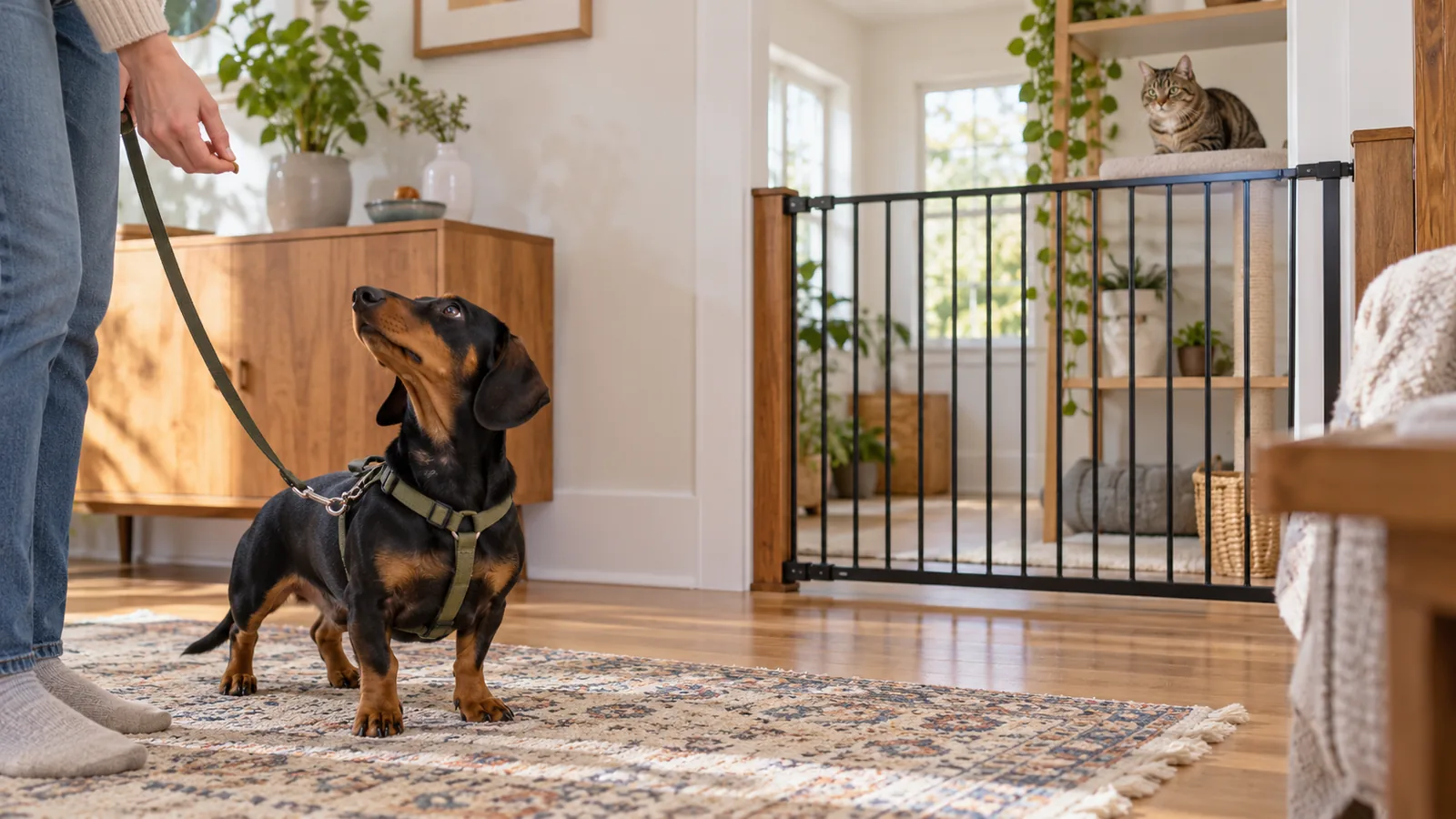
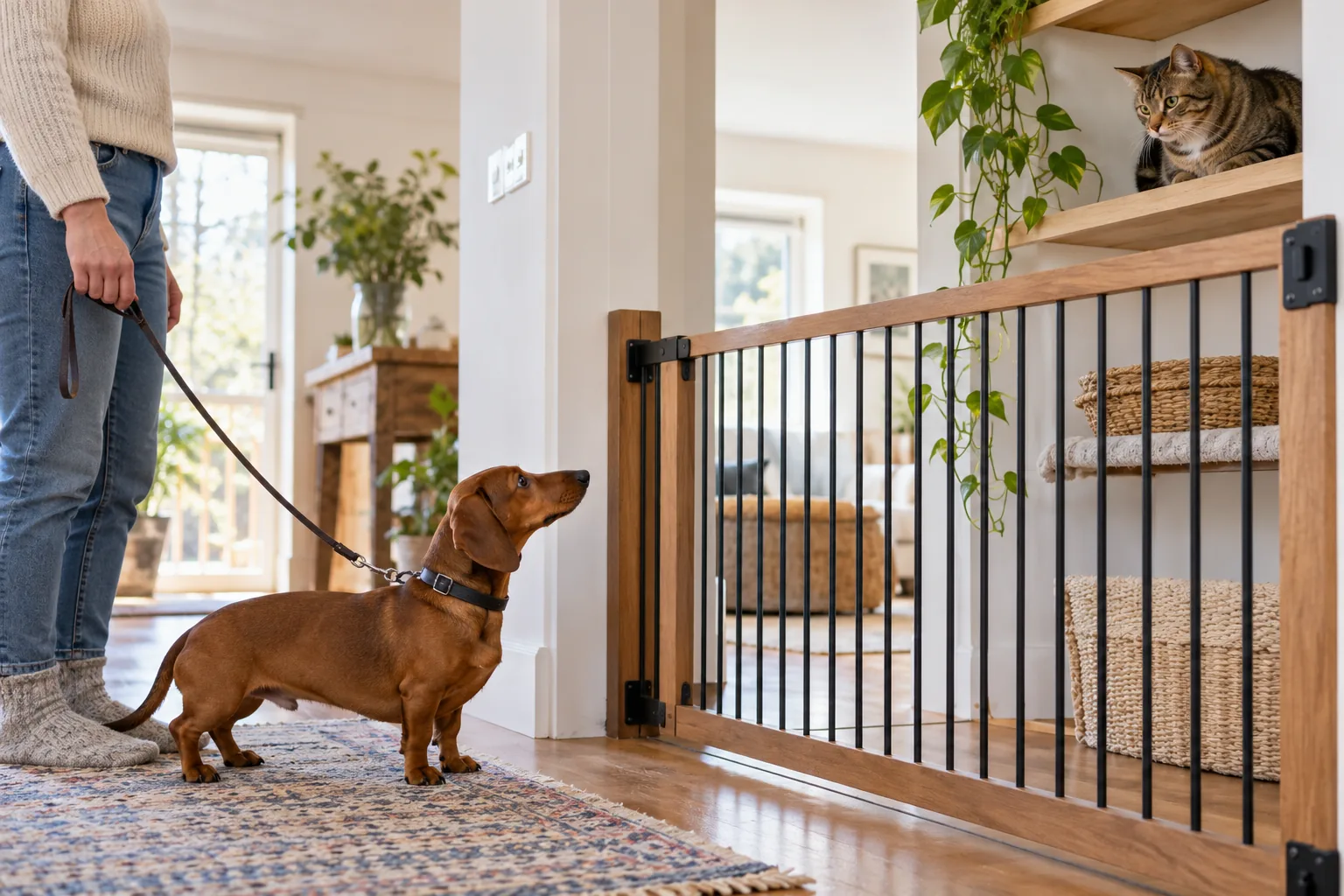
    Dachshund turning toward its owner for a reward while a cat remains behind a gate

    Prevent the first chase

    Chasing can be exciting for a dog and terrifying for a cat. Do not wait for a chase to learn whether the animals are compatible. Check doors and gates before each session, use a secure lead where appropriate, and have one adult focus on the dog while another monitors the cat’s exits. Avoid introductions in a narrow hallway where the cat could be trapped.

    If a chase happens, separate calmly and check for injury. Do not immediately repeat the encounter to “end on a good note.” Give both animals time to settle and reassess the setup. The cat may need a veterinary check after contact even if no wound is obvious. A behavior professional can help create a safer plan, but no plan can guarantee every pair will become friends.

    Life after introductions

    Once the pair is calm in several settings, maintain separate resources and the cat’s escape options. Continue to supervise shared time. Cats Protection advises that dogs and cats should not be left together unsupervised. Households differ in how they use barriers over the long term; base your decision on observed behavior and professional guidance, not wishful thinking.

    Changes can unsettle a previously stable relationship: a new kitten, visitors, illness, pain, or a move. Reintroduce management when needed. A cat that suddenly hides or a dog that newly stalks deserves a closer look, including veterinary assessment where behavior changes abruptly.

    A practical example

    A resident cat watches from a high shelf while a newly adopted Dachshund explores the living room on lead behind a gate. The dog notices the cat, then takes a treat and turns back to the handler. After a short calm session, the dog leaves and the cat continues its normal routine. That is a better first step than placing them nose to nose. If the dog fixates and cannot turn away, increase distance and slow the plan.

    Frequently asked questions

    Are Dachshunds naturally bad with cats?

    No breed label determines every outcome. Their hunting history makes careful introductions sensible, but individual experience and management matter. Ask for actual cat history rather than a generic promise.

    How long should introductions take?

    There is no universal timetable. Progress only when both animals remain comfortable at the current stage. Cats Protection emphasizes settling and gradual exposure.

    Can a Dachshund and cat be left alone together?

    Do not assume so after a few calm meetings. Cats Protection recommends supervision and separate safe spaces. Some households will need permanent barriers during absences.

    What if my Dachshund chases the cat?

    Separate safely, check for injury, stop further rehearsal, and return to a more distant stage. Seek qualified help if the dog fixates, grabs, or repeatedly chases. Do not punish either animal for being frightened.
    Sources

  • Are Dachshunds Good With Other Dogs? A Cohabitation Guide

    Are Dachshunds Good With Other Dogs? A Cohabitation Guide

    Direct answer

    Are Dachshunds good with other dogs? A Dachshund can live well with another dog, but the match depends on both individuals and careful management. Breed alone cannot predict whether two dogs will share space comfortably. Ask about each dog’s history with other dogs, begin on neutral ground, and watch whether both can relax and disengage. Humane World for Animals recommends a neutral outdoor introduction with separate handlers and attention to body language. The AKC’s new-dog guidance similarly advises a neutral first meeting and supervised transitions at home.

    Are Dachshunds good with other dogs when they share a home? It depends on the household pairing and management. This article is about living together, not barking at passing dogs on walks. A Dachshund may be sociable outdoors but guard a bed or food bowl indoors; another may be noisy on lead yet settle near a housemate. The household relationship must be assessed in the situations where the dogs will actually live.

    Evaluate both dogs before arranging a meeting

    Ask the breeder, shelter, or foster home what the Dachshund has done around dogs of different sizes, ages, and energy levels. Has it lived with another dog, only met dogs briefly, or struggled when one approached a resource? Ask the same questions about the resident dog. A friendly greeting at a park is useful information, but it is not a guarantee of sharing a kitchen and family attention.

    Look at age and physical comfort. A young, energetic dog may overwhelm a senior Dachshund. A dog with back pain may react defensively when bumped or chased. If either dog has pain, sudden irritability, or a history of biting, consult a veterinarian and a qualified behavior professional before staging introductions. Dog-dog selectivity varies with individual genetics, socialization, and experience, as AKC’s discussion of selectivity notes.

    Size is not a compatibility test. A larger dog may play gently, while two similarly sized dogs may conflict. For a Dachshund, pay attention to play style and whether each dog can stop when the other needs space. Do not assume a second Dachshund is automatically the easiest companion.

    Meet on neutral ground

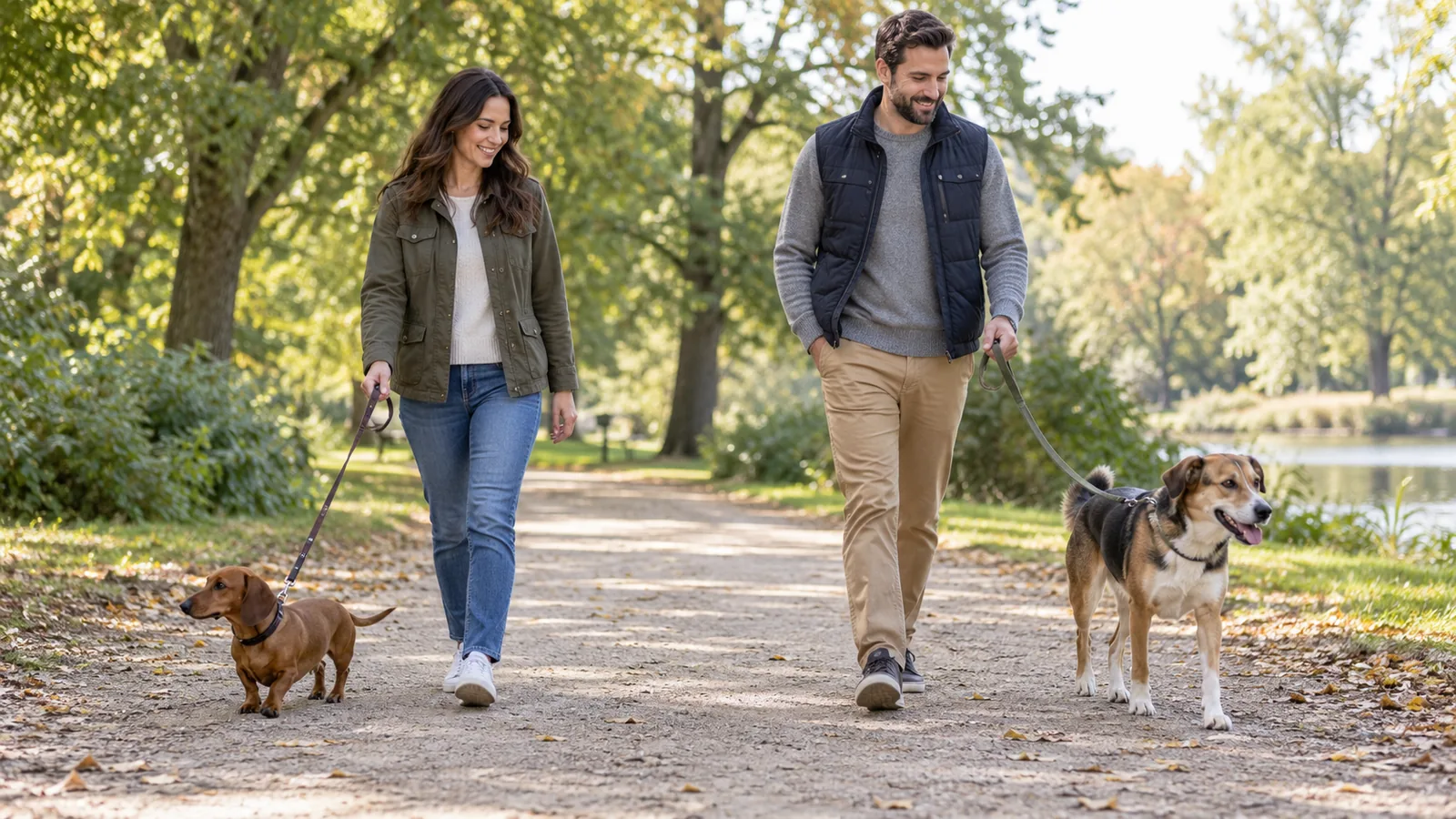
    Choose a quiet outdoor place unfamiliar to both dogs. Have one calm adult handle each dog on a secure lead. Begin far enough apart that both can notice the other and still respond to their handlers. Walk in the same direction, allow sniffing of the environment, and reward calm check-ins. Humane World recommends rewarding calm observation rather than forcing immediate contact.

    If both dogs remain loose-bodied and interested, decrease distance gradually. A brief greeting can be followed by moving apart again. Watch for stiff posture, prolonged staring, blocking, growling, or one dog repeatedly trying to get away. Those signs call for more distance or ending the session, not insisting that the dogs “work it out.” If the dogs cannot relax even with distance, seek professional guidance before deciding to house them together.

    Avoid a first meeting at the resident dog’s front door or over a food bowl. The AKC advises neutral territory because a home entrance can add pressure. A good first walk is a beginning, not permission to remove every barrier indoors.

    Prepare the house before the newcomer arrives

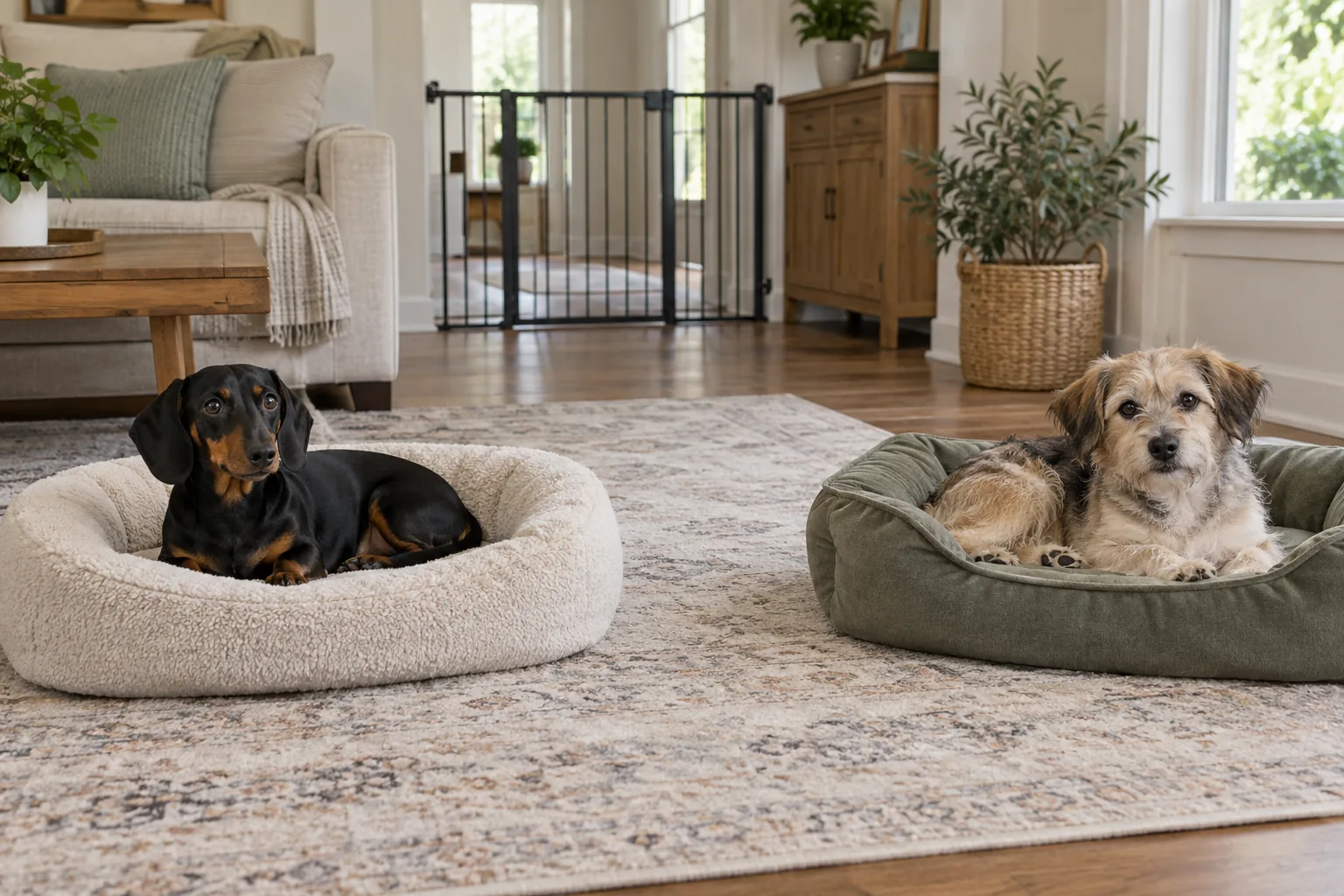
    Are Dachshunds good with other dogs? Separate comfortable rest spaces at home

    Give each dog its own bed, feeding place, and quiet area. Pick up high-value chews, favorite toys, and food bowls during early shared time. Use gates or pens so the dogs can rest separately and so an adult can manage transitions. AKC’s introduction guidance specifically recommends gates, crates, or pens as management tools and close supervision.

    Feed separately at first, with doors or barriers closed if needed. A dog that has never guarded a bowl may still feel pressure when a stranger enters its home. Avoid testing whether the dogs can share a chew. Keep human attention predictable too; a dog should not have to push another away to access its owner.

    Walk the dogs separately sometimes, even after they become housemates. Each needs individual training and rest. A second dog is not a substitute for the first dog’s enrichment or companionship from people.

    Read the relationship over weeks

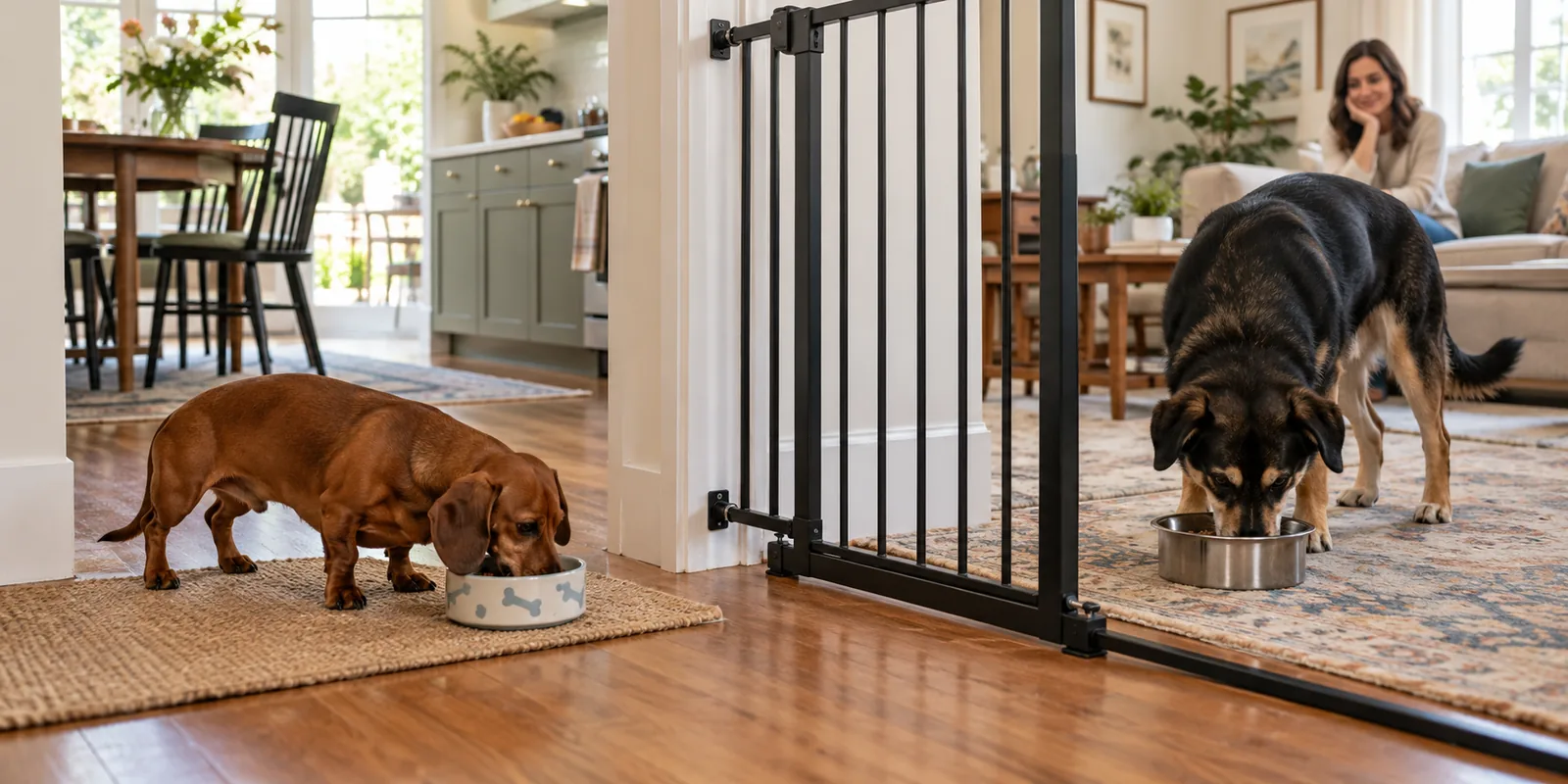
    Two dogs eating in separate spaces with a safety barrier between them

    Look beyond whether the dogs play. Can they stop play and rest? Can one walk past the other without tension? Does either block doorways, follow relentlessly, or prevent access to water or a resting place? Does the resident dog’s appetite or sleep change? An apparently quiet dog may be avoiding conflict rather than enjoying the arrangement.

    Short supervised sessions with breaks are often easier than a full day together. Increase freedom only after repeated calm behavior in several contexts. Return to separation if stress rises. The AKC notes that puppies may not understand an older dog’s communication, so adult management is important even when the puppy wants to play.

    Some pairs become close companions; others coexist peacefully with separate spaces; some should not share a home. Accepting that range is more humane than forcing a “best friends” story.

    Play, conflict, and when to get help

    Healthy play often includes loose bodies, pauses, and role changes. Intervene if one dog continually chases or pins the other, if the smaller dog cannot escape, or if play continues despite clear avoidance. Do not put hands between fighting dogs. Make a safety plan with a qualified professional if there has been serious conflict.

    Growling or a stiff body is information. Separate and investigate the trigger instead of punishing the warning. The AVSAB humane-training statement favors reward-based behavior support and discourages aversive methods. Repeated guarding, bites, or inability to settle deserve veterinary and professional behavior input; online advice cannot assess the dogs in person.

    A practical example

    Two dogs walk calmly side by side in a park. At home, the new Dachshund freezes whenever the resident dog approaches a sofa. Their outdoor meeting did not reveal a conflict over indoor resting space. The owner should separate the dogs, provide distinct beds, prevent competition around the sofa, and rebuild short calm sessions. Ignoring the freezing because “they got along outside” would miss a useful early signal.

    Frequently asked questions

    Are Dachshunds better with another Dachshund?

    Not necessarily. Similar size or breed does not guarantee compatible play, resource sharing, or rest. Evaluate both individuals and their histories.

    Should dogs meet off lead for the first time?

    Not by default. Humane World recommends separate handlers and controlled, neutral introductions. A qualified professional can advise when greater freedom is appropriate.

    Can I leave them alone after one good meeting?

    No. Use separate spaces when no one can supervise until a stable relationship has been observed over time. Some pairs may always need separation during absences.

    What if my Dachshund barks at dogs on walks?

    That is a separate trigger and training question. See the existing barking-at-other-dogs guide, while assessing household compatibility independently.

    Sources

  • Can Dachshunds Swim? A Safety-First Guide to Water

    Can Dachshunds Swim? A Safety-First Guide to Water

    Direct answer

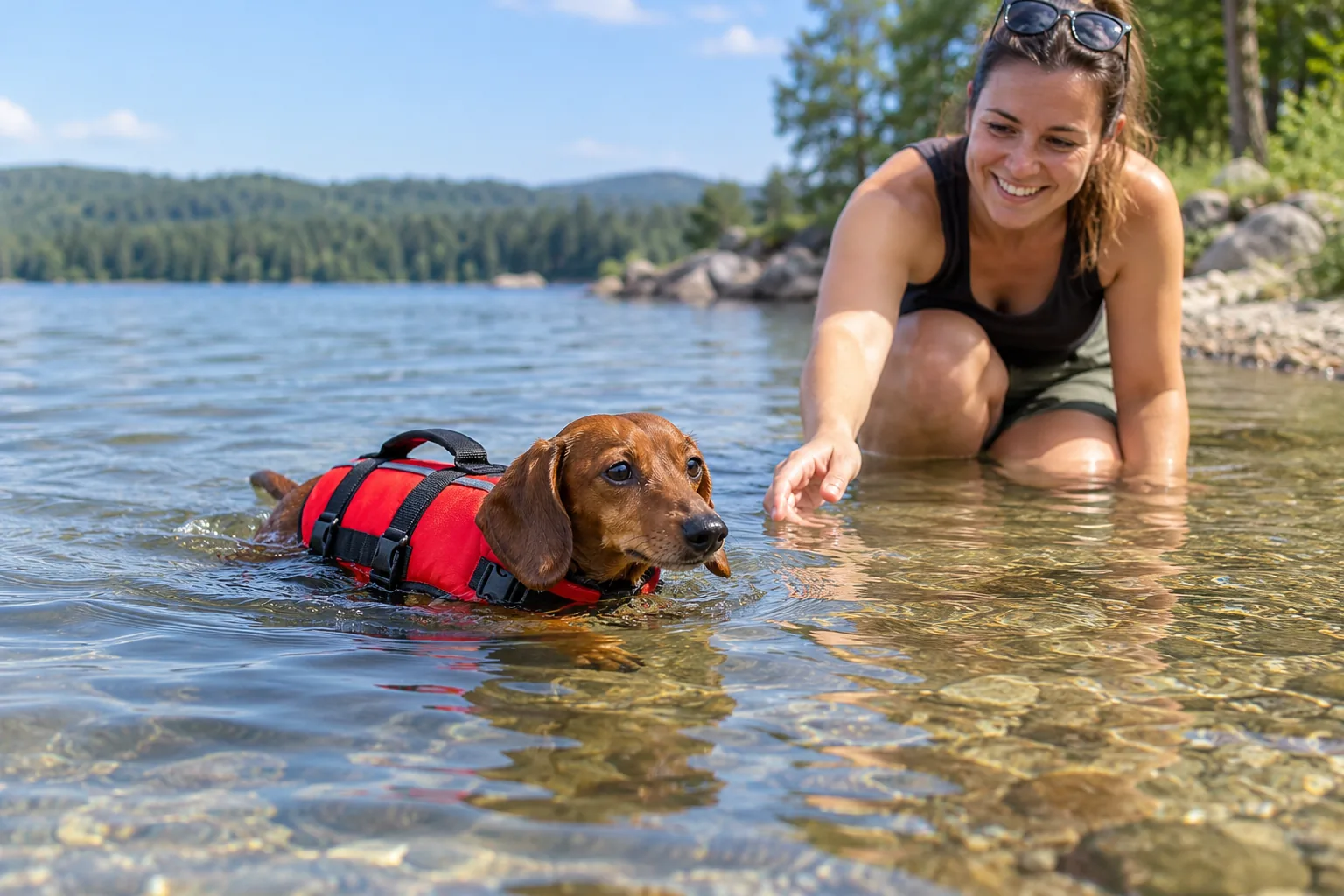
    Can Dachshunds swim? Some can, but the ability to paddle is not a guarantee of safety or enjoyment. An individual dog may be comfortable in shallow, still water yet tire quickly in deeper water. Treat swimming as a supervised activity, not an instinct that needs no preparation. Begin where the dog can enter and leave easily, use a properly fitted canine life jacket for swimming, stay close enough to assist, and end while the dog is still comfortable. AKC’s water-safety guidance recommends gradual introductions, flotation, close supervision, rest breaks, and fresh drinking water.

    Whether Dachshunds can swim safely depends on the dog, environment, and supervision. There is no universal rule that every Dachshund enjoys water. If yours chooses to stay dry, a sniffing walk near the shore can be the entire outing. Our separate guide to whether Dachshunds like water covers that preference question; this page addresses swimming conditions and response to risk.

    First decide whether this water is suitable

    Look at the entry, exit, water movement, depth, footing, temperature, and water quality before the dog approaches. A gentle slope in calm water gives a novice a way back to land. A pool with sheer walls, a river with current, surf, a steep bank, or slippery rocks creates a different risk. If you cannot identify a reliable exit, do not start. AKC’s swimming introduction favors a gradual slope and supervised practice.

    Do not rely on a dog to recognize current or fatigue. Wind, waves, and boat wake can change conditions suddenly. Keep a person close enough to help rather than watching from a distant chair. Never throw a dog into water, pull it beyond its confidence, or treat a panicked paddle as proof of learning. A dog that hesitates or turns away is giving useful information.

    Natural water can carry hazards beyond depth. Provide fresh drinking water so the dog is not encouraged to drink lake or salt water. Avoid visibly contaminated or suspicious water and follow local advisories. If a dog becomes ill after water exposure, tell the veterinarian where it swam. AKC’s water-safety article advises bringing fresh water and preventing consumption of lake or ocean water.

    Fit a life jacket, then supervise anyway

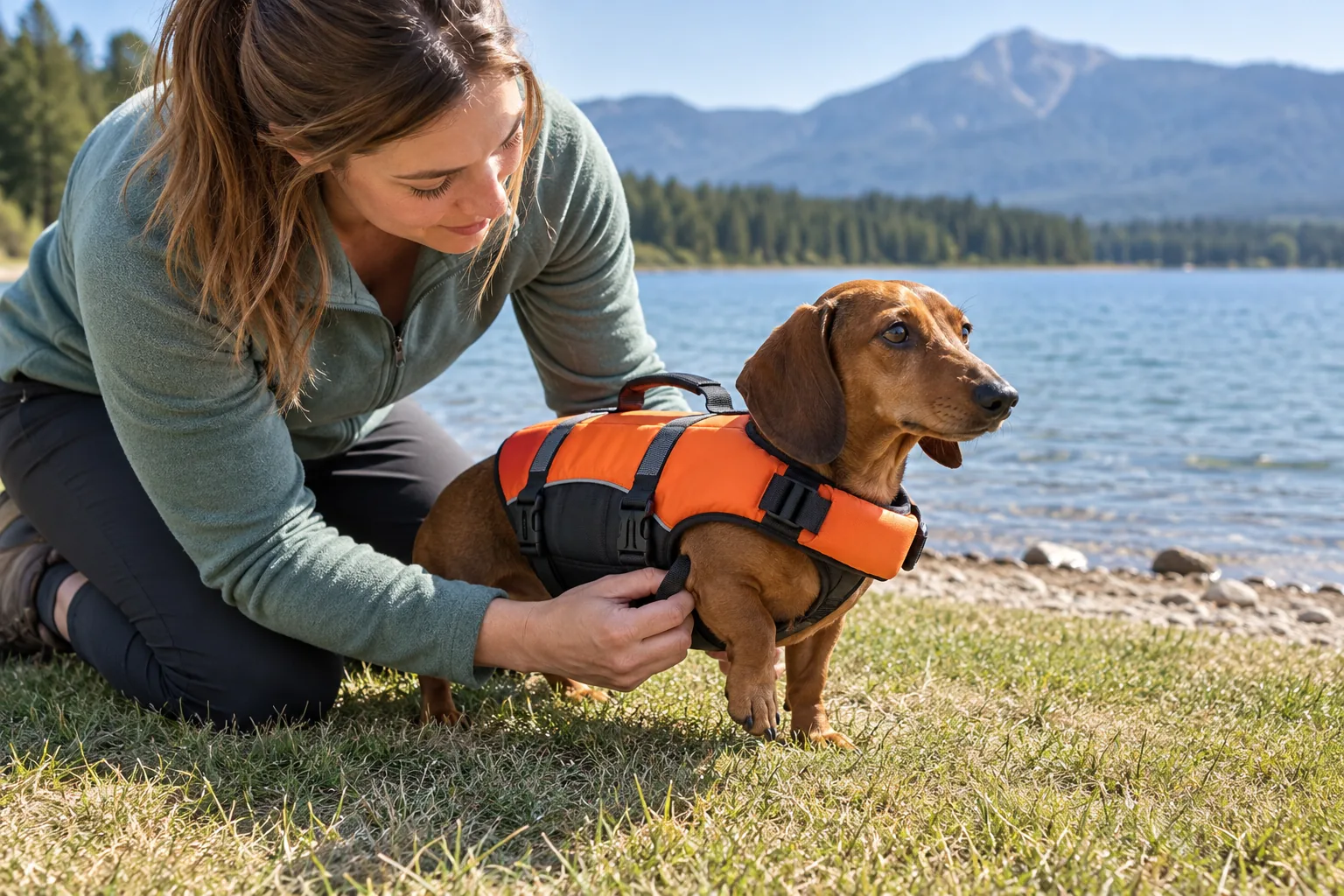
    Can Dachshunds swim safely? Checking a fitted Dachshund life jacket on dry ground

    A canine life jacket adds buoyancy and can make a tired dog easier to assist. It is not permission to enter rough water or leave the dog alone. Before each outing, check buckles, straps, wear, and whether the jacket stays secure without restricting breathing or limb movement. A handle can help guide a dog to the exit, but it is not a substitute for a rescue plan. AKC warns that a loose or worn jacket can itself create problems.

    Try the jacket on dry land first. Allow the dog to walk, turn, and rest; check for rubbing at the chest and under the forelegs. If it shifts, catches a leg, or presses on the throat, change the fit before swimming. Our separate life-jacket guide compares features and sizing; this article is about using flotation during an outing.

    Even a dog that previously swam successfully needs continuous observation. Fatigue may appear as a slower paddle, lower posture, repeated attempts to climb onto a person, disorientation, or trouble reaching shore. Take the dog out before those signs become severe. Build in rest on dry ground; do not extend distance by throwing a ball farther and farther. AKC’s hydrotherapy overview notes that experienced dogs can tire and recommends properly fitted flotation in water.

    Make the first session short and voluntary

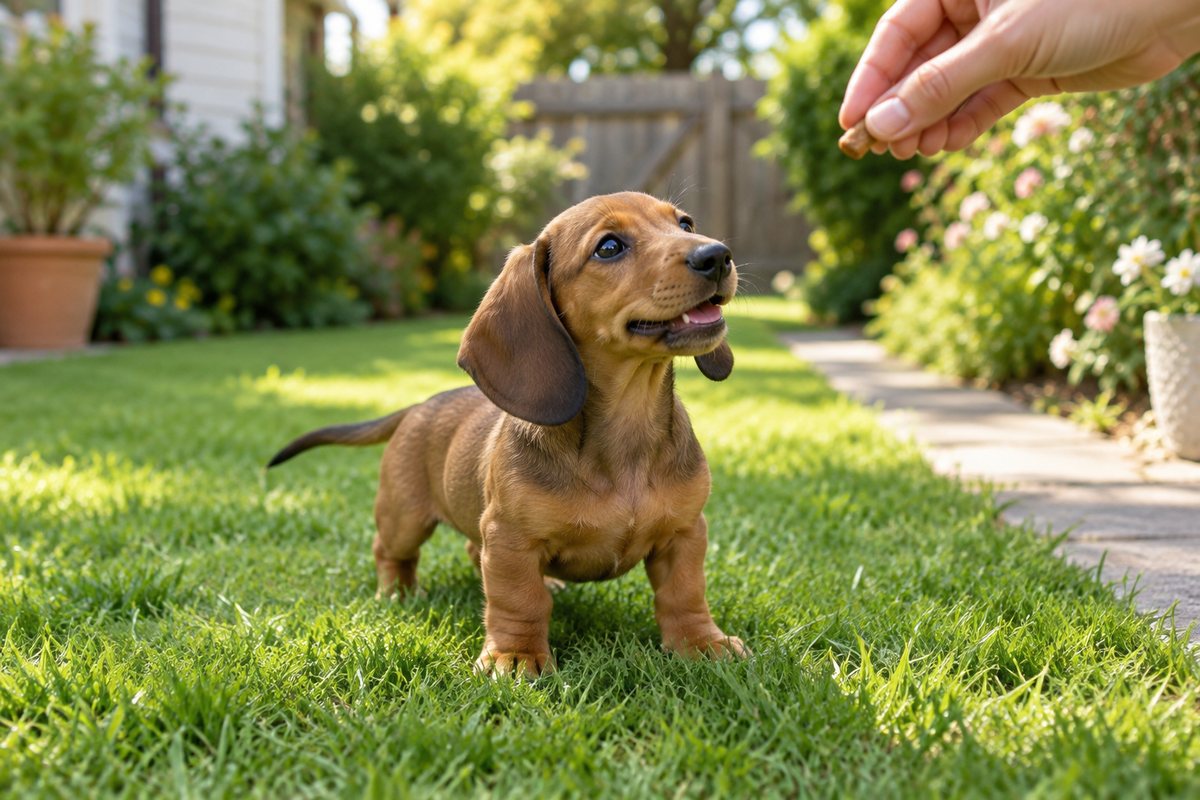
    Start at a calm, shallow place with a gently sloping exit. Let the Dachshund sniff the edge and step in or step back. Reward calm investigation on land. If the dog chooses to enter, stay beside it and keep the first water time brief. Leave the water together, allow a rest, and judge comfort before another short try. Do not make a particular distance the goal.

    If the dog seems tense, circles without finding the bank, scratches at you, or refuses to re-enter, stop. That is not a training failure. Plenty of Dachshunds have enjoyable outdoor lives without swimming. If you hope to use water activity for a dog with a back or joint condition, ask the treating veterinarian whether supervised rehabilitation is appropriate. Recreational swimming and prescribed hydrotherapy are not interchangeable; AKC’s hydrotherapy overview distinguishes therapeutic use from play.

    Pools, lakes, and boats need different plans

    Setting Main question Safer decision
    Pool Can the dog locate and use a reliable exit? Teach the exit under direct supervision; block unsupervised access.
    Lake or pond Is the bank gradual, water still, and water quality acceptable? Choose a shallow section and follow local advisories.
    River or surf Can current or waves move the dog away? Skip swimming when flow, surf, or footing is uncertain.
    Boat Could the dog fall overboard or become separated? Fit a life jacket, plan retrieval, and keep the dog under control.

    These are decision prompts, not promises that any location is safe. The same lake can change with weather. Do not tether a dog in a way that could trap it underwater or leave a leash dragging where it might snag. Ask a qualified local instructor for help if unsure how to practice an exit safely.

    After the water

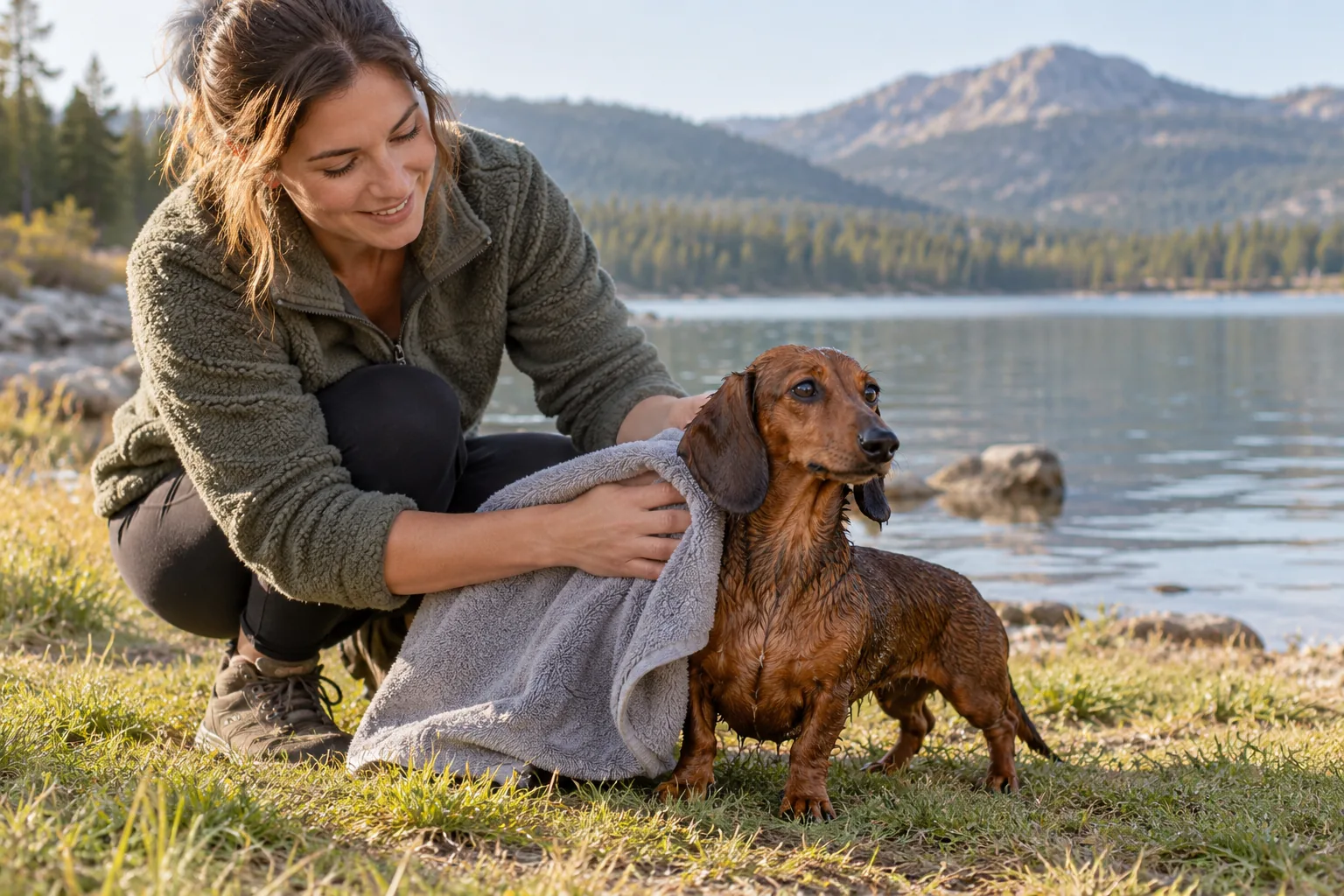
    Owner gently drying a Dachshund on shore after a supervised swim

    Bring the dog to dry, stable ground, offer fresh water, and dry the coat and ears gently. Rinse off pool chemicals or salt as appropriate, and check for debris around paws and skin. Watch for coughing, unusual breathing, marked lethargy, repeated vomiting, or difficulty walking. Contact a veterinarian promptly if these develop rather than assuming the dog is merely tired. AKC’s pool-safety advice includes rinsing after pool exposure.

    Do not prolong a session because the dog still seems eager; excited dogs can exceed their comfortable effort. Note how the dog moves and rests later that day. A successful first visit may be a few relaxed minutes near the edge, not a swim across open water.

    A practical example

    An adult Dachshund has enjoyed walking at a lake but has never swum. Its owner chooses a quiet shore with a gradual bank, checks that dogs are allowed and no water-quality warning is posted, fits the life jacket on land, and stays within reach. The dog wades in and paddles a short distance, then returns with guidance to the same easy exit. The owner ends the water time, dries the dog, and watches recovery. If the dog had refused to enter, the outing could still have been a pleasant lakeside walk.

    Frequently asked questions

    Are Dachshunds natural swimmers?

    Some paddle readily; others do not. Breed and body shape do not establish that an individual can safely handle depth, distance, current, or an unfamiliar exit. Supervision and a suitable environment matter more than the label “natural swimmer.”

    Does a life jacket make deep water safe?

    No. It adds flotation but cannot remove current, cold, fatigue, poor fit, or an inaccessible exit. Keep the dog within reach and choose calm water. AKC pairs a life jacket with human supervision.

    Can swimming replace walking?

    Swimming may be enjoyable for a healthy dog that likes water, but it is not a universal replacement for daily movement. For a dog with pain or a diagnosed condition, ask a veterinarian about an individualized exercise plan.

    What if my dog coughs afterward?

    Move the dog out of the water. Persistent coughing, breathing changes, vomiting, or unusual weakness warrant prompt veterinary advice. Tell the clinician where the dog swam and what you observed.

    Sources

  • Dachshund Home Setup: Make Everyday Routes Easier

    Dachshund Home Setup: Make Everyday Routes Easier

    Direct answer

    A useful Dachshund home setup is not a shopping list of ramps. It is a repeatable layout that lets the dog reach water, rest, people, and the outdoor door without frequent leaps, slippery turns, or confusing barriers. Start by watching where your dog actually walks during a normal day. Place a comfortable quiet bed, water, and other essentials on a practical route; manage stairs and high furniture; add traction where feet slide; and test whether the dog uses the changes. AKC’s Dachshund breed guide advises managing stairs and furniture jumps, while its flooring guide discusses rugs and runners for traction.

    This is a whole-home routine for an adult dog. The separate guide focuses on urgent puppy hazards such as cords and small objects; focuses on daily back-risk choices; is specifically about stair logistics. They should not all become near-identical “Dachshund-proof your house” pages.

    Dachshund home setup: map one ordinary day at dog height

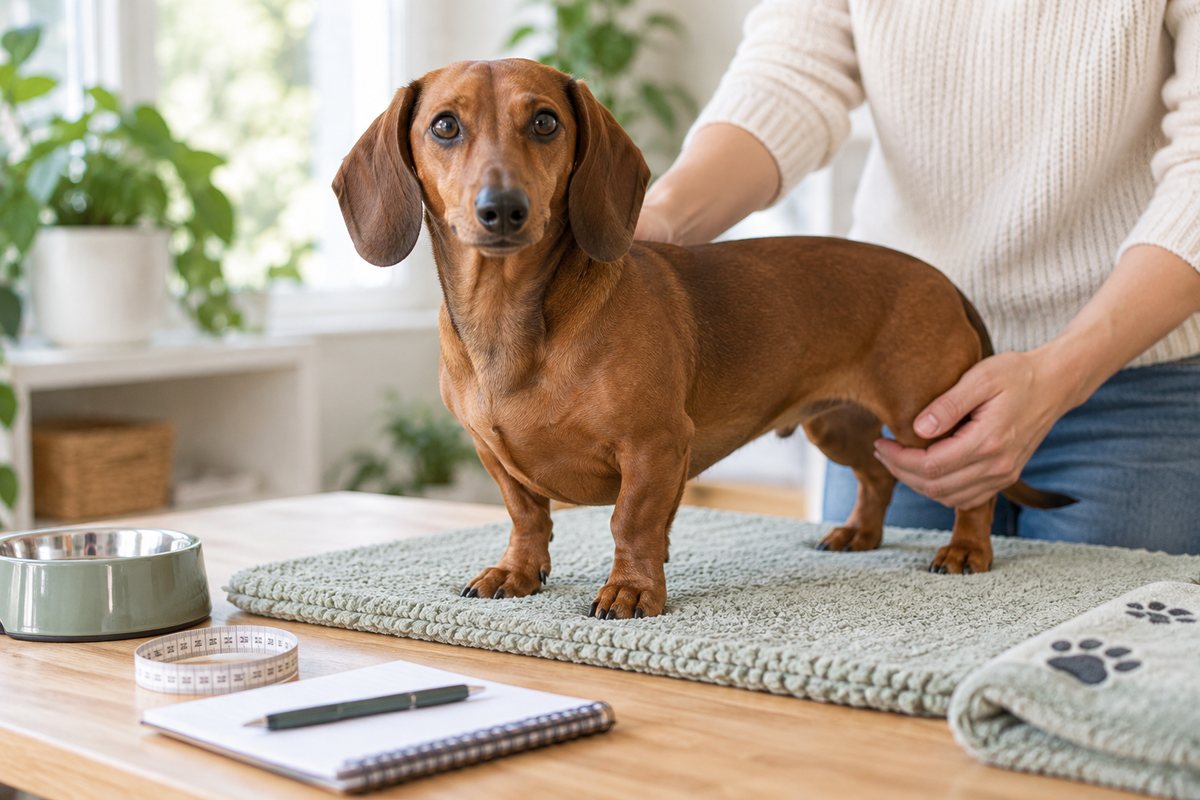
    Follow the dog from the bed to the water bowl, feeding spot, favored person, door, and place it watches the room. Where does it jump to keep up? Where does it skid while turning? Does it take a slippery shortcut because the safer path is too far away? Record the repeated behaviors, not only the obvious hazard. A dog may use a ramp once for a treat but jump from the sofa every evening when someone arrives.

    In a practical Dachshund home setup, choose the highest-frequency problem first. Move a bed closer to the family if that reduces repeated furniture jumps, or place a runner through a slick turn between the hallway and door. A home need not be fully redesigned in a weekend. Change one route, observe for a week, then decide whether it actually helps.

    Measure spaces before buying equipment. A rug that curls at the edge can introduce a trip hazard; a ramp too steep or unstable may be avoided. No accessory is useful merely because it is installed. Reward the dog for choosing the intended path and keep blocking unsafe shortcuts while it learns.

    Make rest easy and predictable

    Give the Dachshund at least one quiet place to sleep where it is not constantly stepped around, interrupted by children, or exposed to a draft. The bed should be easy to enter and leave and have stable footing nearby. In a busy home, a second rest spot close to family activity can reduce a dog’s urge to climb onto high furniture just to stay involved. Do not force a dog to sleep in isolation if that creates distress; arrange both access and quiet.

    Place water where it is reliably reachable. In a multilevel home, consider how the dog will access water without repeatedly using stairs. A non-slip mat around bowls can help on smooth floors, but clean spills promptly. Food storage should be secure and separate from household chemicals and medicines. A dog with mobility changes may need bowl, bed, and toilet access on one level; discuss new difficulty bending or moving with a veterinarian rather than assuming a layout change alone is enough.

    Improve traction where it matters

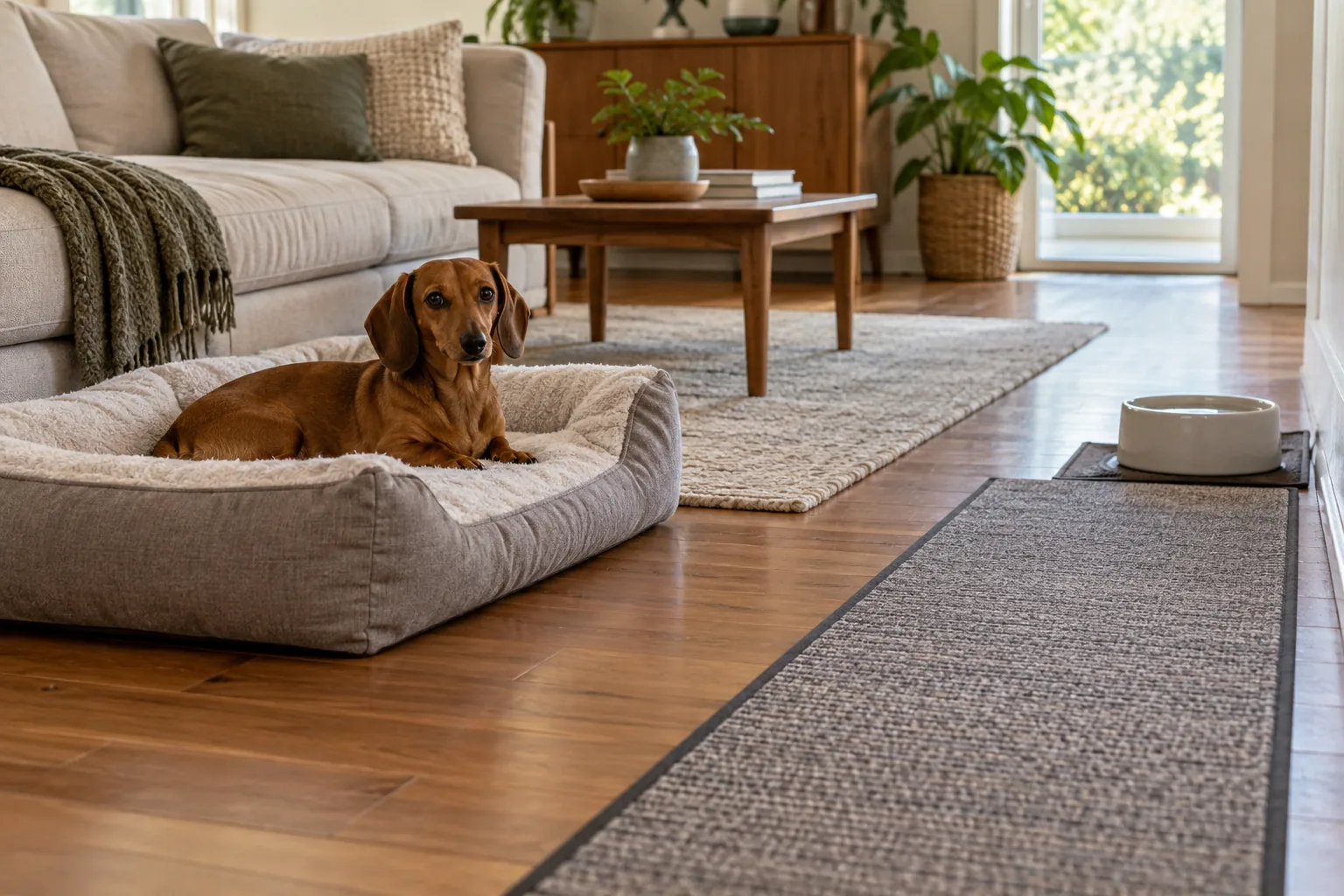
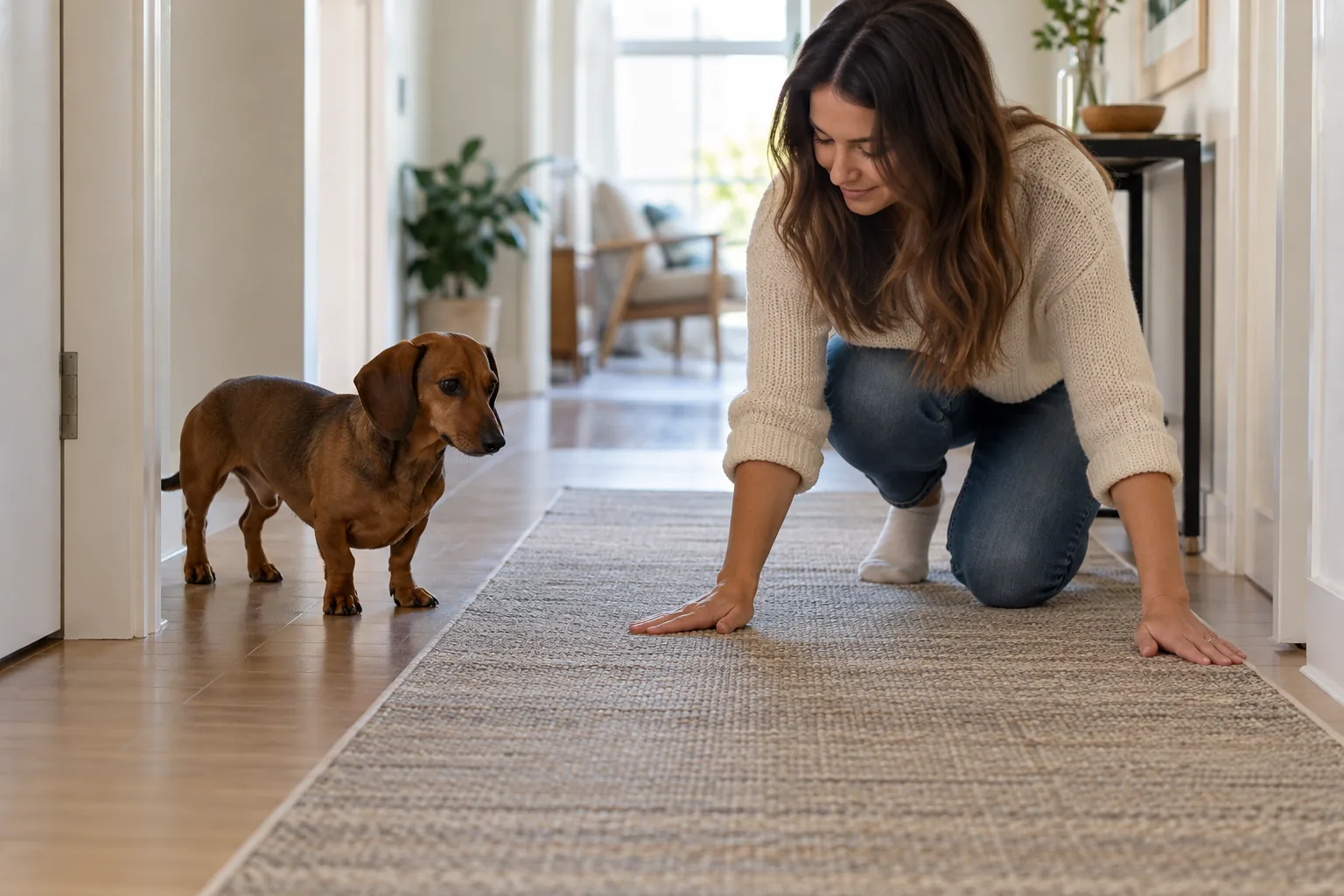
    Dachshund home setup with a flat hallway traction runner

    Hardwood and tile can be easy to clean but may be slippery. AKC’s flooring advice suggests rugs or runners at high-use routes and around food bowls or entryways. Choose low-profile pieces that lie flat, stay fixed, and can be cleaned. A mat at the door can also absorb wet paws before the dog runs onto smooth flooring.

    Focus on launch and landing zones, tight corners, and the route to outdoors. A single decorative rug in the center of a room may do little if the dog skids between it and the sofa. Watch whether the dog actually feels confident on the surface. Keep nails appropriately maintained, since overlong nails may affect grip; ask a groomer or veterinarian if handling is difficult.

    Do not treat rugs as an IVDD prevention guarantee. Back problems have multiple factors, and the evidence for any one household change is not a promise of protection. Traction is a practical way to make movement more controlled. Dachshund Health UK’s back-disease factsheet encourages care around furniture jumps and running down stairs but does not make a no-risk claim.

    Manage heights and stairs with a real plan

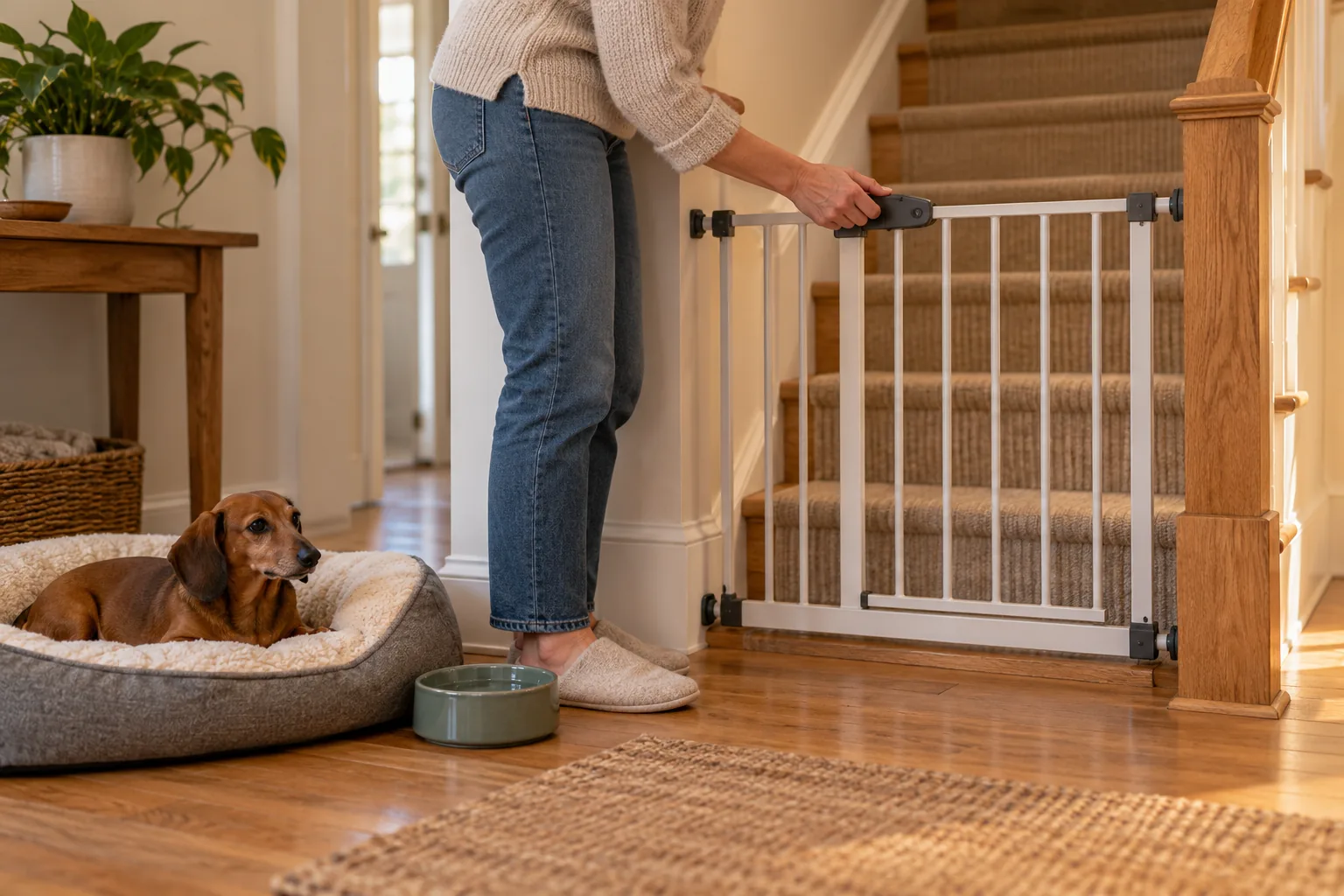
    Owner checking a stair gate with Dachshund bed and water on the same floor

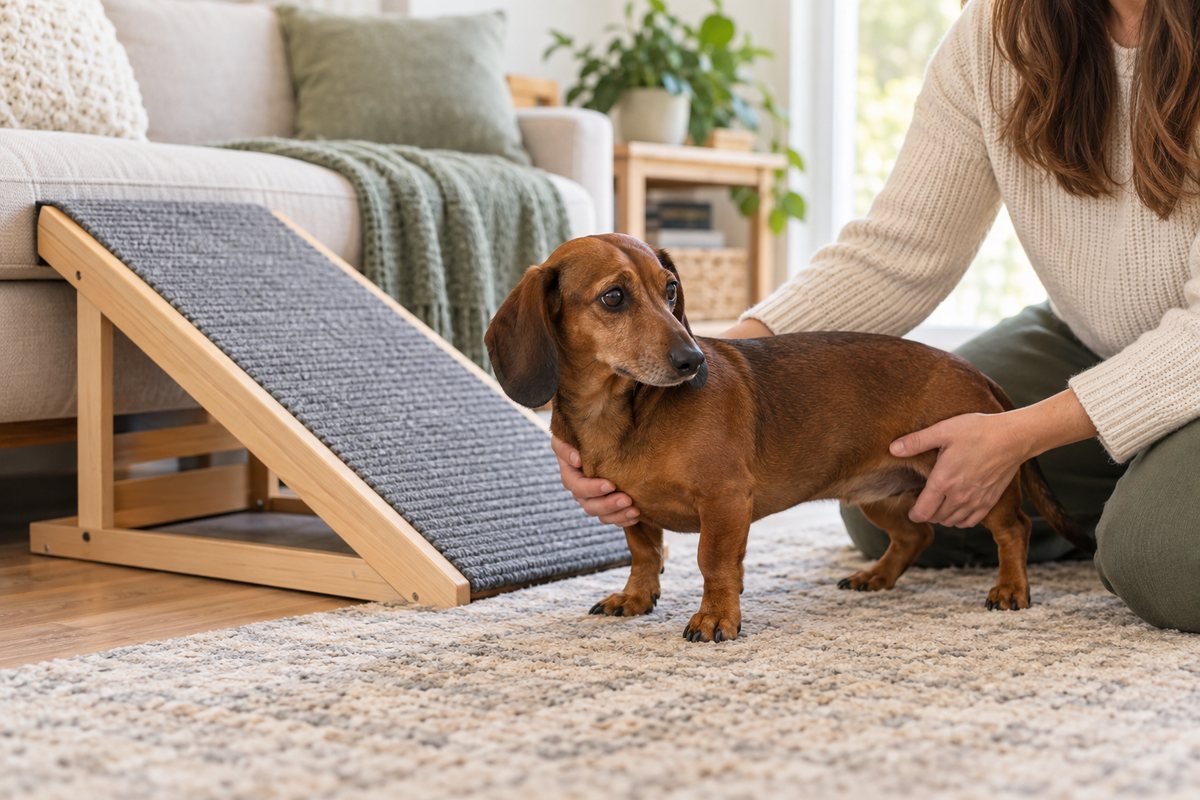
    Decide which furniture access is allowed. If the dog is allowed on a sofa or bed, provide a stable, usable access route and teach it; block the edge where the dog tends to leap. If access is not allowed, give an appealing floor-level bed near people and keep the rule consistent. A ramp is not a safety improvement when it is too steep, slides, or the dog ignores it. The dedicated stair and back-safety guides handle technique and evidence in more detail.

    At stairs, use a secure gate or supervision where appropriate. Consider where the dog sleeps, eats, and toilets so routine care does not require many trips between levels. A gate should be installed correctly and checked for gaps a low dog can squeeze through. Never step over a gate while carrying a wiggling dog if that creates a fall risk. For a dog with pain, weakness, or recent IVDD, use the treating veterinarian’s mobility instructions.

    An apartment may have no interior stairs but a shared elevator, lobby, and busy door. Plan how the dog gets outside without bolting through an entrance or meeting other dogs at close quarters. A small home can work well if its paths are clear and the dog has predictable rest and activity.

    Create management zones, not isolation

    Gates and doors can make visitor arrivals, cleaning, and meals calmer. Set up a space with bedding and water where the dog can relax during temporary management. Introduce it gradually; a dog that panics behind a gate needs training and possibly professional help, not simply a stronger barrier. The aim is predictable access, not confinement throughout the day.

    Keep electrical cords, medication, cleaning products, and human food stored securely regardless of the dog’s age. AKC’s household-hazards overview notes that common products and small items can be chewed or swallowed. The puppy-specific guide gives a room-by-room sweep, but adults can also explore a dropped pill or open trash.

    If you share the home with other dogs or cats, provide separate feeding and rest options and ensure each animal can retreat. Do not place all resources in one narrow passage. This is part of home function, not a claim that every pet pairing will succeed without a separate introduction plan.

    Adapt the setup as the dog changes

    Revisit the layout after a move, new furniture, weight change, injury, or aging. A dog that once bounded across a room may later need shorter, non-slip routes and more accessible rest areas. AKC’s senior-home guidance discusses traction and accessible furniture, but a new refusal to move or sudden weakness should still be assessed medically.

    Use a short monthly walkthrough: are rug edges flat, gates secure, routes clear, water accessible, and ramps stable? Check whether the dog uses the intended path when excited, sleepy, and alone with family. The behavior during ordinary life is more informative than a single demonstration while holding treats.

    A practical room-by-room audit

    Area Watch for Practical adjustment
    Living room Sofa leaps, slick turns, crowded pathways Floor-level rest near people, stable access plan, secured runner
    Bedroom Repeated bed jumps or inaccessible water Decide furniture rule; add accessible bed and water as needed
    Entry Bolting, wet paws on smooth floor Leash station, secure door routine, flat non-slip mat
    Stairs Unplanned repeated trips Gate or supervised access; organize essentials on one level
    Kitchen Spills, food scraps, chemicals Secure storage, clean footing, separate meal spot

    This table is a starting point. A dog with an injury needs an individualized veterinary plan, not merely generic home modifications.

    Frequently asked questions

    Does every Dachshund need a ramp?

    No single product fits every home. The question is whether the dog is repeatedly jumping from a height and whether a stable trained alternative will actually be used. Some households choose to keep the dog at floor level instead.

    Is a slippery floor dangerous?

    Poor traction can make movement less controlled. AKC suggests rugs and runners in high-use areas. This does not mean a rug guarantees prevention of back disease.

    Where should the bed go?

    Choose a quiet, accessible place where the dog can rest without being constantly disturbed, and consider another floor-level spot near family life if that helps reduce high-furniture access.

    Should food and water be on every floor?

    Make water reliably accessible without unnecessary stair use. The best layout depends on the home’s levels and the dog’s mobility. If a new difficulty reaching essentials appears, consult a veterinarian.

    Sources

  • Are Dachshunds Hypoallergenic? What Allergy-Sensitive Homes Should Know

    Are Dachshunds Hypoallergenic? What Allergy-Sensitive Homes Should Know

    Direct answer

    Are Dachshunds hypoallergenic? No, a Dachshund is not a reliably hypoallergenic dog. The AKC’s Dachshund suitability guide explicitly says the breed is not hypoallergenic. More importantly, the American College of Allergy, Asthma and Immunology (ACAAI) says no breed can be guaranteed not to trigger symptoms in a dog-allergic person. Choosing a smooth coat, a miniature dog, or a dog advertised as “low shedding” is not a medical test of household tolerance.

    People can react to proteins associated with a dog’s dander, saliva, urine, and other materials. The National Institute of Environmental Health Sciences (NIEHS) explains that fur often carries allergens but is not the whole source. A person with significant allergy or asthma should discuss the decision with an allergist before adopting. This page is an owner-suitability guide, not a diagnosis or a promise that cleaning will eliminate symptoms.

    Are Dachshunds hypoallergenic? Shedding is not the same as allergen exposure

    All three Dachshund coat varieties shed to some extent, though the amount of visible hair and grooming workload differ. The AKC breed profile provides a shedding-level overview, and the AKC suitability guide notes that long-haired and wire-haired coats need more regular grooming than smooth coats. None of that establishes that a smooth-coated Dachshund is safe for an allergic household.

    The NIEHS states that all breeds, even hairless dogs, can trigger allergies. Allergen particles can move through indoor air and settle on furniture, carpets, and clothing. A clean-looking dog can still expose a sensitive person. Conversely, two people with the same broad “dog allergy” label may react differently in a particular home. Do not turn that variability into a sales claim that one dog is guaranteed compatible.

    What “hypoallergenic” can and cannot mean

    In marketing, “hypoallergenic” often implies low shedding or reduced allergen exposure. It is not a certification that a dog produces no allergens. The ACAAI explains that individual dogs and people vary, and there is no guarantee that choosing a particular breed will prevent symptoms. A breeder cannot certify a puppy as allergy-safe based on coat length, color, or parent appearance.

    Beware of claims such as “wire-haired Dachshunds are allergy-free,” “miniatures are too small to cause reactions,” or “weekly baths solve dog allergy.” These statements skip the actual medical question: what is the person’s allergy, how severe is it, and what exposure level can they tolerate? Products and grooming may reduce some exposure, but they are not a cure.

    Plan before bringing a dog home

    Are Dachshunds hypoallergenic? Grooming does not make a Dachshund allergen-free

    If anyone in the household has suspected dog allergy, seek a clinician’s assessment rather than relying on a quick online checklist. The ACAAI recommends evaluation by an allergist when considering a pet. Ask about testing, current symptoms, asthma control, and what a realistic exposure-management plan would involve. Do not discontinue prescribed treatment because a dog is described as low shedding.

    Spending time with Dachshunds can be informative, but a brief visit is not a definitive medical challenge. The person’s symptoms may depend on duration, environment, cleaning, medication, and the individual animal. If you arrange visits, make them meaningful and discuss any reaction with the clinician. A foster-to-adopt arrangement, when available and ethically appropriate, may provide more information than buying a puppy after one short cuddle; still, the medical advice should guide the decision.

    Consider every household member. A child who wheezes after dog exposure may need a very different plan from an adult with mild seasonal symptoms. Severe reactions or poorly controlled asthma require caution and professional advice. Rehoming later can be painful for people and dog, so honest preparation matters.

    Reducing exposure if you already live with a Dachshund

    Dachshund resting outside a gated dog-free bedroom

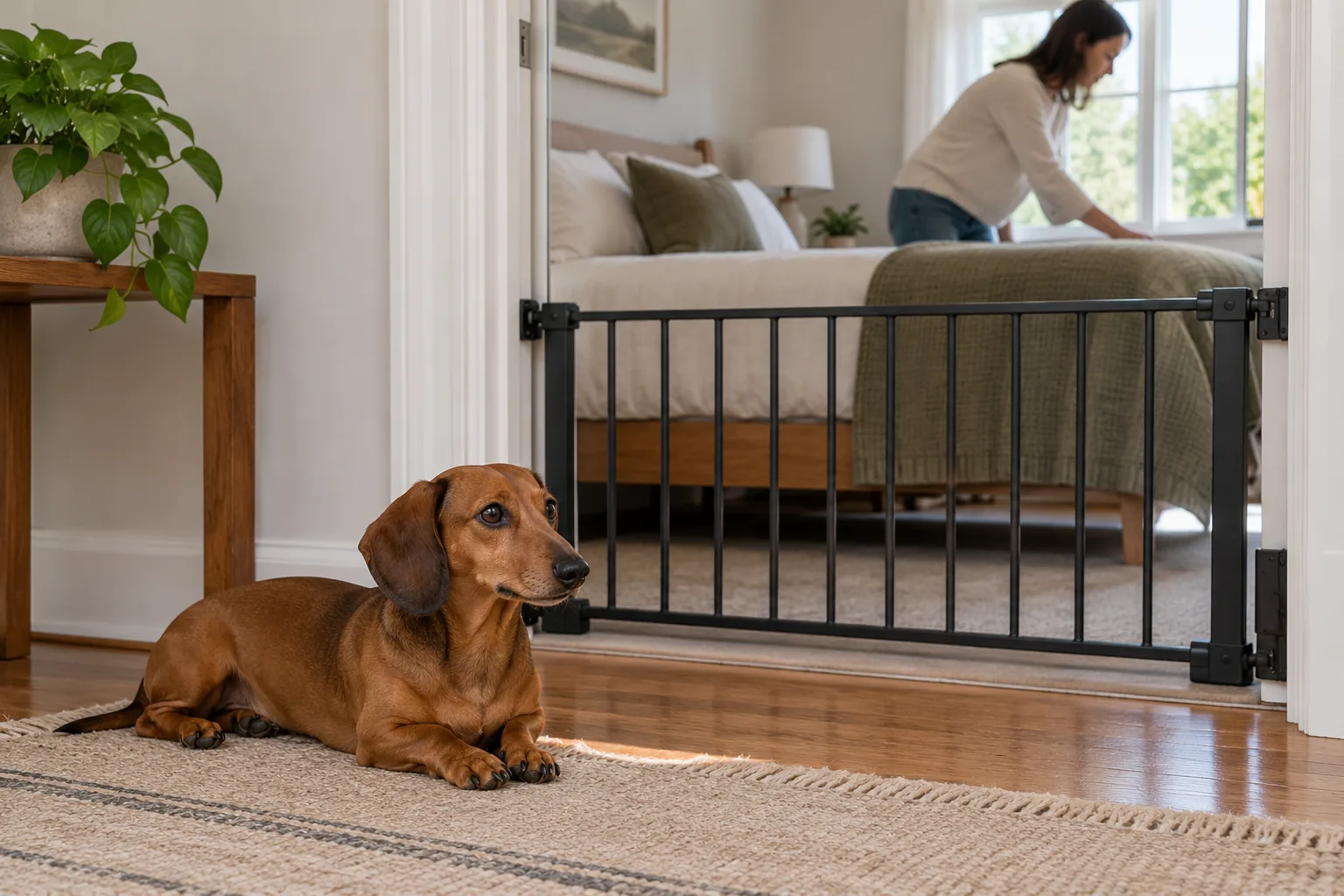
    The NIEHS pet-allergen guidance lists practical ways to lower exposure, including keeping pets out of an allergic person’s bedroom, cleaning textiles, vacuuming with suitable filtration, and using an appropriate air cleaner. Discuss which steps are worth taking with an allergist. Their usefulness varies by home and person, and none guarantees a symptom-free household.

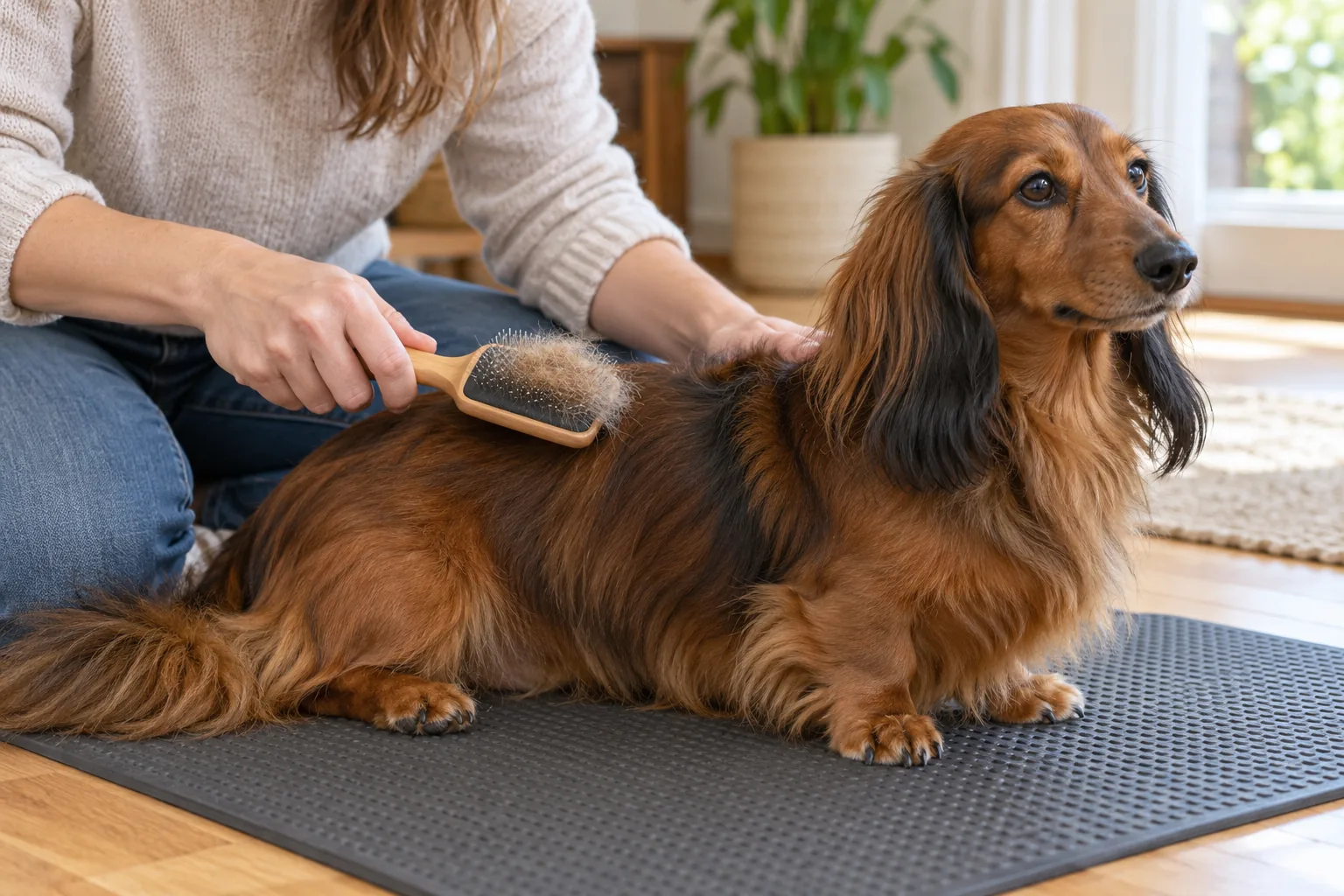
    Have a non-allergic person handle grooming if that reduces exposure. Wash hands after close contact and avoid letting the dog lick an allergic person’s face. Maintain the dog’s skin health and choose grooming products for the dog, not solely as an allergy intervention. Excessive bathing can irritate skin; ask a veterinarian before increasing bath frequency. Our coat-care pages cover grooming needs separately.

    Track symptoms and where they occur. If a person is repeatedly wheezing, coughing, or needing more medication after dog contact, do not simply add more fragrance or shampoo. Seek medical advice. The dog’s welfare also matters; a dog should not endure an unsuitable or excessive grooming regimen to make an unsafe household match appear workable.

    Coat-type comparison without false promises

    Smooth: Short coat, generally simpler grooming, but still sheds and carries allergens.

    Long-haired: Feathering needs more brushing and can hold environmental debris, but that does not prove a higher or lower personal allergy response.

    Wire-haired: Coat care may include specialized grooming; visible shedding patterns can differ, but the coat is not allergen-free.

    This comparison concerns maintenance, not a ranking of medical safety. Our smooth-versus-long and wire-versus-long guides explain the grooming differences in detail. The NIEHS is clear that all dog breeds can trigger allergy.

    A practical example

    An owner with a known dog allergy visits a smooth-coated Dachshund for ten minutes and feels fine. The breeder says that proves the puppy will be safe. It does not. The owner should speak with an allergist, consider longer and repeated exposure in realistic settings, and make a plan for what happens if symptoms increase at home. A good adoption decision respects both the person’s health and the dog’s long-term stability.

    Frequently asked questions

    Is a smooth-haired Dachshund better for allergies?

    It may be easier to groom, but it is not a guaranteed lower-allergen choice for a specific person. The ACAAI cautions against relying on breed or coat labels to prevent symptoms.

    Do Dachshunds shed?

    Yes. Amount and grooming needs vary by coat. Visible hair is only one part of allergen exposure; NIEHS identifies dander and saliva among the relevant sources.

    Can regular baths make a Dachshund hypoallergenic?

    No. Exposure management may help some households but cannot make a dog allergen-free. Choose a bath routine with veterinary advice for the dog’s skin and an allergist’s advice for the person’s health.

    Should an allergic person avoid all Dachshunds?

    The answer depends on the person, severity, and medical advice. Do not assume either guaranteed tolerance or guaranteed inability to live with any dog. Consult an allergist before committing to adoption.

    Sources

  • Dachshund Puppy-Proofing: A Room-by-Room Safety Sweep

    Dachshund Puppy-Proofing: A Room-by-Room Safety Sweep

    Direct answer

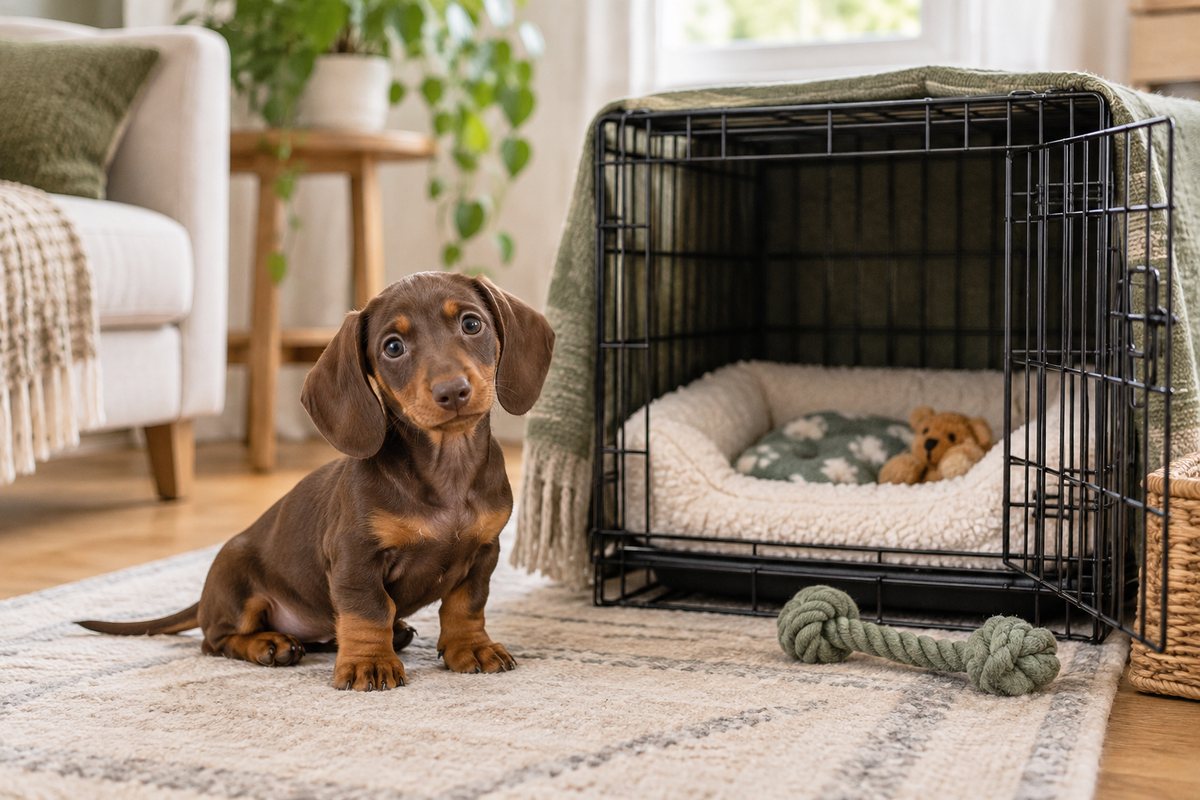
    Dachshund puppy proofing home starts from the floor up, before the puppy arrives. A Dachshund puppy can reach under furniture and find items adults overlook: cords, pills, wrappers, children’s toys, cleaning products, plant leaves, and gaps behind appliances. Move hazards out of reach, secure storage, block unsafe areas, and create one supervised exploration zone. Recheck it as the puppy grows and learns to climb or chew. AKC’s puppy-proofing guidance identifies cords, medication, cleaning supplies, food hazards, windows, and blind cords among common risks.

    This is an urgent hazard-removal checklist for a curious young dog. The adult-home guide is about sustainable routes, rest, and traction; the potty and crate guides teach specific routines. Gates and pens support management but do not make a room safe unless the contents are safe too.

    Start with a puppy-height inspection

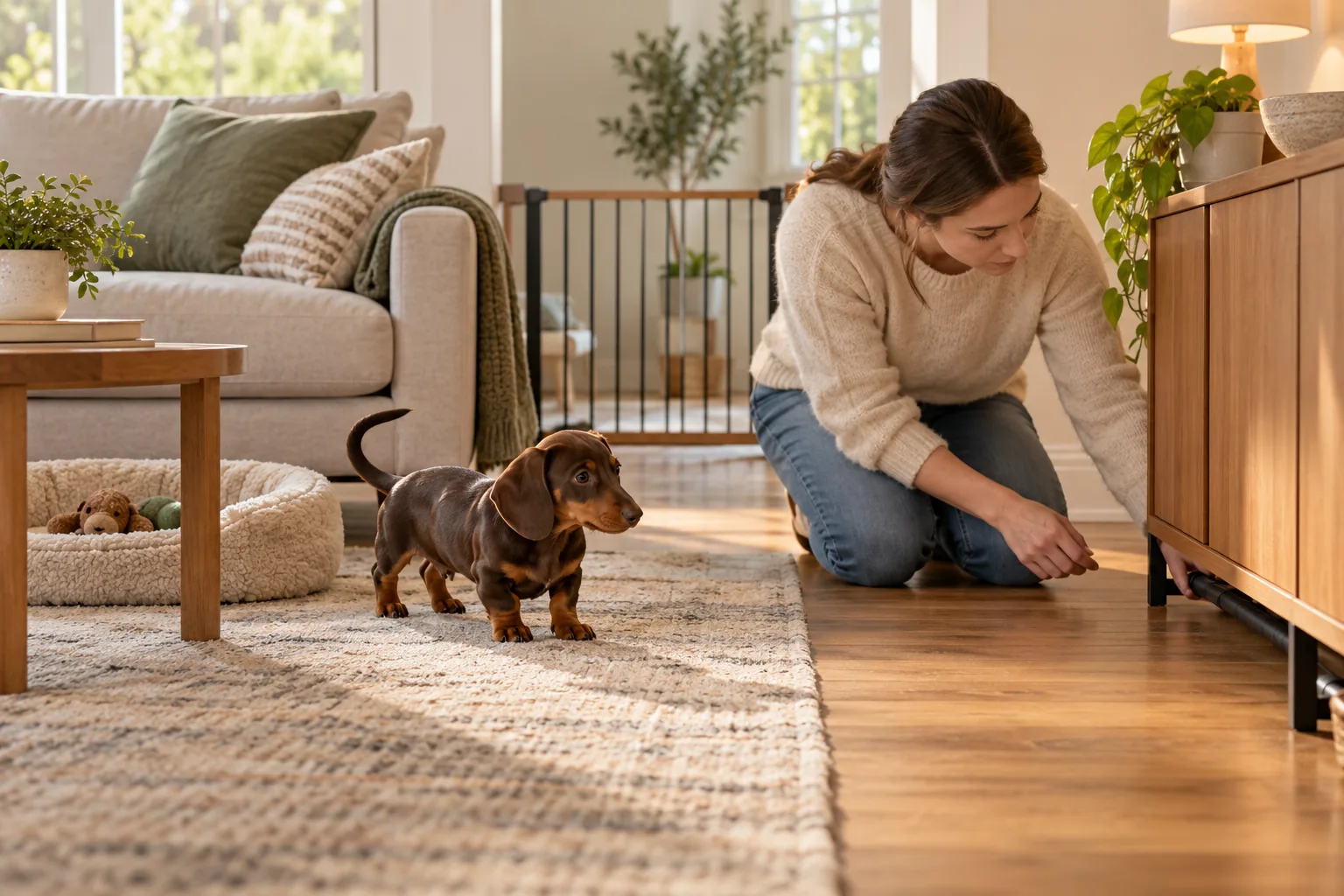
    Get down to the level of a small dog and scan along baseboards, behind the sofa, under low cabinets, and near the front door. Ask what can be chewed, swallowed, pulled down, trapped around a neck, or used as an escape route. A puppy can squeeze behind furniture that an adult dog cannot. Move furniture or block the gap if you cannot supervise access.

    Do a first sweep before arrival, then repeat after a week and again whenever the puppy gains confidence. A cord ignored on day one may become attractive during teething. Visitors, children, and delivery boxes add new items to the floor. Do not rely on a single “puppy-proofed” sticker or a verbal “leave it” cue to prevent contact with serious hazards.

    Separate high-priority risks from less urgent inconvenience. Exposed wiring, medication, toxic food, unstable furniture, open balconies, and escape gaps need physical prevention. A slipper taken from the floor is a training and storage problem, but it should not distract from the danger of a dropped tablet.

    Living room: cords, tiny objects, and heights

    Unplug and reroute cords or cover them with suitable cord protection; do not simply put a toy in front. AKC warns that chewing electrical cords can cause burns or shock. Collect batteries, remote controls, coins, beads, toy parts, hair ties, and loose packaging from floor level. Check under couches and cushions, not only the visible carpet.

    Secure blind cords and hanging fabric that could wrap around the puppy. Move unstable lamps and small tables that might topple if the puppy pulls a cable or cloth. Plan a low, stable resting area so the puppy need not leap from furniture to follow people. A Dachshund’s long back warrants thoughtful handling and access choices, but no one household arrangement eliminates IVDD risk.

    Rugs should lie flat and provide traction rather than creating trip edges. Teach family members to look before moving chairs or opening recliners; a small dog can rest out of sight. Supervise any new puzzle or chew toy until you know the puppy cannot break off pieces.

    Kitchen and dining: food is not automatically safe

    Dachshund puppy proofing home: owner securing household products in a latched cabinet

    Close trash, clear counters and low shelves, and do not leave plates where a puppy can reach them by climbing. AKC’s puppy-proofing article specifically highlights chocolate, raisins, and xylitol-containing foods among hazards. ASPCA’s xylitol warning notes that the sweetener can appear in products beyond gum and candy. Store all human food securely rather than trying to remember only a few dangerous examples.

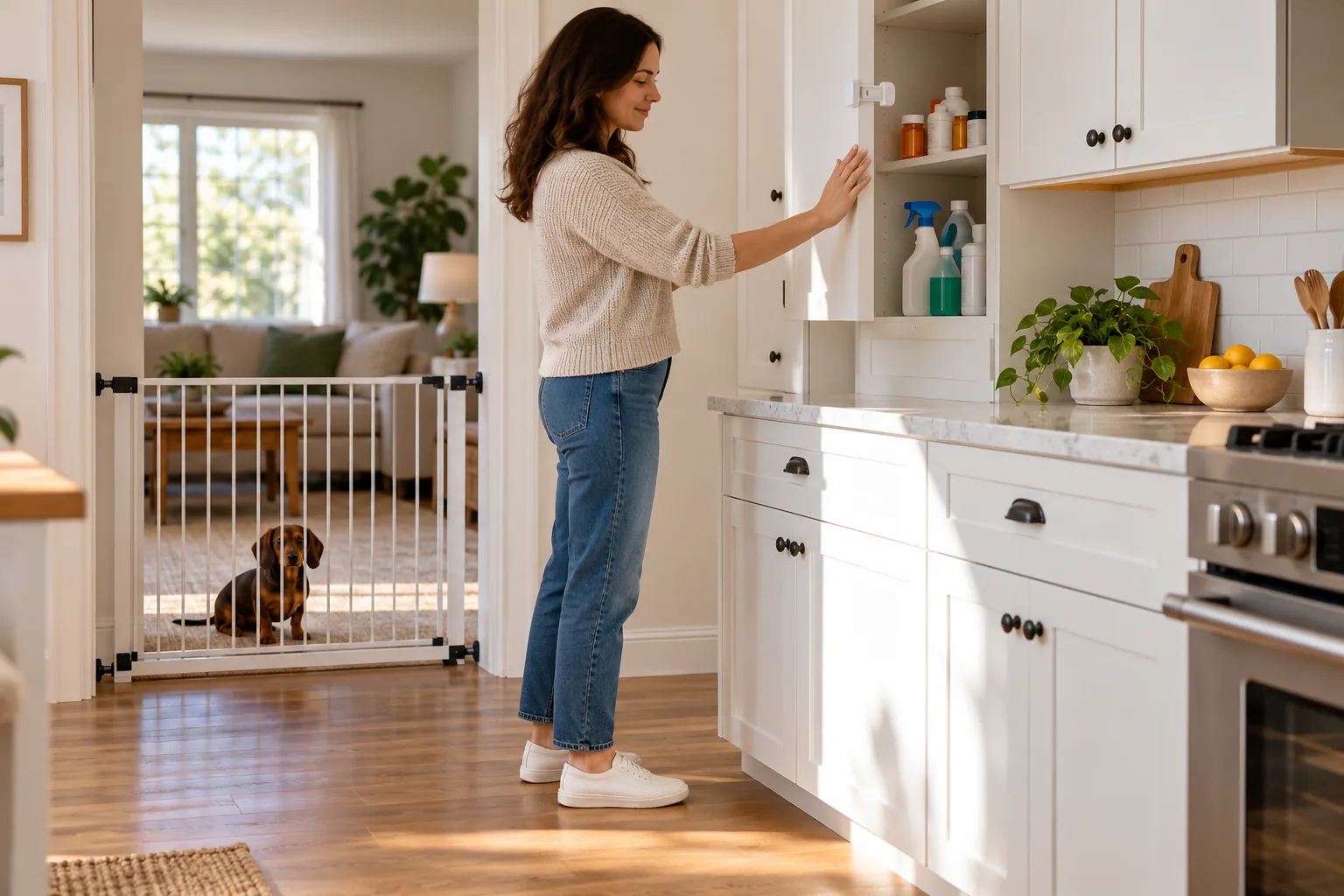
    Keep cleaners, dishwasher products, sharp tools, and bins behind secure doors or high enough that a puppy cannot reach them. Childproof latches can help, but test whether the door actually remains closed. During cleaning, keep the dog out of the area until products are used and dried according to their directions. Do not leave a wet chemical bucket or laundry pod where a puppy can investigate.

    Give the puppy a consistent feeding area away from foot traffic and hot cooking surfaces. Remove food spills promptly. Teach household members not to hand out scraps without checking whether an ingredient is suitable and whether it disrupts the puppy’s diet.

    Bedroom and bathroom: pills and small items

    Put human medication, supplements, and pet medication in secure cabinets, not on a bedside table, bathroom counter, or in an open handbag. AKC warns that even pill bottles or dispensers are unsafe at low or accessible locations. Close laundry hampers if socks and underwear are being chewed. Store razors, cotton buds, dental floss, cosmetics, and hair ties beyond reach.

    Keep toilet lids closed and manage bathroom bins. Check plug-in devices and cords. A puppy can enter while someone showers and find a dropped item before it is noticed. Make door rules clear: either the room is prepared and supervised, or it stays shut.

    If the puppy may sleep in the bedroom, plan how it will reach a safe bed and be taken out for toileting without jumping from adult furniture. The exact crate or sleep routine belongs to its own guide; this page is about preventing access to hazards.

    Doors, stairs, and outside access

    Install gates according to the maker’s instructions and check for a gap a low puppy could slip through. A gate is not a substitute for closing the exterior door. Set a household routine in which the puppy is behind a barrier or held securely before anyone opens the front door. Update microchip and ID information promptly according to your veterinarian’s advice.

    Check windows, balconies, deck rails, garden fences, and gaps under gates. A small Dachshund may fit through openings that appear too narrow for a larger dog. Inspect the yard for toxic plants, fertilizers, pesticides, standing water, sharp debris, and escape routes. AKC’s puppy-proofing guide addresses both house and yard hazards. Supervise the puppy outside even after the fence passes inspection.

    Manage stairs and furniture access from day one so repeated leaps are not practiced. Do not assume the puppy will wait for help when excited. A gate or closed door is more reliable than calling “stay” while carrying groceries.

    Create a safe exploration zone

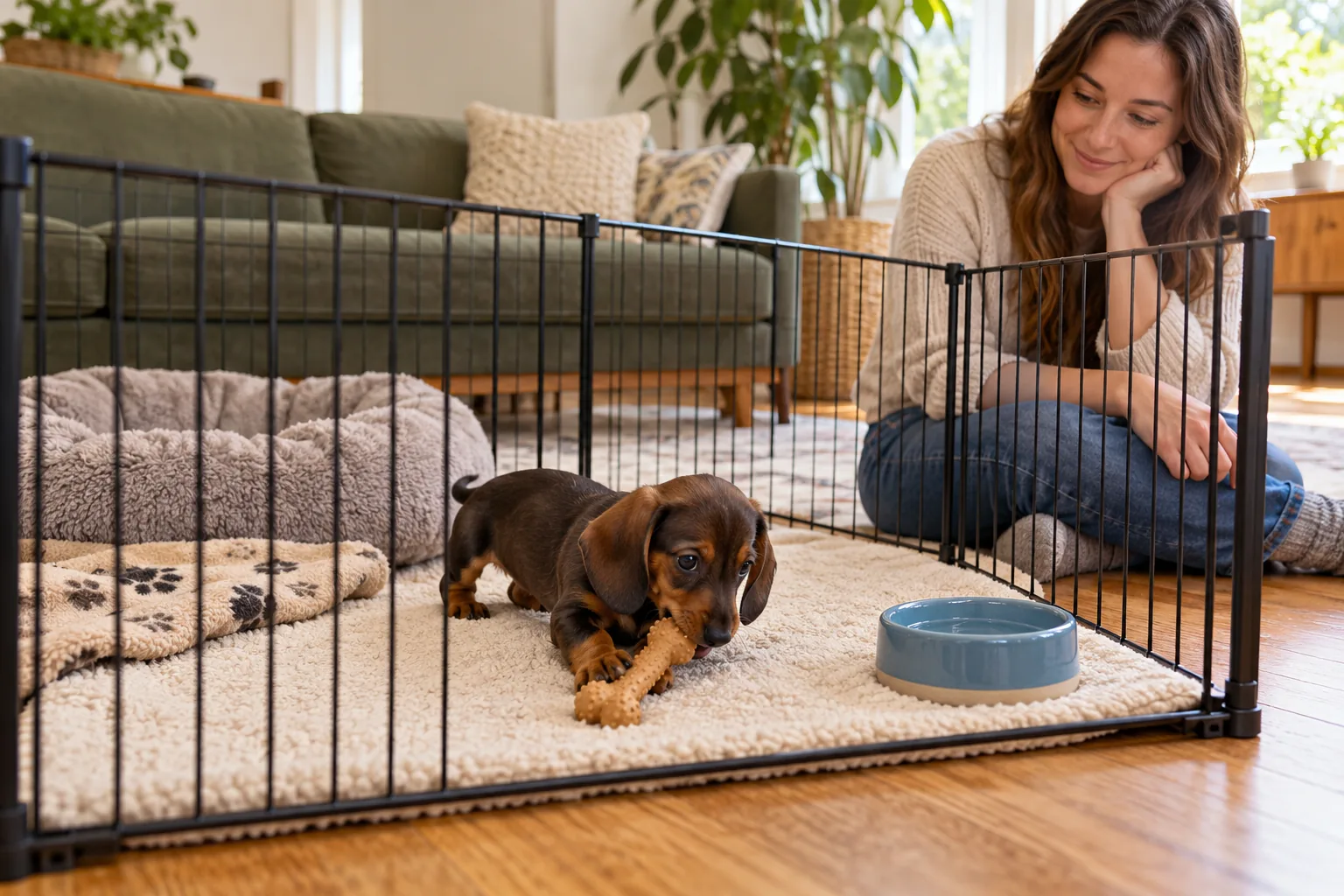
    Dachshund puppy with a supervised chew toy, bed, and water inside a pen

    For a Dachshund puppy proofing home plan, choose one manageable area with a comfortable rest place, suitable chew options, and water as appropriate to the puppy’s schedule. Clear cords and toxins before adding a pen or gate. Give the puppy supervised time to explore, then rest; do not use a pen as all-day isolation. AKC’s management guidance describes gates and a prepared room as ways to control access while the puppy learns.

    Introduce any enclosure gradually with rewards and calm exits. If the puppy becomes distressed, reassess the setup and training rather than merely adding another lock. Check toys and bedding for damage daily. A product safe under supervision may not be safe left alone if the puppy tears or swallows parts.

    Establish shared rules for every person in the household: shoes and medications go away, the bin closes, doors are checked, and the puppy is watched during free exploration. Puppy-proofing succeeds when the whole home follows the same physical system, not when one person remembers a checklist once.

    What to do after a suspected ingestion

    Move the puppy away from the substance and contact a veterinarian or animal poison service promptly. Save the package and estimate what, how much, and when exposure occurred. Do not induce vomiting or offer a home remedy unless a veterinary professional instructs you to do so. ASPCA Poison Control says its general information cannot assess a specific exposure and urges immediate professional contact for suspected poisoning. In the U.S., its Animal Poison Control Center is 888-426-4435; elsewhere, use a local veterinarian or poison service.

    If the puppy has chewed a live electrical cord, do not touch the puppy or wire until the power is safely disconnected. Seek urgent veterinary care. If a small object may have been swallowed, contact the veterinarian even if the puppy initially seems normal; do not wait for a blockage to become obvious.

    A practical pre-arrival sweep

    Area Remove or secure first Recheck after arrival
    Living room Cords, batteries, small toys, unstable lamps Under furniture; chew damage
    Kitchen Toxic foods, cleaning products, trash Dropped scraps and open bins
    Bedroom/bath Medicines, floss, socks, cosmetics Bags left on the floor
    Entry/stairs Escape gaps, stair access, open-door routine Gate fit and visitor habits
    Yard Fence gaps, chemicals, plants, sharp items New holes and seasonal treatments

    Frequently asked questions

    Is one baby gate enough?

    Only if the area behind it has been checked and the gate fits securely. A gate does not remove cords, medicines, or small objects from the puppy’s reach.

    Can I rely on “leave it” training?

    Teach it as a valuable skill, but use physical prevention for high-consequence hazards. A new puppy is not reliable around a dropped pill or live cord.

    When should I recheck the home?

    After the first week, during teething, whenever the puppy gains access to a new room, and after furniture or household routines change. Curiosity and reach change rapidly.

    What if the puppy eats something unknown?

    Contact a veterinarian or animal poison service promptly. Keep packaging and timing information, and do not attempt treatment based on a generic article.

    Sources

  • Best Games for Dachshunds: Safe Indoor & Enrichment Ideas

    Best Games for Dachshunds: Safe Indoor & Enrichment Ideas

    The best games for Dachshunds use their nose, brain, and short bursts of movement without encouraging risky jumping. Dachshunds were bred to track, investigate, dig, and solve problems, so many of the best games are scent games, food puzzles, low-impact training games, hide-and-seek, and controlled fetch alternatives. The goal is a calmer, happier dog, not a frantic dog with a sore back.

    Dachshund playing a calm indoor enrichment game with owner

    This guide gives you safe Dachshund game ideas for puppies, adults, seniors, apartment living, rainy days, and training sessions. If your Dachshund has back pain, limping, weakness, wobbliness, or a recent injury, ask your veterinarian what activities are safe before adding new games.

    Best games for Dachshunds: quick answer

    Start with find-it games, snuffle mats, treat trails, toy hide-and-seek, short trick sessions, name-the-toy, gentle tug with rules, and low-impact fetch on non-slip floors. Avoid repeated jumping, twisting catches, and stairs-based games. Cornell’s IVDD guidance recommends minimizing jumping and time spent going up and down stairs for dogs prone to disc problems, which is directly relevant to Dachshund play choices.

    Best games by goal

    GoalBest gameWhy it fits Dachshunds
    Calm mental workSnuffle matUses the nose and slows eating
    Rainy day energyFind the treatLow impact and easy indoors
    Training focusName response and hand targetBuilds useful everyday skills
    ConfidenceEasy puzzle feederRewards problem solving
    BondingHide-and-seek with ownerEncourages check-ins
    Safe movementLow rolling fetchMovement without high jumps

    If your Dachshund gets overexcited, choose nose work before movement. Sniffing can be tiring in a good way, especially for dogs that bark, pace, or demand attention.

    Scent games

    AKC highlights scent work and jobs at home as ways to channel a dog’s natural instincts. Dachshunds are natural investigators, so scent games often feel more satisfying than endless ball chasing.

    1. Let your Dachshund watch you place a treat under one cup.
    2. Say “find it” and let them sniff.
    3. Reward when they choose the right cup.
    4. Add two empty cups.
    5. Move the game to another room once they understand.
    6. Hide treats under towels, in boxes, or along a safe trail.

    Keep treats tiny. For food-motivated dogs, use part of the meal as game rewards. See best treats for Dachshund training for low-calorie reward strategy.

    Dachshund food rewards portioned for scent games

    Puzzle and food games

    Puzzle toys are useful when they are easy enough to prevent frustration and sturdy enough for your dog’s chewing style. Start simple. A beginner puzzle that your Dachshund can solve calmly is better than an expert toy that creates barking and pawing.

    • Snuffle mat with kibble.
    • Muffin tin with tennis balls over treats.
    • Treats rolled in a towel.
    • Cardboard box search with supervision.
    • Slow feeder at meal time.
    • Frozen lick mat if your dog tolerates it and calories are counted.

    Training games

    Training games are enrichment because they make your Dachshund think. Use short sessions and clear rewards. Good games include hand target, go to mat, find your toy, touch, spin slowly, wait, and recall between two people.

    For a skills list, use Dachshund commands to teach. For puppies, connect games to your Dachshund puppy schedule so play does not replace naps.

    Games to avoid or modify

    GameRiskSafer version
    High ball throwsJumping and twistingRoll toy along floor
    Stair fetchRepeated stairs and impactFlat hallway find-it
    Rough tugNeck and back twistingGentle tug with drop cue
    Chasing on slick floorsSlippingUse rugs or play on traction
    Jumping tricksImpactTeach nose target or mat work
    Dachshund playing low-impact games that protect the back

    Daily game routine

    • Morning: 5 minutes of find-it after potty break.
    • Midday: puzzle feeder or snuffle mat.
    • Afternoon: short training game.
    • Evening: calm hide-and-seek or chew time.
    • Before bed: quiet sniffing or settle mat, not wild chase.

    If games cause barking, nipping, frantic zooming, or refusal to settle, simplify. Many Dachshunds need better-paced enrichment, not more intensity.

    FAQ

    What games do Dachshunds like most?

    Many love scent games, food puzzles, hide-and-seek, gentle tug, and short training games. Nose work is often more satisfying than high-impact chasing.

    Is fetch bad for Dachshunds?

    Fetch can be okay if it is low, short, and controlled. Avoid high throws, twisting catches, slick floors, and stair fetch.

    How much play does a Dachshund need?

    Several short sessions usually work better than one long session. Puppies also need plenty of sleep, and seniors may need gentler games.

    A weekly Dachshund game menu

    Rotate games so your Dachshund does not get bored or over-aroused. Nose work can happen most days. Movement games should stay low-impact. Training games can be very short because mental effort adds up quickly for a clever, food-motivated dog.

    DayGameGoal
    MondayFind-it treatsScent work
    TuesdayName the toyListening and memory
    WednesdaySnuffle dinnerSlow feeding
    ThursdayHand target courseFocus and movement
    FridayHide-and-seekRecall and bonding
    SaturdayLow rolling fetchSafe activity
    SundayCalm chew and settleRecovery

    Games for multi-dog homes

    If you have more than one dog, run food games separately unless you know there is no guarding. Dachshunds can be intense around food and toys. Separate puzzle time prevents competition and lets each dog work at their own level. Group games should be simple, low-value, and supervised.

    Game safety rules for Dachshunds

    The best Dachshund games use the nose and brain without turning every session into high-impact jumping. Avoid repeated leaps, sharp turns on slick floors, and tug games that twist the neck or back. Use rugs, keep fetch low and short, and choose sniffing games when your dog is already excited.

    Game typeGood choiceSkip or modify
    FetchLow rolling toyHigh bouncing throws
    Hide and seekPerson hides in easy spotStairs or jumping onto furniture
    TugGentle side-to-side controlHard lifting or shaking
    PuzzlesBeginner level firstFrustrating hard puzzles
    Scent workFood scatter or find-itUnsafe objects to chew

    Best games by life stage

    • Puppies: short find-it games, name response, gentle toy play.
    • Adults: scent trails, toy names, low-impact fetch, training games.
    • Seniors: slow sniff walks, easy puzzle meals, calm handling games.
    • Over-aroused dogs: sniffing and chewing before active games.
    • Shy dogs: simple wins that build confidence without pressure.

    Low-impact game plan for Dachshunds

    The best games for Dachshunds use their nose, brain, and problem-solving without turning every play session into jumping, twisting, or frantic chasing. Think scent games, hide-and-seek, trick training, gentle tug rules, and food puzzles.

    A good game should leave your dog satisfied, not overstimulated. If your Dachshund barks more, mouths harder, or cannot settle after play, the game may be too intense or too long.

    SituationWhat it suggestsBest next step
    Rainy dayIndoor energyUse scent boxes or towel scatter
    PuppyShort focusPlay two-minute training games
    SeniorMobility limitsUse nose work and easy puzzle toys
    BarkerArousal controlChoose sniffing before window triggers
    Food-motivated dogCalorie riskUse meal portions as rewards

    best games for Dachshunds: practical checklist

    1. Keep high-energy games short.
    2. Avoid repeated jumping for toys.
    3. Use rugs or traction for indoor games.
    4. Let your dog sniff and search instead of only run.
    5. End with a calm chew or settle cue.
    6. Rotate games so your dog does not become frustrated.

    When to change course

    If a game triggers guarding, frantic barking, or body soreness, remove that version and choose a calmer activity. Enrichment should improve daily life, not create a new problem.

    best games for Dachshunds: owner scenarios and fixes

    The final step for best games for Dachshunds is matching the advice to the exact situation in front of you. Dachshunds are small, persistent, routine-sensitive dogs, so a plan that looks correct on paper can fail if the room setup, timing, gear, reward value, or health context is wrong. Before changing everything, choose the one pattern that happens most often and work there first.

    This also helps prevent mixed signals. If you sometimes reward the unwanted pattern, sometimes interrupt it, and sometimes ignore it, your Dachshund may keep trying the behavior because the rules are unclear. A simple plan that everyone in the home follows for one week is usually more useful than a complicated plan that changes every day.

    Owner situationHow to handle it
    When the main issue is rainy dayStart with the practical fix: use scent boxes or towel scatter. Give it several calm repetitions before adding a second change.
    When the pattern looks like puppyAssume the setup is slightly wrong for your Dachshund and adjust the environment before expecting better behavior.
    When you see seniorSlow the plan down. Dachshunds often improve faster when the next step is easier, clearer, and more predictable.
    When barker keeps returningLook for a trigger that happens before the problem. Changing that trigger usually works better than reacting afterward.
    When food-motivated dog is involvedTreat it as a sign to re-check fit, comfort, schedule, or health rather than assuming your dog is ignoring you.

    How to make the plan easier for your Dachshund

    If progress stalls, make the next repetition easier instead of louder or longer. For best games for Dachshunds, easier can mean more distance, a shorter session, a lower height, a quieter room, softer handling, smaller rewards, or fewer choices. The easier version should let your dog succeed while still practicing the skill you want.

    Watch recovery time. A Dachshund who can return to sniffing, eating, resting, or walking normally is usually in a workable zone. A dog who stays frantic, stiff, avoidant, or obsessed with the trigger is telling you the setup is too difficult. That is useful information, not a training failure.

    7-day improvement plan

    1. Day 1: write down when the best games for Dachshunds problem happens, where it happens, and what happened right before it.
    2. Day 2: remove the easiest trigger or setup mistake connected to rainy day.
    3. Day 3: practice the first checklist step: keep high-energy games short..
    4. Day 4: repeat the same plan at an easier level instead of adding a new rule.
    5. Day 5: add one support step from the checklist: avoid repeated jumping for toys..
    6. Day 6: ask whether your dog recovers faster than earlier in the week.
    7. Day 7: keep what improved, drop what confused your dog, and decide whether health or professional support is needed.

    This seven-day plan will not solve every case of best games for Dachshunds, but it gives you cleaner information. If the pattern improves, keep building gradually. If it stays the same or worsens, the cause may be discomfort, fear, poor fit, too much freedom, or a trigger that needs a different article-specific plan.

    Quality check before you rely on the advice

    The safest version of the advice should be specific, observable, and easy to repeat. You should know what you are changing, what success looks like, and when to stop. For Dachshunds, stop signs include pain, limping, yelping, frantic barking, snapping, refusal to eat rewards, vomiting, repeated accidents, or sudden behavior changes.

    When in doubt, choose the lower-risk version: more distance, better traction, shorter sessions, calmer rewards, clearer routines, and earlier veterinary input. That keeps the best games for Dachshunds plan helpful without pushing a small long-backed dog through stress, pain, or confusion.

    Sources


    Related Dachshund guides

  • Dachshund Enrichment Ideas: Complete Dachshund Owner Guide

    Dachshund Enrichment Ideas: Complete Dachshund Owner Guide

    Dachshund enrichment ideas should use the breed’s nose, brain, and problem-solving style without encouraging risky jumping. Good enrichment includes scent games, food puzzles, digging boxes, training games, safe chews, calm exploration, and predictable routines. The best activities leave your Dachshund satisfied, not frantic.

    Dachshund enrichment game using scent and owner interaction

    Best Dachshund enrichment ideas

    Enrichment typeIdeaDachshund benefit
    ScentFind-it treatsUses natural tracking drive
    FoodSnuffle matSlows eating and adds work
    TrainingHand targetBuilds focus
    DiggingTowel or cardboard dig boxSafer outlet for instinct
    ChewingVet-approved chewCalm independent activity
    MovementLow-impact hallway searchActivity without jumping

    AKC recommends giving dogs jobs at home and using scent work to channel natural instincts. This fits Dachshunds well because sniffing and searching can tire the brain without high-impact movement.

    Dachshund enrichment using measured food puzzle rewards

    Simple daily enrichment routine

    • Morning: scatter part of breakfast in a snuffle mat.
    • Midday: 3 minutes of trick training.
    • Afternoon: cardboard box search game.
    • Evening: calm chew or lick mat if appropriate.
    • Rainy day: hide toys around one room.

    For more game-specific ideas, see best games for Dachshunds. For treat choices, see best treats for Dachshund training.

    Dachshund puppy enrichment added to a daily routine

    Avoid

    • High jumping games.
    • Stair fetch.
    • Food puzzles that create frustration.
    • Unsafe chews or tiny toy parts.
    • Too many treat calories.

    Enrichment by age

    AgeBest enrichmentWatch-out
    PuppyShort sniff games, handling practice, simple puzzlesOvertired puppies get bitey and wild
    AdultScent work, trick training, puzzle mealsDo not rely only on high-energy play
    SeniorGentle sniff walks, easy food games, soft toysAdjust for teeth, vision, hearing, and mobility

    If enrichment makes your Dachshund bark, guard toys, or become frantic, make it easier. Good enrichment should lower stress over time. It should not create a daily competition your dog cannot win.

    Room-by-room enrichment ideas

    Dachshund enrichment works best when it is easy to repeat. Put one simple activity in each part of the home instead of relying on one big play session. In the kitchen, use a snuffle mat for a few pieces of kibble. In the living room, hide one toy behind a pillow and ask your Dachshund to find it. In the hallway, roll a treat slowly across the floor instead of throwing a ball into the air. In the bedroom, practice a calm settle on a mat before bedtime.

    PlaceEnrichment ideaWhy it helps
    KitchenSnuffle mat breakfastSlows eating and uses scent
    Living roomFind the toyBuilds problem solving
    HallwayLow treat rollAdds movement without jumping
    BedroomSettle matBuilds calm independence
    YardLeashed sniffariLets the nose lead safely

    Match enrichment to behavior

    If your Dachshund barks at windows, use scent work away from the window before high-traffic times. If your dog chews household items, offer legal chewing and food puzzles before boredom peaks. If your Dachshund follows you everywhere, add short independent activities where you stay nearby but do not constantly interact. If your puppy gets wild in the evening, choose sniffing and settle games rather than chase games.

    • For barky dogs, choose sniffing before movement.
    • For clingy dogs, reward short independent mat time.
    • For food-driven dogs, use part of the meal instead of extra treats.
    • For seniors, lower the difficulty and avoid slick floors.
    • For puppies, stop before they become overtired.

    How to choose the right difficulty level

    Enrichment should make your Dachshund think, not frustrate them. Start with easy wins. If your dog gives up, barks at the puzzle, or tries to chew the equipment apart, the activity is too hard or too exciting. Make the next round easier by leaving drawers partly open, scattering food more visibly, or using a familiar toy.

    Dog responseWhat it meansAdjustment
    Sniffs and solvesGood levelRepeat or add one small challenge
    Walks awayToo hard or low valueMake it easier
    Barks at puzzleFrustrated or over-arousedPause and lower difficulty
    Chews equipmentUnsafe setupSwitch to supervised food scatter
    Finishes too fastToo easyAdd hiding spots or rotation

    Simple daily enrichment schedule

    • Morning: scatter part of breakfast in a towel or snuffle mat.
    • Midday: offer a short sniff walk or indoor find-it game.
    • Afternoon: practice two minutes of cues your dog already knows.
    • Evening: use a calm lick mat, chew, or settle routine.
    • Busy days: choose one easy activity rather than skipping enrichment completely.

    Dachshund enrichment FAQ

    How much enrichment does a Dachshund need each day?

    Most Dachshunds do well with several small enrichment moments instead of one long session. Try one food puzzle or scent game, one short training game, and one calm chew or settle activity. If your dog becomes frantic, guards items, or cannot relax afterward, reduce the difficulty and excitement.

    What is the easiest enrichment idea for a busy day?

    Scatter part of a meal on a towel, in a snuffle mat, or across a small safe room. This uses the nose, slows eating, and requires little setup. For puppies, keep the area small. For seniors, choose a surface that is easy to stand on and avoid making them reach or twist.

    Can enrichment reduce barking and chewing?

    It can help, but it works best as part of a plan. Enrichment can lower boredom and give your Dachshund legal work to do. It will not fully solve barking at strangers, separation anxiety, pain, or under-trained potty habits. Match the activity to the reason behind the behavior.

    Final enrichment tip

    Rotate activities instead of buying more and more toys. A cardboard box, towel, kibble scatter, training cue, and sniff walk can create many different sessions. The value comes from novelty, scent, problem solving, and calm success, not from complicated equipment.

    Final enrichment check

    If an activity makes your Dachshund calmer afterward, it is probably a good fit. If it creates barking, guarding, frantic chewing, or jumping, change the setup. Good enrichment should leave your dog satisfied, not more stressed.

    Build a weekly Dachshund enrichment menu

    Dachshund enrichment works best when it rotates through nose work, chewing, food puzzles, training, gentle movement, and rest. Doing the same puzzle every day can become boring; doing everything at once can create a frantic dog who never settles.

    Think of enrichment as a menu. Pick one sniffing activity, one chew or lick option, one short training game, and one calm recovery period. The goal is a more satisfied dog, not a more exhausted one.

    SituationWhat it suggestsBest next step
    Rainy dayLess outdoor timeUse towel scatter, hide-and-seek, and calm chewing
    Busy workdayShort owner timeUse meal puzzle and five-minute training
    PuppyShort attention spanKeep games easy and add naps
    SeniorMobility limitsUse low-impact scent games
    BarkerTrigger rehearsalAdd decompression before hard moments

    Dachshund enrichment ideas: practical checklist

    1. Use part of meals for enrichment instead of extra calories.
    2. Start puzzles easy enough that your dog succeeds.
    3. Supervise chews and remove small pieces.
    4. Avoid jumping games for high-impact excitement.
    5. Rotate activities before frustration appears.
    6. End with rest so arousal comes back down.

    When to change course

    If enrichment makes your Dachshund guard food, bark more, or become frantic, simplify the activity and choose calmer sniffing or licking options.

    Dachshund enrichment ideas: owner scenarios and fixes

    The final step for Dachshund enrichment ideas is matching the advice to the exact situation in front of you. Dachshunds are small, persistent, routine-sensitive dogs, so a plan that looks correct on paper can fail if the room setup, timing, gear, reward value, or health context is wrong. Before changing everything, choose the one pattern that happens most often and work there first.

    This also helps prevent mixed signals. If you sometimes reward the unwanted pattern, sometimes interrupt it, and sometimes ignore it, your Dachshund may keep trying the behavior because the rules are unclear. A simple plan that everyone in the home follows for one week is usually more useful than a complicated plan that changes every day.

    Owner situationHow to handle it
    When the main issue is rainy dayStart with the practical fix: use towel scatter, hide-and-seek, and calm chewing. Give it several calm repetitions before adding a second change.
    When the pattern looks like busy workdayAssume the setup is slightly wrong for your Dachshund and adjust the environment before expecting better behavior.
    When you see puppySlow the plan down. Dachshunds often improve faster when the next step is easier, clearer, and more predictable.
    When senior keeps returningLook for a trigger that happens before the problem. Changing that trigger usually works better than reacting afterward.
    When barker is involvedTreat it as a sign to re-check fit, comfort, schedule, or health rather than assuming your dog is ignoring you.

    How to make the plan easier for your Dachshund

    If progress stalls, make the next repetition easier instead of louder or longer. For Dachshund enrichment ideas, easier can mean more distance, a shorter session, a lower height, a quieter room, softer handling, smaller rewards, or fewer choices. The easier version should let your dog succeed while still practicing the skill you want.

    Watch recovery time. A Dachshund who can return to sniffing, eating, resting, or walking normally is usually in a workable zone. A dog who stays frantic, stiff, avoidant, or obsessed with the trigger is telling you the setup is too difficult. That is useful information, not a training failure.

    7-day improvement plan

    1. Day 1: write down when the Dachshund enrichment ideas problem happens, where it happens, and what happened right before it.
    2. Day 2: remove the easiest trigger or setup mistake connected to rainy day.
    3. Day 3: practice the first checklist step: use part of meals for enrichment instead of extra calories..
    4. Day 4: repeat the same plan at an easier level instead of adding a new rule.
    5. Day 5: add one support step from the checklist: start puzzles easy enough that your dog succeeds..
    6. Day 6: ask whether your dog recovers faster than earlier in the week.
    7. Day 7: keep what improved, drop what confused your dog, and decide whether health or professional support is needed.

    This seven-day plan will not solve every case of Dachshund enrichment ideas, but it gives you cleaner information. If the pattern improves, keep building gradually. If it stays the same or worsens, the cause may be discomfort, fear, poor fit, too much freedom, or a trigger that needs a different article-specific plan.

    Quality check before you rely on the advice

    The safest version of the advice should be specific, observable, and easy to repeat. You should know what you are changing, what success looks like, and when to stop. For Dachshunds, stop signs include pain, limping, yelping, frantic barking, snapping, refusal to eat rewards, vomiting, repeated accidents, or sudden behavior changes.

    When in doubt, choose the lower-risk version: more distance, better traction, shorter sessions, calmer rewards, clearer routines, and earlier veterinary input. That keeps the Dachshund enrichment ideas plan helpful without pushing a small long-backed dog through stress, pain, or confusion.

    Sources


    Related Dachshund guides

  • Dachshund Birthday Ideas: Complete Dachshund Owner Guide

    Dachshund Birthday Ideas: Complete Dachshund Owner Guide

    The best Dachshund birthday ideas are fun, safe, low-jump, and built around your dog’s personality. Think sniff games, a tiny dog-safe treat, a photo setup, a new toy, a ramp-friendly outing, or a quiet party with people your Dachshund actually likes. A good birthday does not need sugar, balloons within reach, or overwhelming crowds.

    Dachshund birthday celebration with safe enrichment games

    Dachshund birthday ideas: quick answer

    • Snuffle mat birthday breakfast.
    • Dog-safe mini treat plate.
    • Low-impact toy treasure hunt.
    • Dachshund photo backdrop.
    • New harness, sweater, or bed.
    • Quiet walk in a favorite sniffing spot.
    • Small playdate with one compatible dog.
    • Donation to a Dachshund rescue.

    Use dog-safe food only. Avoid chocolate, xylitol, grapes, raisins, alcohol, cooked bones, and rich fatty foods. For food safety, see what Dachshunds can eat and what Dachshunds should not eat.

    Dog-safe birthday treats portioned for a Dachshund

    Safe party plan

    Party pieceGood ideaAvoid
    FoodTiny dog-safe treatHuman cake, chocolate, xylitol
    DecorBackdrop out of reachBalloons, ribbons, choking hazards
    GamesFind-it and snuffle gamesJumping contests
    GuestsCalm familiar peopleCrowds that stress your dog
    GiftsRamp, harness, puzzle toyUnsafe chews or tiny parts

    For safe activities, use best games for Dachshunds and Dachshund enrichment ideas once live.

    Measured birthday food portions for a Dachshund

    Dachshund birthday themes

    • Sniffari party: visit a quiet park and let your Dachshund choose the route.
    • Cozy movie night: new blanket, chew, and a calm evening at home.
    • Treasure hunt: hide tiny treats or toys around one safe room.
    • Back-safe adventure: use a ramp-friendly outing instead of stairs or jumping.
    • Photo day: keep the outfit comfortable and the session short.
    • Rescue birthday: donate food, blankets, or money to a Dachshund rescue.

    Birthday safety checklist

    Keep decorations above mouth level, supervise toys, count treat calories, and give your dog quiet breaks. If guests visit, make sure your Dachshund has a retreat space where nobody follows them. A birthday should feel safe to the dog, not just cute in photos.

    Keep birthday food simple. A Dachshund does not need a full plate to feel celebrated. Use one tiny dog-safe treat, a few pieces of plain cooked lean meat, a spoon of plain pumpkin, a blueberry scatter, or part of the normal meal served in a puzzle toy. Avoid sugar-free baked goods, chocolate, grapes, raisins, onion, garlic, rich frosting, fatty meat scraps, and cooked bones.

    Birthday treatHow to use itDachshund caution
    Plain cooked chickenPea-size piecesCount calories
    BlueberriesScatter in a snuffle matUse a small amount
    Plain pumpkinSmall spoon on a lick matNot pie filling
    Normal kibbleTreasure huntBest for weight control
    Dog bakery treatOne small portionCheck ingredients first

    Gift ideas that solve real problems

    The best Dachshund birthday gifts often improve daily life. A stable ramp helps reduce jumping. A better harness improves walks. A puzzle feeder adds enrichment. A washable bed gives a cozy place to settle. A grooming tool helps maintain a long coat. Choose one useful gift instead of several noisy toys that create clutter or overstimulation.

    • For a jumper, choose a ramp.
    • For a puller, choose a better-fitted harness.
    • For a bored dog, choose a beginner puzzle.
    • For a senior, choose a supportive bed and traction rugs.
    • For a long-haired Dachshund, choose grooming tools or a groomer visit.

    How to plan a Dachshund birthday without stomach trouble

    Birthday parties often go wrong when everyone wants to give the dog “just one little bite.” For a small Dachshund, those bites add up quickly. Decide the treat plan before guests arrive. Put the allowed treats in one bowl and tell everyone that anything outside that bowl is off limits.

    Keep excitement short and structured. A five-minute photo moment, a short sniff game, and a calm chew may be better than a loud party that leaves your Dachshund overstimulated. If children visit, create a no-chase rule and give the dog a quiet retreat where no one follows.

    Photo ideas that are safe for long backs

    • Use a floor setup instead of placing your Dachshund on a table.
    • Choose a soft blanket, birthday bandana, and natural light.
    • Keep props low so your dog does not jump over them.
    • Take breaks after a few photos.
    • Skip costumes that restrict walking, breathing, ears, or vision.

    The best birthday idea is one your dog can enjoy without stress. A calm sniff walk, a puzzle meal, a new ramp, or a cozy bed may feel less flashy than a party, but it often fits a Dachshund’s real needs better.

    Dachshund birthday FAQ

    What should I avoid at a Dachshund birthday party?

    Avoid rich cakes, fatty scraps, chocolate, xylitol, grapes, raisins, cooked bones, and too many guests feeding treats. Also avoid games that encourage jumping from furniture or racing on slick floors. Dachshunds often enjoy attention, but a party should not create stomach upset or risky movement.

    What is a good birthday idea for an older Dachshund?

    For seniors, choose comfort and calm: a supportive bed, traction rugs, a slow sniff walk, a gentle grooming session, or a soft food puzzle. Keep photos on the floor and avoid costumes that make movement harder. A senior Dachshund may prefer a quiet routine over a busy celebration.

    How can I make the day special without extra calories?

    Use the normal meal in a puzzle toy, hide small pieces of kibble around one room, or take a new sniffing route. You can also give a non-food gift such as a ramp, harness, blanket, toy, or grooming tool. The celebration does not need to be food-heavy to feel special to your dog.

    Final birthday planning tip

    Plan the birthday around your individual dog. A social Dachshund may enjoy a few calm visitors. A sensitive Dachshund may prefer a quiet sniff walk and a new blanket. The best celebration is one that leaves your dog relaxed, safe, and comfortable the next day.

    Dachshund birthday ideas: owner scenarios and fixes

    The final step for Dachshund birthday ideas is matching the advice to the exact situation in front of you. Dachshunds are small, persistent, routine-sensitive dogs, so a plan that looks correct on paper can fail if the room setup, timing, gear, reward value, or health context is wrong. Before changing everything, choose the one pattern that happens most often and work there first.

    This also helps prevent mixed signals. If you sometimes reward the unwanted pattern, sometimes interrupt it, and sometimes ignore it, your Dachshund may keep trying the behavior because the rules are unclear. A simple plan that everyone in the home follows for one week is usually more useful than a complicated plan that changes every day.

    Owner situationHow to handle it
    When the main issue is food-motivated dogStart with the practical fix: use tiny portions from daily calories. Give it several calm repetitions before adding a second change.
    When the pattern looks like shy dogAssume the setup is slightly wrong for your Dachshund and adjust the environment before expecting better behavior.
    When you see senior dogSlow the plan down. Dachshunds often improve faster when the next step is easier, clearer, and more predictable.
    When puppy keeps returningLook for a trigger that happens before the problem. Changing that trigger usually works better than reacting afterward.
    When photo setup is involvedTreat it as a sign to re-check fit, comfort, schedule, or health rather than assuming your dog is ignoring you.

    How to make the plan easier for your Dachshund

    If progress stalls, make the next repetition easier instead of louder or longer. For Dachshund birthday ideas, easier can mean more distance, a shorter session, a lower height, a quieter room, softer handling, smaller rewards, or fewer choices. The easier version should let your dog succeed while still practicing the skill you want.

    Watch recovery time. A Dachshund who can return to sniffing, eating, resting, or walking normally is usually in a workable zone. A dog who stays frantic, stiff, avoidant, or obsessed with the trigger is telling you the setup is too difficult. That is useful information, not a training failure.

    7-day improvement plan

    1. Day 1: write down when the Dachshund birthday ideas problem happens, where it happens, and what happened right before it.
    2. Day 2: remove the easiest trigger or setup mistake connected to food-motivated dog.
    3. Day 3: practice the first checklist step: avoid chocolate, xylitol, grapes, raisins, cooked bones, and fatty scraps..
    4. Day 4: repeat the same plan at an easier level instead of adding a new rule.
    5. Day 5: add one support step from the checklist: keep decorations out of chewing reach..
    6. Day 6: ask whether your dog recovers faster than earlier in the week.
    7. Day 7: keep what improved, drop what confused your dog, and decide whether health or professional support is needed.

    This seven-day plan will not solve every case of Dachshund birthday ideas, but it gives you cleaner information. If the pattern improves, keep building gradually. If it stays the same or worsens, the cause may be discomfort, fear, poor fit, too much freedom, or a trigger that needs a different article-specific plan.

    Quality check before you rely on the advice

    The safest version of the advice should be specific, observable, and easy to repeat. You should know what you are changing, what success looks like, and when to stop. For Dachshunds, stop signs include pain, limping, yelping, frantic barking, snapping, refusal to eat rewards, vomiting, repeated accidents, or sudden behavior changes.

    When in doubt, choose the lower-risk version: more distance, better traction, shorter sessions, calmer rewards, clearer routines, and earlier veterinary input. That keeps the Dachshund birthday ideas plan helpful without pushing a small long-backed dog through stress, pain, or confusion.

    Sources


    Related Dachshund guides

  • Can Dachshunds Sleep in your Bed? Safety, Risks & Practical Advice

    Can Dachshunds Sleep in your Bed? Safety, Risks & Practical Advice

    Dachshunds can sleep in your bed if it is safe, clean, and not worsening behavior, allergies, sleep quality, or back risk. The biggest Dachshund-specific concern is jumping on and off the bed. A dog that launches from a high bed every day may be better sleeping in a dog bed, crate, pen, or on the bed only with a ramp and rules.

    Dachshund bed safety with ramp instead of jumping

    Can Dachshunds sleep in your bed?

    Yes, many adult Dachshunds can sleep in bed with their owners. AKC notes that bed sharing may be fine when allergies, sleep disruption, and safety are not problems, but puppies should generally sleep somewhere safer until housebroken and mature enough to avoid risky jumping. For Dachshunds, a ramp, low bed, or separate dog bed beside yours can reduce jumping.

    SituationBed sharing?Better setup
    Housebroken adultUsually possibleUse ramp and rules
    Young puppyUsually not yetCrate or pen near bed
    Back pain historyUse cautionFloor bed or ramp-only access
    Allergies/asthmaMay be a problemSeparate dog bed
    Guarding/growlingNo until trainedBehavior plan and own bed
    Dachshund calmly sleeping near owner with safe bedtime routine

    Bed rules for Dachshunds

    • No jumping on or off the bed.
    • Use a ramp or lift carefully if your vet approves.
    • Keep a washable blanket for hygiene.
    • Do not allow growling or guarding space.
    • Move to a floor bed if sleep quality suffers.
    • Use crate training for puppies that are not ready.

    For ramp selection, see best dog ramp for Dachshunds. For back warning signs, see Dachshund back pain signs.

    Dachshund puppy bedtime crate routine before bed sharing

    When your Dachshund should not sleep in your bed

    • Your puppy is not house trained yet.
    • Your Dachshund jumps on and off a high bed.
    • Your dog growls, guards pillows, or snaps when moved.
    • You have allergies or asthma that worsen overnight.
    • Your sleep is poor because your dog wakes, licks, barks, or crowds you.
    • Your veterinarian recommended restricted movement because of back pain.

    A separate bed does not mean your Dachshund is less loved. Many dogs sleep better in a predictable spot beside the bed, especially if that spot has a soft surface, warmth, and a consistent bedtime routine.

    How to transition to a dog bed

    1. Place the dog bed close to your bed at first.
    2. Reward your Dachshund for stepping onto it.
    3. Add a chew or safe bedtime enrichment item.
    4. Use the same bedtime cue every night.
    5. Block bed access if jumping is the problem.
    6. Move the dog bed gradually only after the routine is calm.

    Dachshund-specific bed sharing risks

    The biggest breed-specific risk is not the sleeping itself. It is the jumping before and after sleep. A sleepy Dachshund may leap from the bed before you can help. A young dog may jump up and down many times per evening. A senior dog may misjudge the edge. If bed sharing leads to repeated jumping, the setup needs to change.

    RiskWhy it mattersSafer option
    Jumping downImpact and awkward landingRamp, low bed, or floor bed
    Night wakingPoor sleep for people and dogSeparate bed beside yours
    Resource guardingGrowling or snapping over spaceNo bed access until behavior plan
    Puppy accidentsHouse training setbackCrate or pen near bed
    AllergiesWorse sleep and symptomsWashable dog bed outside bed

    Back-safe bedtime routine

    • Final potty trip before bed.
    • Use the ramp every time, not only sometimes.
    • Block direct jumping paths if needed.
    • Keep water and bedding predictable.
    • Teach a cue for going to the dog bed.
    • Move restless dogs to a safer sleep spot before frustration builds.

    Should your Dachshund sleep in your bed?

    The answer depends on sleep quality, safety, and behavior. Bed sharing can be fine for a calm adult Dachshund who uses a ramp, sleeps through the night, and does not guard space. It is a poor choice for a puppy still having accidents, a dog who jumps off the bed repeatedly, or a dog who growls when moved.

    Good candidateWait or choose separate bed
    Uses ramp reliablyJumps on and off furniture
    House trainedStill has night accidents
    Settles calmlyPaces, whines, or guards space
    People sleep wellAllergies or broken sleep worsen
    No pain signsRecent back pain or mobility concern

    How to transition to a dog bed if needed

    If bed sharing is not working, make the new spot attractive before bedtime. Place the dog bed beside your bed, reward calm settling during the day, and use the same bedtime routine every night. Do not wait until everyone is exhausted to introduce the change.

    • Practice mat or bed settling before bedtime.
    • Use a low-value chew only if your dog does not guard it.
    • Keep the bed warm, stable, and easy to access.
    • Reward quiet moments before whining starts.
    • Move gradually farther away only after several calm nights.

    Dachshund bed sharing FAQ

    Is it bad for a Dachshund to sleep under the covers?

    Many Dachshunds like burrowing, but comfort and safety matter. Make sure your dog can move freely, does not overheat, and is not trapped under heavy bedding. If your dog pants, struggles, or startles when touched under blankets, use a lighter blanket or a separate dog bed.

    Will bed sharing cause separation anxiety?

    Bed sharing does not automatically cause separation anxiety. Problems are more likely when a dog cannot settle anywhere else, panics when alone, or receives no independence practice. Teach your Dachshund to relax on a dog bed, in a crate, or behind a gate during the day even if they sleep near you at night.

    What is the safest setup if I allow bed sharing?

    Use a stable ramp, block jumping paths, keep the bed surface uncluttered, and teach a calm up-and-down routine. If your dog has back pain history, mobility concerns, or night restlessness, ask your veterinarian whether a floor-level dog bed is safer.

    Rules that make bed sharing safer

    Bed sharing is a lifestyle choice, not an automatic training failure. The risk comes from jumping on and off the bed, poor sleep boundaries, guarding, or a dog who cannot settle anywhere else. A safe setup matters more than the simple yes-or-no answer.

    If your Dachshund sleeps in your bed, make the path predictable. Use a ramp, block jump routes, and teach a cue for where your dog sleeps. If your dog has back pain history or nighttime restlessness, a floor-level bed may be the kinder option.

    SituationWhat it suggestsBest next step
    High mattressJump impactUse ramp and block shortcuts
    Restless sleeperFalls or startled reactionsOffer separate dog bed nearby
    Resource guardingTension around spaceUse management and training help
    PuppyPotty and chewing riskUse crate or pen until reliable
    Senior dogMobility and comfortChoose low, supportive sleeping setup

    can Dachshunds sleep in your bed: practical checklist

    1. Decide whether bed access is always allowed or invitation-only.
    2. Add a stable ramp before bed sharing becomes routine.
    3. Teach a bed cue for your dog's spot.
    4. Keep nighttime exits calm and supervised.
    5. Practice daytime independence even if nights are shared.
    6. Move to a separate bed if guarding, falls, or pain signs appear.

    When to change course

    If bed sharing leads to worse separation distress, poor sleep, guarding, or unsafe jumping, change the setup gradually instead of waiting for a crisis.

    can Dachshunds sleep in your bed: owner scenarios and fixes

    The final step for can Dachshunds sleep in your bed is matching the advice to the exact situation in front of you. Dachshunds are small, persistent, routine-sensitive dogs, so a plan that looks correct on paper can fail if the room setup, timing, gear, reward value, or health context is wrong. Before changing everything, choose the one pattern that happens most often and work there first.

    This also helps prevent mixed signals. If you sometimes reward the unwanted pattern, sometimes interrupt it, and sometimes ignore it, your Dachshund may keep trying the behavior because the rules are unclear. A simple plan that everyone in the home follows for one week is usually more useful than a complicated plan that changes every day.

    Owner situationHow to handle it
    When the main issue is high mattressStart with the practical fix: use ramp and block shortcuts. Give it several calm repetitions before adding a second change.
    When the pattern looks like restless sleeperAssume the setup is slightly wrong for your Dachshund and adjust the environment before expecting better behavior.
    When you see resource guardingSlow the plan down. Dachshunds often improve faster when the next step is easier, clearer, and more predictable.
    When puppy keeps returningLook for a trigger that happens before the problem. Changing that trigger usually works better than reacting afterward.
    When senior dog is involvedTreat it as a sign to re-check fit, comfort, schedule, or health rather than assuming your dog is ignoring you.

    How to make the plan easier for your Dachshund

    If progress stalls, make the next repetition easier instead of louder or longer. For can Dachshunds sleep in your bed, easier can mean more distance, a shorter session, a lower height, a quieter room, softer handling, smaller rewards, or fewer choices. The easier version should let your dog succeed while still practicing the skill you want.

    Watch recovery time. A Dachshund who can return to sniffing, eating, resting, or walking normally is usually in a workable zone. A dog who stays frantic, stiff, avoidant, or obsessed with the trigger is telling you the setup is too difficult. That is useful information, not a training failure.

    7-day improvement plan

    1. Day 1: write down when the can Dachshunds sleep in your bed problem happens, where it happens, and what happened right before it.
    2. Day 2: remove the easiest trigger or setup mistake connected to high mattress.
    3. Day 3: practice the first checklist step: decide whether bed access is always allowed or invitation-only..
    4. Day 4: repeat the same plan at an easier level instead of adding a new rule.
    5. Day 5: add one support step from the checklist: add a stable ramp before bed sharing becomes routine..
    6. Day 6: ask whether your dog recovers faster than earlier in the week.
    7. Day 7: keep what improved, drop what confused your dog, and decide whether health or professional support is needed.

    This seven-day plan will not solve every case of can Dachshunds sleep in your bed, but it gives you cleaner information. If the pattern improves, keep building gradually. If it stays the same or worsens, the cause may be discomfort, fear, poor fit, too much freedom, or a trigger that needs a different article-specific plan.

    Quality check before you rely on the advice

    The safest version of the advice should be specific, observable, and easy to repeat. You should know what you are changing, what success looks like, and when to stop. For Dachshunds, stop signs include pain, limping, yelping, frantic barking, snapping, refusal to eat rewards, vomiting, repeated accidents, or sudden behavior changes.

    When in doubt, choose the lower-risk version: more distance, better traction, shorter sessions, calmer rewards, clearer routines, and earlier veterinary input. That keeps the can Dachshunds sleep in your bed plan helpful without pushing a small long-backed dog through stress, pain, or confusion.

    Sources


    Related Dachshund guides